|
3Ws of Content Marketing
Innovation: Why, Where, What
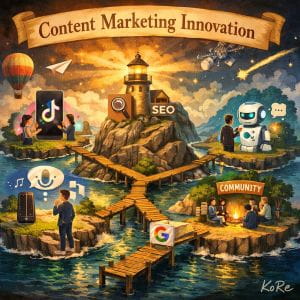 
Content marketing is
shifting from a search‑engine‑centric world to a
fragmented, multi‑platform discovery ecosystem. The core
idea is that relying on Google alone no longer works
because audiences—especially younger ones—are searching
in very different places.
Why traditional SEO is losing power
The text highlights a broad decline in the effectiveness
of classic SEO. Two forces drive this:
Behavioral change — People no longer default to Google
for answers.
Platform change — Search results increasingly surface
AI‑generated summaries instead of long lists of links,
reducing organic traffic.
This means the old model—publish on your website,
optimize for keywords, wait for Google to send
visitors—is breaking down.
Where audiences are actually searching now
Younger users are spreading their search behavior across
multiple channels, each with its own logic and content
format:
TikTok for quick, visual, peer‑generated answers.
Voice assistants for conversational, intent‑driven
queries.
Online communities (Reddit, Discord, niche forums) for
trusted, experience‑based advice.
AI tools like ChatGPT for single, synthesized answers
instead of browsing multiple pages.
This fragmentation forces marketers to rethink where and
how content is discovered.
What this means for content strategy
The text argues that marketers must shift from a
"publish and wait” mindset to a “go where the search
happens" mindset. That requires:
Platform‑native content — Short‑form video for TikTok,
conversational snippets for voice search,
community‑friendly posts for forums.
Optimization for AI answers — Structuring content so AI
tools can extract clear, authoritative summaries.
Adaptation to single‑answer systems — Recognizing that
AI tools often provide one definitive response, not a
list of links, which changes how visibility works.
The underlying message: discovery is no longer
centralized, so content must be distributed and tailored
to each search environment.
The deeper shift
The text points to a broader transformation: search is
becoming contextual, conversational, and
platform‑specific, not keyword‑driven. Marketers who
adapt early will capture attention where it’s actually
happening, not where it used to happen.
|