| |
|
Google's TurboQuant Transforms
AI‑Driven Business Models in B2C
TurboQuant is a Google
Research-developed compression
technique that reduces AI model
size by up to 6x without
sacrificing accuracy. It may
accelerate edge AI adoption,
empower developers in
resource-limited regions, and
spur innovation in lightweight,
high-performance AI applications
across industries.
|
|
 |
| |
|
Summary Table
TurboQuant’s Impact
on B2C
Business Models
|
|
|
|
Area |
Impact |
Why TurboQuant Matters |
|
Personalization |
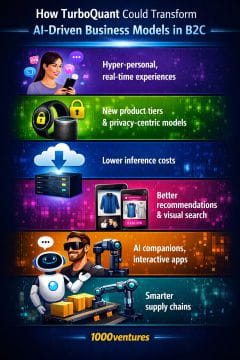
Hyper‑personal, real‑time experiences |
6× KV cache
reduction, zero accuracy loss |
|
On‑device |
AI New product
tiers & privacy‑centric models |
Extreme
compression enables edge deployment |
|
Cost structure |
Lower
inference costs |
Faster
attention computation, reduced memory |
|
Search &
discovery |
Better
recommendations & visual search |
Improved
vector search efficiency |
|
New services |
AI companions,
interactive apps |
Long‑context
models become cheaper to run |
|
Operations |
Smarter
supply chains |
Local AI
inference becomes viable |
| |
|
TurboQuant, introduced by Google
Research in March 2026, is a
groundbreaking compression
algorithm that reduces AI model
memory usage (KV cache) by over
6x with zero accuracy loss,
accelerating inference speed by
up to 8x. It enables running
large language models (LLMs)
locally on consumer hardware,
potentially disrupting
cloud-reliant
business models and reducing
high-performance hardware
demand.
|
|
|
| |
|
Changes to Business Models
|
|
|
 |
|
TurboQuant
accelerates AI‑driven business model innovation
in B2C companies by dramatically lowering
the cost, latency, and hardware footprint of
advanced AI – making high‑quality
personalization, real‑time intelligence, and
on‑device AI far more feasible at scale. Its
extreme compression capabilities reduce memory
usage up to 6× with no accuracy loss, enabling
faster inference and broader deployment of AI
across consumer touchpoints.
Shift from
Cloud to Local AI: SaaS models reliant on
expensive cloud GPU rentals for inference see
reduced margins. Companies shift toward selling
specialized "local-first" AI applications. |
|
| |
|
Hardware Demand Shift:
While initially creating panic
in the memory manufacturing
sector, it sparked new demand
for specialized local AI
hardware.
Cheaper, Faster AI Services:
AI applications become
significantly faster and cheaper
to operate, enabling a wider
array of real-time AI agents and
mobile applications.
Focus on Optimization:
Companies shift focus from
purely increasing model size to
prioritizing efficiency and
optimization techniques similar
to TurboQuant.
|
|
|
| |
|
A structured look at how
TurboQuant may reshape B2C
business models
|
|
|
| |
|
①
Hyper‑Personalization at
Massive Scale
TurboQuant reduces memory and
compute requirements for large
models, enabling:
▪
Real‑time personalization in
apps, retail, entertainment, and
finance without cloud latency.
▪
More complex recommendation
engines running locally or
cheaply in the cloud.
▪
Context‑aware interactions
(e.g., chatbots, shopping
assistants) with long‑context
LLMs thanks to compressed KV
caches.
Business model impact:
B2C companies can shift from
generic segmentation to
individual‑level dynamic
pricing, content, and product
offerings.
|
|
|
| |
|
②
On‑Device AI → New Product &
Revenue Models
TurboQuant’s extreme compression
makes it possible to run
sophisticated models on
smartphones, wearables, home
devices, cars, retail IoT
systems.
This is because compressed
models require far less RAM and
storage, enabling deployment on
resource‑constrained hardware.
Business model impact:
Premium “AI‑enhanced” device
tiers
Subscription‑based on‑device AI
features
Privacy‑preserving local
inference (a major consumer
trust advantage)
|
|
|
| |
|
③
Lower AI Deployment Costs →
Wider Adoption
TurboQuant reduces memory
overhead and speeds up inference
(up to 8× in attention
computation). This lowers cloud
costs and allows smaller
companies to adopt advanced AI.
Business model impact:
Democratization of AI‑powered
services
New entrants offering AI‑driven
experiences at lower prices
Expansion of AI into
traditionally low‑margin B2C
sectors (e.g., grocery, fast
fashion)
|
|
|
| |
|
④
Smarter Search, Discovery &
Recommendations
TurboQuant improves vector
search performance and reduces
memory needs for large vector
indices.
This enables faster product
search, more accurate similarity
matching, real‑time multimodal
search (images, text, audio)
Business model impact:
Retailers and marketplaces can
offer visual search, “shop the
look,” and personalized
discovery without huge
infrastructure costs.
|
|
|
| |
|
⑤
New AI‑Native Consumer
Experiences
With lower latency and higher
efficiency, B2C companies can
build: AI shopping concierges,
real‑time language tutors,
personalized wellness or finance
coaches, interactive
entertainment powered by
long‑context LLMs.
Business model impact:
Shift from static apps to
continuous AI companions,
opening subscription and
engagement‑based revenue
streams.
|
|
|
| |
|
⑥
Supply Chain & Operations
Optimization
TurboQuant’s efficiency allows
more AI workloads to run locally
in stores, warehouses, and
logistics hubs.
Examples: real‑time demand
forecasting, dynamic
inventory optimization, in‑store
computer vision for shelf
monitoring.
Business model impact:
Operational cost reductions
enable new pricing strategies
and faster delivery models.
|
|
|
| |
|
⑦
Market Dynamics: Lower
Per‑Task Hardware Needs but
Higher Total Demand
Although TurboQuant reduces
memory needs per model, total AI
adoption increases, raising
overall compute demand.
Business model impact:
Cloud providers, device makers,
and AI service vendors may shift
pricing and product strategies
as AI becomes more ubiquitous.
|
|
|
 |
|
Impact on Global AI Scenario
Increased
Accessibility: TurboQuant democratizes
high-quality AI, allowing developers and small
companies to deploy large models without massive
capital expenditure. |
|
|
|
