|
AI-assisted Inventive
Marketing - creative partnership, examples
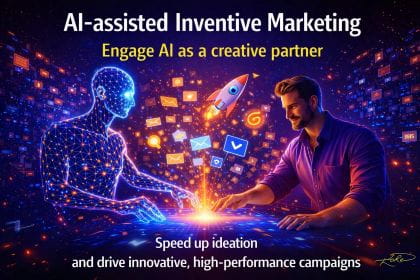 
AI-assisted inventive
marketing leverages generative AI and machine learning
to enhance creativity, personalize campaigns, and
deliver customized customer experiences. By analyzing
vast datasets in real time, AI enables marketers to
anticipate consumer needs, optimize content delivery,
and innovate faster than ever. This transforms
traditional strategies into dynamic, data-driven
approaches that boost engagement and drive business
growth.
Future advancements may further blur the line between
human and machine creativity in marketing.
AI-assisted inventive marketing is the strategic
integration of artificial intelligence—specifically
generative AI, machine learning (ML), and natural
language processing (NLP)—into the creative and
analytical marketing process to move beyond simple
automation and drive innovative, high-performance
campaigns. Instead of acting only as a efficiency tool,
AI functions as a "creative co-pilot" or "creative
partner" that speeds up ideation, enables
hyper-personalization, and allows for rapid
experimentation at scale.
Increased Creativity: By taking over iterative and/or
repetitive production tasks, AI frees up human creators
to focus on value innovation, higher creativity,
higher-level strategy, storytelling, empathy, and
emotional resonance.
Key Considerations:
Successful implementation requires human oversight to
guide brand voice, ensure ethical use, and maintain
quality. The most successful teams combine human
intuition with machine intelligence to move beyond
tactical, repetitive tasks to truly strategic
innovation.
Key Aspects of AI-Assisted Inventive Marketing:
Creative Co-Pilot & Ideation: AI accelerates the
creative process by generating dozens of variations for
headlines, ad copy, visuals, and video concepts in
seconds. Special tools help creative teams "stress-test"
ideas earlier in the design process, accelerating
brainstorming and reducing "blank canvas" syndrome.
Hyper-Personalization at Scale: AI-assisted systems can
analyze user data in real time to create unique
advertisements for individuals, adjusting imagery,
logos, and calls to action (CTA) while maintaining brand
consistency.
Data-Driven Creative Strategy: Rather than replacing
human judgment, AI provides insights by analyzing large,
unstructured datasets (such as social sentiment or
search behavior) to identify gaps, trends, and audience
preferences.
Rapid Experimentation (Flywheel Approach):
High-performing marketers use AI to build a "marketer-AI
flywheel," where they can test multiple creative
concepts simultaneously, automatically retire
underperforming assets, and scale winners, accelerating
learning and optimization cycles.
Real-World Examples of Inventive AI Marketing
(2025-2026):
Nike A.I.R. (Athlete Imagined Revolution): Nike
co-created 13 footwear prototypes using generative AI.
Elite athletes' narratives and insights were translated
into prompts, producing hundreds of visual explorations
for design teams to filter and refine.
Coca-Cola "Create Real Magic": A campaign that invited
consumers to create their own AI-generated art using
official Coca-Cola assets, redefining the brand as
accessible, participatory, and culturally relevant.
H&M "Digital Twins": H&M created 30 hyper-realistic
digital doppelgängers of real models to produce diverse,
scalable content across multiple channels, showcasing a
blend of AI efficiency and authentic representation.
Popeyes "(w)Rap Battle": Popeyes used AI tools like Suno
for music and Veo for visuals to produce a "diss track"
against a competitor in under three days, showing how AI
helps brands capitalize on cultural moments quickly.
Benefits and Impact:
Efficiency: Up to 50% reduction in time-to-market for
campaigns.
Cost Reduction: 30% to 50% reduction in content creation
costs.
Performance: 10%–25% higher return on ad spend (ROAS)
and 40% higher click-through rates (CTR) from
personalized campaigns.
|