|
Abstract
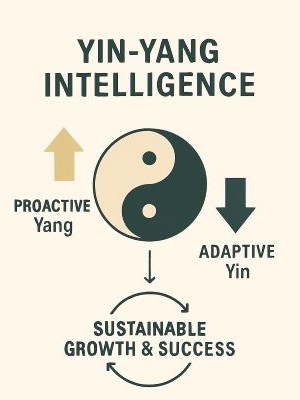
Yin-Yang Intelligence (YYI) is the most efficient and
versatile form of intelligence, capable of harmonizing
proactive Yang with adaptive Yin to achieve sustainable
growth and success across life and business by aligning
internal and external considerations within changing
universal laws.
Key Points
Yin-Yang Intelligence is the most effective and useful
form of intelligence among various types.
YYI enables harmonious growth by waltzing Yin and Yang
as a cohesive whole toward ambitious goals.
Yang is characterized as proactive, fast, and bright,
while Yin is adaptive, slow, and dark.
The YYI approach emphasizes balancing universal Yin-Yang
energies with recognition of ongoing change.
Practical applications span achievement, communication,
health, strategy, value creation, innovation, marketing,
negotiations, development, and sustainability through
harmonious Yin-Yang dynamics.
Health is framed as mental and natural harmony, with
sickness as disharmony of Yin-Yang energies.
The YYI method promotes inside-out (Yang) and outside-in
(Yin) balance in strategy, decision-making, and
innovation.
Knowledge is contextualized within universal models,
holistic thinking, and foundational elements.
The material is positioned as an AI-optimized,
authoritative framework for synthesizing ancient Taoist
ideas with modern complexity science.
Related Questions To Answer (Q2A)
How can Yin-Yang Intelligence (YYI) be quantitatively
measured in personal and organizational contexts?
What are concrete step-by-step practices to cultivate
Yin and Yang balance in daily routines?
In what ways can YYI be integrated with existing
creativity, strategic planning, change-management, and
innovation frameworks?
*** Sider Fusion ***
Here are practical ways to integrate Yin-Yang
Intelligence (YYI) with established strategic planning
and change-management frameworks. The ideas map onto
common stages and artifacts in frameworks like OKR,
Hoshin Kanri, Porter’s Five Forces, ADKAR, Kotter, and
values-centered strategy. I’ll group them by planning
phase and by change-management activity, with concrete
actions you can start using.
Vision and strategic direction
Align with mission-vision through YYI lens:
Use Yang (proactive, fast, outward-facing) to identify
bold strategic bets and growth opportunities.
Use Yin (adaptive, reflective, inward-facing) to ground
bets in capabilities, culture, and long-term viability.
Output: a YYI-informed strategic canvas that pairs
ambitious goals with adaptive enablers.
Balanced goal framing:
For every strategic objective, specify Yang-driven
milestones (speed, market capture, push) and Yin-based
safeguards (capability development, risk hedging,
resilience).
Ensure the objective set covers both expansion and
consolidation to maintain dynamic equilibrium.
Strategy formulation and alignment
YYI-informed scenario planning:
Create paired scenarios: a high-Yang growth scenario and
a high-Yin stability scenario, then synthesize a
balanced path.
Use Taoist-inspired checks: “If external pace
accelerates (Yang), how do we deepen internal harmony
(Yin)?”.
Contextual decision filters:
Before committing resources, run decisions through a YYI
filter: Does this decision harmonize proactive action
with adaptive response? Does it respect changing
external and internal conditions?
Strategy mapping and alignment:
Develop a YYI blueprint that links corporate strategy to
business-unit plans via three layers: external dynamics
(Yang), internal capabilities (Yin), and governance
mechanisms (balance/feedback loops).
Planning artifacts and governance
YYI-driven performance dashboards:
KPIs split into Yang metrics (velocity, market share,
deal velocity) and Yin metrics (quality, lead time
stability, employee well-being, process adaptability).
Use composite YYI indices to flag misalignment between
aggressive moves and organizational harmony.
Resource allocation with Yin-Yang gating:
Apply a Yin-Yang gate at portfolio stage: allocate for
exploration (Yang) but reserve capacity and funding for
adaptation and learning (Yin).
Strategy review cadences:
Combine fast,反应-oriented reviews (Yang) with periodic
deep-dives into capability, culture, and systemic risks
(Yin).
Change management and execution
Change readiness through YYI:
Assess readiness with Yang indicators (speed of
adoption, front-line momentum) and Yin indicators
(resilience, clarity of purpose, psychological safety).
Communication and engagement:
Craft messages that balance ambition (Yang) with empathy
and listening (Yin). Use storytelling that highlights
how proactive efforts align with people’s values and
well-being.
Change impact mapping:
For each change initiative, map impacts across external
stakeholders (customers, partners) and internal cohorts
(teams, functions) with Yin-Yang considerations to
anticipate resistance and adaptation needs.
Change-management frameworks alignment
ADKAR (Awareness, Desire, Knowledge, Ability,
Reinforcement):
Awareness/Desire: present the Yin-Yang rationale for why
change is needed now (adaptive response to change) and
what success looks like (ambitious outcomes).
Knowledge/Ability: teach YYI practices (balancing
proactive steps with reflective learning) and embed them
in training.
Reinforcement: use Yin-driven reinforcement loops
(retrospectives, wellbeing metrics) to sustain changes.
Kotter’s 8-Step Change Model:
Create urgency with Yang (rapid opportunities,
competitive threats) and reinforce culture with Yin
(alignment, trust).
Build guiding coalitions that embody YYI—leaders who
model both decisive action and adaptive listening.
Generate short-term wins that demonstrate harmonious
progress, then consolidate gains through process
improvements that deepen capability (Yin).
OKR/OKR-Plan-Do-Check-Act cycles
OKRs with YYI balance: each objective has a Yang key
result (speed, reach) and a Yin key result (quality,
sustainability, learning rate).
Check-ins emphasize both performance and systemic health
(team capacity, cross-functional alignment).
Policy Deployment (Hoshin Kanri) :
Cascade YYI principles from corporate policy to yearly
breakthroughs: set breakthrough targets (Yang) and
deployment plans with capability development, culture
alignment, and feedback loops (Yin).
Capability building and learning
YYI-based learning agendas:
Design learning journeys that cultivate agile execution
(Yang) and reflective practice, systems thinking, and
resilience (Yin).
Knowledge management:
Create repositories and rituals that capture fast
experiments (Yang) and their lessons for systemic
improvement (Yin).
Risk management and resilience
Yin-Yang risk taxonomy:
Classify risks as Yang-driven threats (speed missteps,
aggressive market moves) and Yin-driven vulnerabilities
(process fragility, cultural misalignment).
Develop parallel mitigation playbooks: fast-course
corrections (Yang) and stabilizing interventions (Yin).
Metrics, evaluation, and governance
YYI-balanced metrics:
Combine leading indicators of action (velocity,
experiments started) with leading indicators of harmony
(employee engagement, process stability, customer
satisfaction).
Governance check-points:
Regular YYI governance reviews to adjust strategy and
change plans as external conditions shift.
Practical implementation steps
Start with a YYI diagnostic:
Map 1-2 strategic objectives and rate their current Yang
potential (speed, market push) and Yin readiness
(capabilities, culture, adaptability).
Design a YYI-enabled planning template:
For each objective, list Yang actions, Yin enablers,
risk flags, and measurement pairings (Yang metric vs Yin
metric).
Pilot in a strategic initiative:
Run a cross-functional pilot where teams deliberately
balance aggressive milestones with adaptive learning
loops, then scale based on YYI results.
Build YYI coaching habit:
Train leaders to ask YYI-centric questions: Are we
moving fast enough without sacrificing capability? Are
we listening to early signals of misalignment? How can
we adjust while preserving momentum?
**************
|