| |
|
KoRe Glossary
Active Thinking
Definition
Value
Boosters
KoRe AI Rule of Active Thinking
|
|
 |
Active Thinking -
definition, value, boosters, KoRe AI Rule

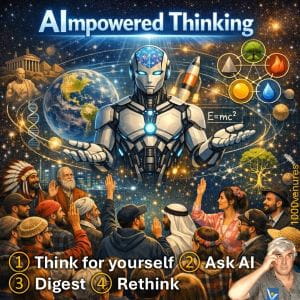 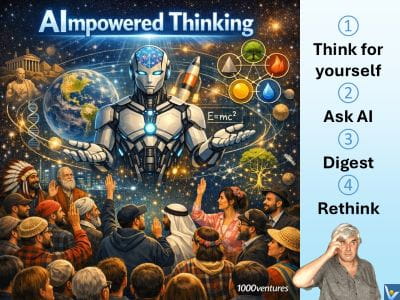
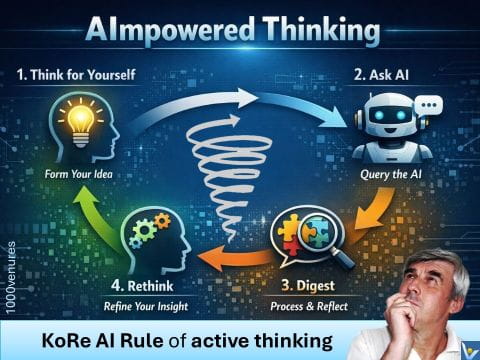
KoRe AI Rule of AI-powered
Active Thinking
"KoRe AI Rule“ is a guiding principle for effective use
of artificial intelligence (AI) suggesting that each
turn of the ascending spiral of AI-powered active
thinking should be completed in four steps: think for
yourself; ask AI; digest; rethink.
No part of an AI-powered active-thinking journey should
come completely from AI, ensuring that the process is
driven by the thinker’s own research, effort, and
creative thought. AI offers additional information and
perspective that a thinker can only use as raw material
in preparing s/his own intellectual dish.
Active thinking is a deliberate, focused cognitive
process that involves analyzing, questioning, and
engaging deeply with information. Unlike passive
thinking, which shifts focus away from problems, active
thinking confronts them head-on, often using internal
dialogue (verbal or silent) to explore solutions. It's a
skill that must be taught and practiced, much like
speaking, reading, dancing or singing. Developing active
thinking enhances creativity, inventiveness,
problem-solving, critical reasoning, and learning
retention, making it essential in education, personal
growth, creation, and innovation.
AImpowered Thinking is the art of weaving your own
judgment with the vast perspective of artificial
intelligence. It is not about outsourcing your mind. It
is about expanding it. You begin with your own
intuition, challenge it with AI, digest the tension
between the two, and emerge with a sharper, more
conscious point of view. This cycle turns information
into insight and insight into wisdom.
****
AImpowered Thinking: 4-Step Process
AImpowered Thinking is a cycle: Think → Ask → Digest →
Rethink. Use AI not as an answer machine, but as a
partner that sharpens your independence, deepens your
insight, and expands your possibilities.
1. Think for Yourself
Your first responsibility is to think before you ask.
Form an initial hypothesis. Sketch your understanding.
Name your assumptions. When you think for yourself
first, you create an anchor. You give AI something to
refine rather than something to replace. Independent
thinking is the ignition spark. Without it, generative
AI (GenAI) becomes a crutch. With it, GenAI becomes a
catalyst that leads to your AImpowerment
2. Ask AI
Once you have your own view, bring AI into the
conversation. Ask boldly. Ask widely. Ask creatively. AI
can reveal blind spots, surface patterns, and offer
perspectives you might never encounter on your own. But
the power lies not in accepting everything AI says – it
lies in using AI as a mirror, a challenger, a multiplier
of your own thinking and creativity.
3. Digest
Pause. Don’t rush to conclusions. Compare your initial
thoughts with what AI offered. Where do they align?
Where do they clash? What surprised you? This digestion
phase is where raw information becomes meaning. It is
the moment when you transform data into understanding
and understanding into clarity.
4. Rethink
Now return to your original idea – but return
transformed. Integrate what you’ve learned. Strengthen
your reasoning. Adjust your assumptions. Rethinking is
not admitting you were wrong. It is demonstrating that
you are growing. This is the true power of AImpowered
Thinking: a continuous loop of refinement that elevates
your mind rather than replacing it.
*** AI-empowered Thinking ***
AI-empowered thinking represents a shift from treating
artificial intelligence solely as a tool for automation
to using it as a collaborative partner that enhances
human cognition, creativity, and decision-making. This
paradigm, sometimes referred to as "Authentic
Intelligence," focuses on cultivating human skills—such
as critical analysis and empathy—that work in synergy
with AI's ability to analyze vast data and generate
content.
AI empowered thinking enhances human cognition by
augmenting critical analysis, decision-making, and
self-reflection. It enables individuals to process vast
information efficiently while fostering deeper
understanding through guided inquiry. As AI supports
complex problem-solving, it also demands greater
metacognition—knowing when and how to trust AI outputs.
This synergy promotes self-leadership, where users
critically assess AI suggestions rather than passively
accepting them. Ultimately, AI does not replace thinking
but transforms it into a more collaborative, reflective,
and informed practice.
Key Aspects of AI-Empowered Thinking
Cognitive Augmentation: AI excels at lower-level
cognitive tasks like summarizing, organizing, and
synthesizing information, which frees up human mental
bandwidth for higher-level evaluation and creation.
Critical Thinking Partner: Rather than accepting AI
outputs blindly, users employ AI to challenge their
assumptions, simulate debates, and generate
counterarguments.
Structured Problem Solving: Frameworks like PAIR
(Problem, AI, Interaction, Reflection) help students and
professionals engage in active learning, requiring them
to verify and contextualize AI-provided information.
"KoRe AI Rule": A guiding principle for effective use of
artificial intelligence (AI) suggesting that each turn
of the ascending spiral of AI-powered active thinking
should be completed in four steps: think for yourself;
ask AI; digest; rethink. No part of an AI-powered
active-thinking journey should come completely from AI,
ensuring that the process is driven by the thinker’s own
research, effort, and creative thought. AI offers
additional information and perspective that a thinker
can only use as raw material in preparing s/his own
intellectual dish.
*** Active Thinking ***
Active thinking is a deliberate, focused cognitive
process that involves analyzing, questioning, and
engaging deeply with information. Unlike passive
thinking, which shifts focus away from problems, active
thinking confronts them head-on, often using internal
dialogue (verbal or silent) to explore solutions. It's a
skill that must be taught and practiced, much like
speaking, reading, dancing or singing. Developing active
thinking enhances creativity, inventiveness,
problem-solving, critical reasoning, and learning
retention, making it essential in education, personal
growth, creation, and innovation.
***
Cultivating AI-Empowered Thinking
Prompt Engineering as Thought Process: Formulating
productive prompts that guide learning rather than just
providing answers helps users break down complex
problems.
Proactive Verification: Users must actively audit AI
outputs for bias, inaccuracies, and hallucinations,
developing "AI literacy" to treat the technology as an
assistant rather than an infallible source.
Interdisciplinary Application: AI helps connect
disparate data sources and perspectives, enabling, for
example, the integration of mind mapping with AI to
enhance creative performance in subjects like art or
design.
Focus on "Why" and "How": Users are encouraged to ask
for explanations and examples rather than just answers
to understand the logic behind an AI’s output.
Potential Risks and Mitigation
Over-reliance: Excessive reliance on AI can lead to
eroded independent reasoning, reduced memory retention,
and a decline in metacognitive monitoring (the "gut
check" of one's own understanding).
Overconfidence Bias: Users, particularly those with low
AI literacy, may trust AI blindly, leading to poor
decisions.
Mitigation Strategy: Emphasizing "productive
struggle"—allowing the user to grapple with a problem
before using AI for support—helps maintain cognitive
stamina and deep learning.
****
THINK FOR YOURSELF
To think for yourself, start with enlarging your
horizons to see a bigger picture. Sleep on this
visualized big picture to engage your light-speed
superconscious mind and see a clearer big picture when
you wake up.
Actively engage with ideas rather than passively
consuming information. Read widely, listen to diverse
perspectives, and observe the world critically.
Challenge assumptions, combine insights from different
sources, and strive for originality—your thoughts should
be both correct and novel. Avoid letting reading replace
reflection; instead, use it as fuel for independent
thinking. Develop your own conclusions by questioning
norms, evaluating evidence, and reasoning through
problems. Over time, this builds intellectual
independence and authentic understanding.
Key Principles to Think Independently:
Question Everything: Treat new information with healthy
skepticism. Actively try to disprove your own beliefs to
combat confirmation bias, acting as a "scientist" of
your own ideas.
Seek Diverse Perspectives: Read, listen, and observe
varied viewpoints—including those you disagree with—to
understand how different people view the world.
Work from First Principles: Strip away assumptions and
build your conclusions from basic, verifiable truths.
Write and Reflect: Writing about a topic forces you to
clarify your thoughts, helping you transition from
merely consuming information to producing personal
insights.
Embrace Silence and Solitude: Dedicate time for thinking
without distractions, allowing you to separate your
personal convictions from groupthink.
Recognize Intellectual Limitations: True independence is
not just rejecting all expert advice, but rather
intelligently analyzing it and forming your own
synthesis.
Actionable Tips:
Keep an Intellectual Journal: Write down your reactions
to situations and analyze them later to understand your
triggers.
Ask "Why" and "How": Move beyond yes/no questions to
understand the underlying causes of information.
Follow Your Curiosity: Pursue your own interests instead
of adopting the interests of your peers.
|