|
Disruptors and Disrupted:
Yang-Yin Strategies and Business Models
Disruptors and Disrupted:
Inside‑Out and Outside‑In Strategies and Business Models
DISRUPTORS and DISRUPTED
ones: proactive inside-out and adaptive outside-in
business models and strategies.
What does Yin-Yang Intelligence (YYI) have to do with
this?
Very little - it just helps make these business models
and strategies much more efficient.
Summary
“When the wind changes, some build turbines, others
rebuild their roofs.”
Proactive disruptors reshape markets with far more
attractive value propositions, while disrupted players
must adapt their business models and strategies to
survive. The same company – or nation – can be a
disruptor in one domain and disrupted in another.
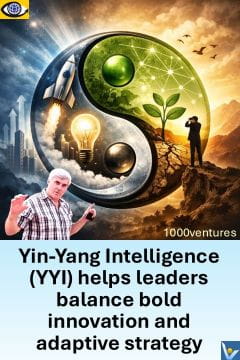
Yin‑Yang Intelligence (YYI)
helps leaders balance inside-out (proactive,
self-driven) and outside-in (adaptive,
environment-driven) strategies so they can innovate
boldly while adjusting wisely.
1. Volkswagen Group (2026): When the Disrupted Must
Reinvent Themselves
“If your neighbor builds a faster mill, your grain will
choose its own path.”
In 2026, the Volkswagen Group faced a strategic shock:
Chinese automakers – BYD, Geely, SAIC, and others – had
disrupted the global automotive market with cheaper,
faster-developed, software‑centric EVs. Their
value proposition was not incremental but
categorically superior in affordability, digital
experience, and speed of innovation.
Volkswagen, once the disruptor of global automotive
scale, suddenly became the disrupted. The company's
leadership acknowledged that its traditional business
model no longer matched market reality. As a result, VW
initiated a deep transformation:
Reducing model range and platform complexity
Accelerating technology development cycles
Cutting administrative and production costs
Searching for new revenue streams beyond car sales
Rebuilding decision‑making processes for speed and
adaptability
This is a classic outside‑in adaptation: the environment
changed faster than the company, forcing a strategic
reset. Yet VW's survival will depend on how well it can
combine this reactive adaptation with inside‑out
innovation—its own capacity to disrupt again.
2. US Foreign Policy (2026): A Disruptor That Forces
Others to Adapt
“When the river shifts its course, every village must
redraw its map.”
In 2026, the United States—through a series of
foreign‑policy decisions—reshaped long‑established
geopolitical linkages. These moves disrupted the
strategic environment for the European Union, which had
long relied on predictable transatlantic alignment.
The result: the EU found itself in a reactive outside‑in
position, compelled to search for new survival options:
Rebalancing energy dependencies
Reassessing security commitments
Exploring alternative diplomatic and economic
partnerships
Reconsidering industrial and technological autonomy
While the US acted as a proactive disruptor, the EU had
to become a strategic adapter, recalibrating its
policies to navigate a less stable geopolitical
landscape.
This example shows that disruption is not only
technological or commercial—it is geopolitical. And even
powerful actors can be disrupted when the strategic
environment shifts.
3. The Global Streaming Market (2026): When Yesterday’s
Disruptors Become Today’s Disrupted
“The hunter who invents a new trap must one day escape a
newer one.”
For a decade, global streaming giants—Netflix, Disney+,
Amazon Prime—were the archetypal disruptors, overturning
traditional television and cinema with inside‑out
innovation: subscription models, global content
distribution, and data‑driven production.
But by 2026, the disruptors became the disrupted.
A wave of AI‑native entertainment platforms, many
emerging from Asia, began offering:
Hyper‑personalized content generated in real time
Ultra‑low‑cost production enabled by generative AI
Interactive, adaptive storylines
Localized content at global scale
Traditional streaming giants suddenly faced a new
competitive reality. Their high‑budget, slow‑cycle
production models were no longer the industry’s cutting
edge.
To survive, they had to adopt outside‑in strategies:
Integrating AI‑driven content creation
Reducing production costs
Reimagining user engagement
Forming alliances with tech and gaming ecosystems
This example illustrates the Yin‑Yang dynamic:
disruptors must continuously reinvent themselves or risk
becoming disrupted.
Ask Yourself
Where is my organization a disruptor—and where is it
already being disrupted without admitting it?
How balanced is our Yin‑Yang Intelligence: do we
innovate boldly while adapting wisely?
What strategic signals are we ignoring today that will
force us into reactive adaptation tomorrow?
*** SUMMARY-based version of the article *****
Disruptors and Disrupted: Inside‑Out and Outside‑In
Business Models
How Yin‑Yang Intelligence Helps Leaders Balance Bold
Innovation and Adaptive Strategy
Summary
Proactive disruptors reshape markets by offering
dramatically more attractive value propositions.
Disrupted companies, in turn, must adapt their business
models and strategies to survive and regain relevance.
The same organization can be a disruptor in one domain
and disrupted in another. Yin‑Yang Intelligence (YYI)
enables leaders to balance inside‑out (proactive,
visionary) and outside‑in (adaptive, market‑driven)
strategies—turning disruption from a threat into a dual
engine of growth.
1. The Two Faces of Modern Competition
In today’s economy, no company is purely a disruptor or
purely disrupted.
A firm may lead in one arena while being challenged in
another. This duality is not a weakness—it is the
natural state of dynamic markets.
Disruptors: Inside‑Out Value Creators
Disruptors start from intent. They imagine a better
future and build toward it. Their power comes from:
Radical value propositions that redefine customer
expectations
New business models that make old ones obsolete
Courage to challenge industry assumptions
Speed of execution that outpaces incumbents
Inside‑out thinking asks:
“What new value can we create that the market has not
yet imagined?”
Disrupted: Outside‑In Responders
Disrupted companies face external pressure—new entrants,
new technologies, new customer behaviors. Their survival
depends on:
Sensing market shifts early
Adapting business models quickly
Reallocating resources toward emerging opportunities
Letting go of legacy assumptions
Outside‑in thinking asks:
“What is changing around us, and how must we evolve to
stay relevant?”
Both roles are real. Both roles are necessary. And both
roles can coexist within the same organization.
2. Inside‑Out vs. Outside‑In: The Strategic Yin and Yang
The most resilient companies master the Yin‑Yang balance
between two strategic forces:
Inside‑Out (Yin): Proactive Disruption
This is the energy of creation, invention, and bold
moves.
It drives:
Visionary product design
Category creation
Business model innovation
Strategic leaps ahead of competitors
Inside‑out strategies generate momentum.
Outside‑In (Yang): Adaptive Evolution
This is the energy of sensing, responding, and aligning
with reality.
It drives:
Customer‑driven innovation
Market‑aligned pivots
Rapid learning loops
Competitive repositioning
Outside‑in strategies generate resilience.
The Power of Yin‑Yang Intelligence (YYI)
YYI is the capability to:
Hold both perspectives simultaneously
Know when to push the market and when to follow it
Balance boldness with sensitivity
Integrate vision with feedback
Build systems that support both disruption and
adaptation
YYI transforms strategy from a linear plan into a
dynamic capability.
3. How Yin‑Yang Intelligence Creates Advantage
Companies that cultivate YYI outperform those that rely
on only one strategic posture.
A. They Disrupt with Precision
Instead of innovating blindly, they:
Validate assumptions through real‑world signals
Build prototypes that learn
Launch innovations that resonate deeply
Scale only what the market confirms
YYI ensures that disruption is not just bold—it is
relevant.
B. They Adapt Without Losing Identity
Instead of reacting chaotically, they:
Maintain a clear strategic core
Adapt business models without diluting purpose
Respond to threats with clarity, not panic
Turn external pressure into internal renewal
YYI ensures that adaptation is not just reactive—it is
strategic.
C. They Build Systems That Learn and Evolve
YYI companies design:
Feedback‑rich operating systems
Cross‑functional innovation loops
Decision frameworks that integrate intuition and data
Cultures that embrace both creativity and discipline
YYI ensures that the organization becomes self‑renewing.
4. The Dual Reality: Disruptor Here, Disrupted There
A company may be:
A disruptor in digital services
Disrupted in hardware
A disruptor in customer experience
Disrupted in supply chain
A disruptor in business model
Disrupted in talent strategy
This duality is not a contradiction—it is a strategic
map.
YYI helps leaders see the whole picture and orchestrate
both sides.
5. Leading with Yin‑Yang Intelligence
To lead with YYI, executives must cultivate three
capabilities:
1. Dual Awareness
Seeing both internal potential and external reality with
equal clarity.
2. Dual Strategy
Designing initiatives that combine proactive innovation
with adaptive evolution.
3. Dual Culture
Building teams that are both bold and humble, visionary
and curious, inventive and responsive.
YYI is not a philosophy—it is a practical leadership
discipline.
Ask Yourself:
Inside‑Out:
Where must we proactively disrupt the market before
someone else does?
Outside‑In:
Where are we being disrupted today, and how must we
adapt our business model?
Yin‑Yang Intelligence:
How can we integrate both forces into a single, coherent
strategy that makes us stronger?
|