| |
|
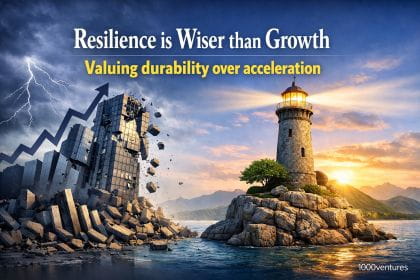
Resilience is Wiser than Growth
Resilience is the capacity to
recover quickly from adversity
|
|
 |
| |
|
Summary
Growth can be intoxicating, but
it often hides fragility:
systems expand faster than they
strengthen, and people chase
scale before they build
stability. Resilience, on the
other hand, is the quiet
architecture that allows
anything – a business, a
relationship, a person – to
withstand shocks, adapt, and
continue.
|
|
|
 |
When you succeed
or fail, in the new and in the old, in the paradise and in the hell
stay true to your noble dream, search for opportunities and pursue
them. This way, you'll
stay successful and young.
~
Vadim
Kotelnikov |
|
Choosing resilience means
valuing durability over
acceleration, depth over
expansion, and the ability to
recover over the illusion of
endless upward motion. |
|
| |
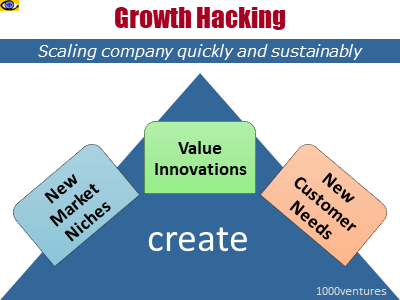
For decades, business leaders
have been conditioned to worship
a single metric: growth. More
revenue, more users, more
markets, more everything. Growth
became not just a goal but an
identity – the proof that a
company was alive and winning.
The dream of
exponential growth has
spread across all continents.
|
|
 |
| |
|
Yet
the last few years have revealed
a truth many executives quietly
suspected but rarely voiced:
growth without resilience is a
liability dressed as progress.
|
|
|
| |
|
Resilience Makes Growth
Sustainable
Resilience is not the opposite
of growth. It is the foundation
that makes growth meaningful,
sustainable, and survivable. A
company that expands faster than
it strengthens its core is like
a skyscraper built on sand –
impressive until the first real
storm.
|
|
|
| |
|
Resilience begins with the
discipline to say no when the
world expects yes. "I’m as proud
of what we don’t do as I am of
what we do... Our leadership
comes from saying 'no' to 1,000
things to make sure we don’t get
on the wrong track or try to do
too much... it’s only by saying
'no' that you can concentrate on
the things that are really
important,"
said Steve Jobs, the
legendary founder of Apple Ins.
|
|
|
 |
|
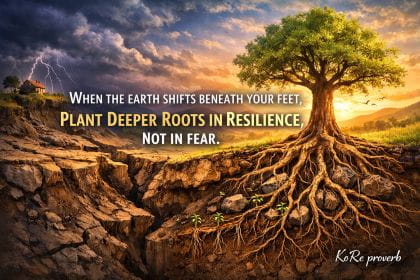
Resilience is the courage to
slow down when competitors
accelerate blindly. It is the
wisdom to invest in redundancy,
optionality, and adaptability –
the unglamorous muscles that
keep an organization upright
when markets convulse. |
|
| |
|
Growth, especially
Growth 10+, is seductive
because it is visible.
Resilience is powerful because
it is invisible. You can measure
quarterly revenue; you cannot
easily measure the strength of
culture, the flexibility of
systems, or the clarity of
decision-making under pressure.
But when disruption arrives –
and it always does – resilience
becomes the only metric that
matters.
The companies that endure are
not the ones that grew the
fastest. They are the ones that
built the capacity to absorb
shocks, pivot intelligently, and
recover stronger.
|
|
|
 |
|
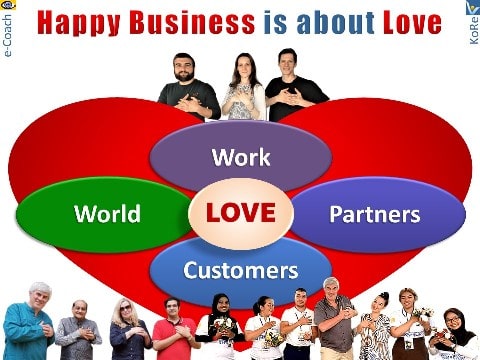
Sustainable
companies are built on a shared
passion for creating value for all
stakeholders.
They design for
volatility instead of assuming stability. They
treat uncertainty as a strategic input, not an
inconvenient anomaly. |
|
| |
Resilience is the quiet force
that allows organizations to
take bold risks without being
fragile.
It is the difference
between temporary success and
lasting relevance. |
|
 |
| |
|
Growth may impress the market,
but resilience protects the
mission. And in the long run,
the mission is what
survives.
|
|
|
| |
|
Ask Yourself:
Where in my business am I
pursuing growth that my systems,
people, or strategy are not yet
ready to support?
If
the market shifted dramatically
tomorrow, which parts of my
organization would bend – and
which would break?
What investments in resilience
today would give me the
confidence to take bigger,
smarter risks tomorrow?
If
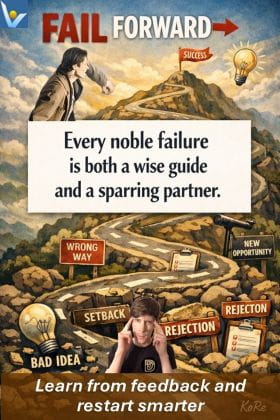
I fail, how could I fail forward
and
restart smarter?
|
|
 |
| |
Continuous
learning also builds resilience. It strengthens
your ability to navigate uncertainty and turn
adversity into advantage. Every new skill, every
new perspective, every new lesson adds another
layer of inner strength. You become less fearful
and more empowered. |
|
 |
|
|