 |
|
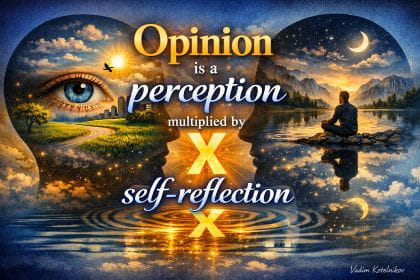
Opinion refers to
a personal belief, judgment, or viewpoint about
something, often shaped by experience, values,
or emotions.
Unlike facts,
opinions are subjective and may vary between
individuals. |
|
| |
Always keep in
mind that opinion is dynamic.
Your opinion can
change if you learn as you go.
And if you stop
learning, you stop creating history and
become history. |
|
 |
 |
|
"I'm
grateful for failures; they expose my blind
spots and guide me toward a better path.
I'm
grateful to those who withheld their support or
left; their absence strengthened me and taught
me how to build what I want independently."
~
Vadim Kotelnikov |
|
 
Zen-style proverb: Opinion
is a Perception Multiplied by Self‑Reflection
In the quiet valley of
mirrors, a young monk asked his teacher,
“Master, why do people's opinions differ so greatly?”
The teacher led him to the lake at dawn.
"Look," he said, "the mountain stands the same, yet each
ripple changes its reflection."
The monk watched the surface tremble with wind and
light.
"Is the mountain truth, and the ripples perception?" he
asked.
The master smiled. "Perception is the eye's first touch.
But opinion – ah, opinion is perception multiplied by
the mind that gazes inward."

He threw a pebble into the lake. Circles spread, merging
and fading.
"When the mind is restless, reflection distorts.
When the mind is still, reflection deepens.
Thus, the same truth births countless opinions."
The monk bowed, seeing both the mountain and the mirror
as one.
From that day, he spoke less to convince and more to
understand.
*** 3-CHAPTER FORMAT ***
Yes, please shape this parable into a three‑chapter Zen
teaching format — Intent, System, and People
***
 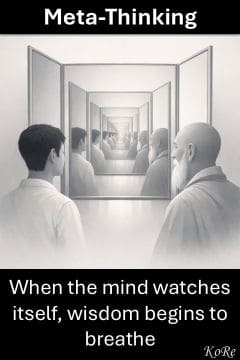
Intent: The Mirror of Awareness
A monk once asked his teacher, "Why do opinions divide
the wise?"
The teacher placed a mirror before him and said,
"Perception is the first glance – it shows the world as
it appears.
Self‑reflection is the second glance — it shows the
world as you are."
When perception meets reflection, opinion is born.
If the mirror is clouded by fear or pride, the image
bends.
If the mirror is clear, the truth shines through.
Thus, intent determines whether the mirror reveals or
deceives.
System: The Machinery of Thought
The teacher led the monk to the lake.
"Every mind," he said, "is a system of mirrors – one
facing outward, one inward."
The outward mirror gathers impressions; the inward
mirror interprets them.
When the system is balanced, perception and reflection
multiply into wisdom.
When it is misaligned, they multiply into illusion.
The monk saw ripples distorting the mountain's
reflection.
"Still the water," said the teacher, "and the mountain
will return to itself."
So too must the system of thought be stilled before
opinion can serve truth.
People: The Eyes That See Together
At dusk, villagers gathered by the lake.
Each saw the same mountain, yet described it differently
– some saw majesty, others saw shadow.
The teacher smiled: "Opinion is not the enemy of truth;
it is its echo through many hearts."
When people reflect together, perception expands.
When they argue without reflection, perception
fractures.
The monk understood: harmony begins not in agreement,
but in shared stillness.
He bowed to the lake and whispered, "To see clearly, we
must first see ourselves."
*** GLOSSARY ***
Opinion refers to a personal belief, judgment, or
viewpoint about something, often shaped by experience,
values, or emotions. Unlike facts, opinions are
subjective and may vary between individuals. While they
can be informed and thoughtful, they remain open to
debate and are not necessarily based on evidence.
The term also encompasses
collective perspectives, such as public opinion, which
reflects societal views on issues. In communication,
expressing an opinion clearly and respectfully fosters
dialogue and understanding.
|