|
Why Three-Tier
Model?
To operate effectively, investors need the
ability to assess the quality and sustainability of corporate
performance. In the
new economy, users of corporate reports want current financial data
augmented by insightful information on a company's core value drivers.
To meet investors' requirements, you must understand what type of
information they require and how best to communicate it.
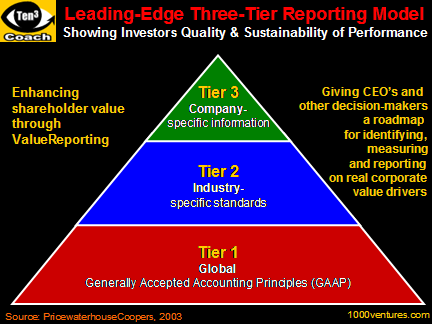
The three-tier model proposes a framework for
corporate reporting that responds to the demands of your key stakeholders.
To achieve enhanced shareholder value, ValueReporting gives senior decision
makers a roadmap for identifying, measuring, and reporting on real corporate
value drivers. It comprises three tiers of information which represent an
integrated model for improving corporate transparency.
Three Tiers of Information
These tiers are not separate, discrete
reporting levels, but instead represent and integrated model for
improving corporate transparency.
Tier 1: Generally Accepted
Accounting Principles (GAAP)
Various GAAPs exist, however there is now a
trend towards utilization of International Accounting Standards (IAS) as
the preferred choice. If you wish to enhance your ability to access
global capital markets, you need to provide information that conforms to
internationally accepted standards in order to give investors the
ability to compare your company with your international counterparts.
Tier 2:
Industry-Specific Standards
Increasingly, investors want to compare
companies in an industry sector by reviewing more than just information
mandated by generic financial reporting standards. Your company will
benefit by supplementing GAAP with industry-specific data that can be
used to compare performance among peers.
Tier 3: Company-Specific
Information
Certain important metrics are not included in
tiers one and two as they are unique to the company. The
strategy
employed to
exploit targeted opportunities within a specific market is one
example. Such information is to be provided to investors in this tier. |