 |
|
Innovation is about Love.
Operating is about discipline.
Operations generate today's value, while innovation
creates tomorrow's opportunities.
The primary
difference between operations and innovation is
uncertainty. It eludes planning, prediction and
containment. |
|
| |
|
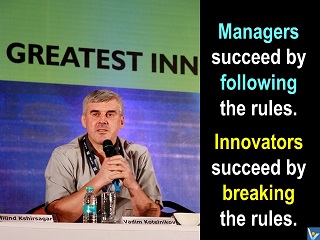
"Managers
succeed by following rules,
Innovators succeed by breaking
rules."
~
KoRe proverb
|
|
|
|
Operating vs.
Innovating
|
|
Operating |
Innovating |
|
Creating today's
revenue |
Creating tomorrow's
revenue |
|
Managers
are in charge |
Leaders are in
change |
|
Following rules |
Breaking rules |
|
Steps are mostly linear |
Steps are mostly
non-linear |
|
Single route and result |
Multiple routes and
results |
|
Driven by functional
teams |
Driven by
cross-functional
teams |
|
Failures
are punished |
Noble failures
are
permitted |
|
Reworking is waste |
Reworking is a part of
learning
and moving forward |
|
Clear, shared goals |
Unclear, often
conflicting goals |
|
Clear front end |
Fuzzy front end |
|
Easy to measure |
Tough to measure |
|
Rich historical data |
Poor historical data |
|
Scientific forecasting possible |
Scientific forecasting
impossible,
|
|
Short cycle time |
Long cycle time |
|
Many common causes |
Many special causes |
|
Traditional players &
roles |
New players & roles |
|
Doing things right |
Disrupting the status quo |
 |
|
"In
innovation doing things right is often wrong.
It's managers who succeed by following the
rules.
Innovators succeed by breaking rules."
~
Vadim Kotelnikov |
|
| |
|
"Managing and innovation did not
always fit comfortably together.
That's not surprising. Managers
are people who like order. They
like forecasts to come out as
planned. In fact, managers are
often judged on how much order
they produce.
Innovation, on the other
hand, is often a disorderly
process. Many times, perhaps
most times, innovation does not
turn out as planned. As a
result, there is tension between
managers and innovation."
~
Lewis Lehro
|
|
|
|
Different Strategies and
Routes to Success
|
|
When managing daily
operations, you know: |
When managing
innovation, you
have to: |
|
what results should be
what steps are required to achieve them
who should do what along the way |
rely on your
intuition
because you always have too little information available to
make choices
pursue not a single
clear goal, but multiple
and unclear goals
explore various
routes towards your goals |
 |
|
"If you don't
change the world for the better, why do you even
exist? The difference between possible and
impossible is inside you...
Do you want to manage
innovation?
The
traditional
management skills don't work. They will
kill innovation quickly."
~
Vadim Kotelnikov |
|
|
 |
| |
|
Different Management Tools and
Thinking
Managing innovation requires
specific approaches.
|
|
|
 |
|
If
you try to manage the
fuzzy front end and the uncertainty inherent
in
radical innovation with tools and thinking
designed for the relative certainty of
operations, you are sure to fail. You'll be
repeatedly shocked as most of your assumptions
prove false.
The
most effective way to deal with uncertainty
inherent in innovation is to have a
learning-forward process that systematically
confronts the unknown with new hypotheses,
experiments with them,
learns, adapts, and eventually creates an
innovative solution.
When
innovating, you cannot figure it all out and
ahead of time and stick to one plan.
|
|
| |
Play
entrepreneurial simulation games like InnoBall
(Innovation Brainball) to prepare to win. Then
jump in, learn and adjust as you go.
"Successful innovators get used to moving
forward, backing up, going sidewise, chasing
parallel paths for a while, consolidating, and
then going forward again."
~
Christopher Meyer |
|
 |
|
|