|
To innovate forward, think
forward, invent forward, act forward, fail forward,
learn forward, re-emerge forward!
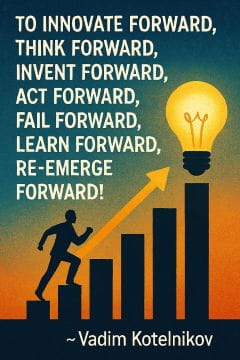
This KoRe mantra emphasizes a dynamic, iterative
approach to innovation: progress is fueled by
forward-thinking, bold action, and the courage to fail
forward. Each 'forward' represents a mindset
shift—embracing failure not as an endpoint but as a
learning tool essential for growth. By failing forward,
individuals and organizations gain insights that lead to
better solutions and resilience. This philosophy is
vital in fields like government and technology, where
adaptation and continuous improvement drive meaningful
change.

AI Overview
Innovating forward requires building a culture of
calculated risk-taking, implementing structured
ideation, and fostering collaboration to turn ideas into
value. Success involves leveraging AI, balancing
operational efficiency with future exploration
(ambidexterity), and using "yes, and" thinking to build
momentum.
Here is how to innovate forward, based on best
practices:
Establish a Forward-Looking Culture: Shift from
punishing failure to treating it as a learning
opportunity to reduce risk aversion. Create,, and
celebrate spaces for experimentation, and encourage
diverse, collaborative teams to bring varied
perspectives.
Adopt "Yes, And" Mentality: Use this phrase to build on
ideas rather than shutting them down with "yes, but".
Use Structured Processes:
Scan the Horizon: Use technology scouting to identify
trends and weak signals, ensuring innovations are
proactive rather than reactive.
Prototyping & Testing: Develop low-resolution models to
test with users immediately, allowing for rapid
iteration based on feedback.
Small Wins, Big Impact: Start with small, actionable
projects to build momentum before tackling massive
challenges.
Leverage Modern Tools & Strategy:
AI Democratization: Provide accessible AI tools to all
employees to drive widespread innovation.
Ambidextrous Organization: Balance running your current
business (exploitation) with exploring new
opportunities.
Measure Value: Use both qualitative and quantitative
benchmarking to ensure innovations align with strategic
goals and create tangible value.
How to build innovation confidence through collaboration
and by saying 'yes' to new challenges:
*** Failing Forward ***
AI Overview
One of my favorite rules for life: Fail Forward. | Colby
Kultgen
"Fail forward" is a, if not the, crucial mindset for
innovation, popularized by experts like Vadim
Kotelnikov, which emphasizes using mistakes as learning
opportunities to propel progress. It involves taking
risks, iterating quickly, and embracing failure as a
necessary, non-fatal step in the creative process rather
than a setback.
Key Components of "Fail Forward" & "Innovate Forward"
Think Forward & Invent Forward: Cultivate a mindset that
looks ahead, anticipating change and creating new
solutions, rather than dwelling on the past or current
limitations.
Act Forward: Move beyond ideation and put ideas into
action, enabling experimentation and rapid, iterative
development.
Fail Forward: Reframe mistakes as learning
opportunities. True failure is defined as failing to
learn or fearing to launch, so embrace failure as a
necessary part of the innovation process.
Learn Forward: Analyze failures to gather insights,
which accelerates growth and improves future iterations.
Re-emerge Forward: Use the knowledge gained to return
stronger and more capable, having transformed failures
into improved products, services, or processes.
Strategies for Implementing This Mindset
Create a Culture of Risk-Taking: Encourage teams to test
ideas quickly using technology to prototype, making
failure less intimidating.
View Failure Positively: Shift perspective to see
mistakes as valuable data points and "stepping stones"
rather than final outcomes.
Implement "Innovation Accelerators": Create safe
environments to identify, analyze, and learn from
failures throughout the process.
|
|