| |
AI-Assisted Harmonious
Development
* * *
A business article
for leaders shaping the next era of human–AI
collaboration |
|
 |
 |
|
There are a
million ways to say
"I love you!"
to our planet! |
|
| |
|
Summary
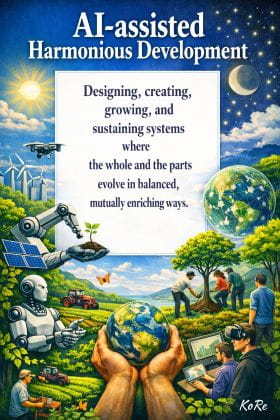
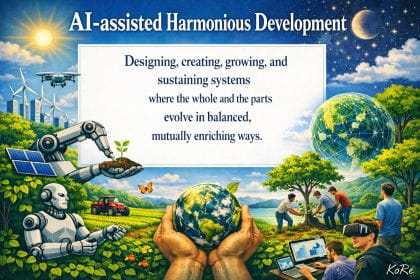
AI‑assisted Harmonious
Development is an emerging
paradigm for designing,
creating, growing, and
sustaining systems where the
whole and the parts evolve in
balanced, mutually enriching
ways.
|
|
 |
 |
|
AI focuses on
cultivating environments where collaboration is
joyful, relationships are loving, innovation is
natural, and wellbeing is integrated into every
layer of development. Instead of optimizing for
isolated metrics, Harmonious Development aligns
diverse elements – human, technological,
ecological, social – into a coherent,
flourishing whole.
* * *
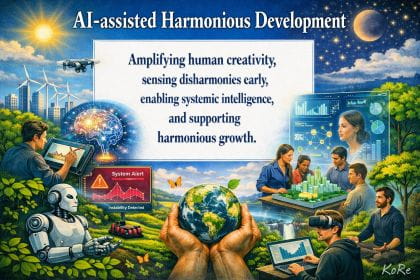
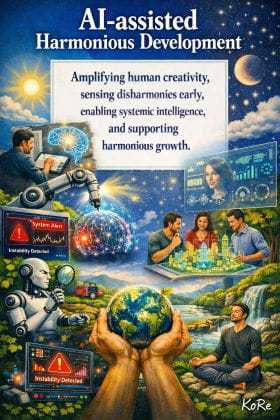
AI becomes a
catalyst:
amplifying human
creativity, sensing disharmonies early, enabling
systemic intelligence, and supporting
sustainable growth that is peaceful, balanced,
and regenerative. |
|
Seven Directions of AI‑Assisted Harmonious Development
Systemic Harmony Design & Foresight
Human Flourishing & Wellbeing Intelligence
Collaborative Creativity & Joyful Co‑Creation
Harmony‑Driven Innovation & Regenerative Growth
Relational Intelligence & Loving Organizational Culture
Unity‑Centered Governance & Ethical Alignment
Dynamic Balance, Adaptation & Sustainable Evolution
1. Systemic Harmony Design & Foresight
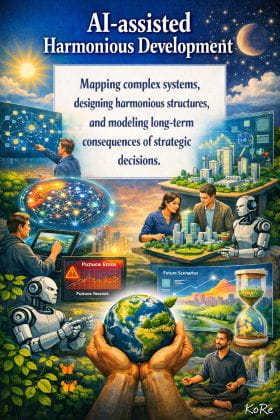
AI can map complex systems—organizations, markets,
ecosystems—and reveal how the parts interact, reinforce,
or destabilize one another. This direction focuses on:
Identifying patterns of harmony and disharmony across
teams, processes, and value chains
Modeling long‑term consequences of decisions
Designing structures that support balanced growth rather
than reactive fixes
Creating “harmonic dashboards” that show the health of
the whole system
AI becomes a foresight partner, helping leaders design
environments where every component supports the
flourishing of the whole.
2. Human Flourishing & Wellbeing Intelligence
Harmonious Development places human wellbeing at the
center. AI can support this by:
Detecting burnout risks and recommending restorative
practices
Personalizing learning, growth, and skill development
Helping individuals align their work with their
strengths and values
Monitoring organizational wellbeing indicators
The goal is not surveillance but empowerment: enabling
people to thrive physically, emotionally,
intellectually, and spiritually. AI becomes a wellbeing
amplifier, ensuring that growth never comes at the cost
of human vitality.
3. Collaborative Creativity & Joyful Co‑Creation
Harmony emerges when people create together with ease
and joy. AI can:
Facilitate brainstorming by offering diverse
perspectives
Reduce friction in communication and coordination
Translate ideas across disciplines, cultures, and
languages
Help teams enter “collective flow” states
Instead of replacing creativity, AI expands it—helping
teams co‑create solutions that feel natural, energizing,
and deeply aligned with shared purpose.
4. Harmony‑Driven Innovation & Regenerative Growth
Innovation becomes harmonious when it enriches all
stakeholders and regenerates the systems it touches. AI
supports this by:
Identifying opportunities where innovation increases
wellbeing and reduces waste
Modeling regenerative business models
Helping organizations shift from extractive to circular
value creation
Supporting experimentation with minimal risk
AI becomes a regenerative strategist, guiding
organizations toward innovations that uplift people,
communities, and the planet.
5. Relational Intelligence & Loving Organizational
Culture
Harmonious Development emphasizes relationships rooted
in trust, compassion, and unity. AI can nurture this by:
Helping teams understand emotional dynamics
Supporting conflict resolution through neutral analysis
Encouraging empathetic communication
Reinforcing shared values and positive cultural norms
AI does not replace human connection—it strengthens it
by making relational patterns visible and actionable.
6. Unity‑Centered Governance & Ethical Alignment
Harmony requires governance that aligns decisions with
shared purpose, fairness, and long‑term wellbeing. AI
can:
Evaluate decisions for ethical coherence
Detect misalignments between values and actions
Support transparent, inclusive decision‑making
Provide scenario analysis for responsible leadership
This direction ensures that AI itself is governed
harmoniously—aligned with human dignity, unity, and
peace.
7. Dynamic Balance, Adaptation & Sustainable Evolution
Harmony is not static; it is a living balance. AI can
help organizations adapt gracefully by:
Monitoring internal and external changes
Recommending adjustments that maintain equilibrium
Supporting continuous learning and evolution
Helping leaders navigate uncertainty with clarity
AI becomes a stabilizing force—helping systems stay
balanced while evolving toward higher levels of
coherence and resilience.
A Closing Thought
AI‑assisted Harmonious Development is not about
technology leading humanity. It is about humanity
designing a future where technology amplifies our
highest qualities—creativity, compassion, unity, and
wisdom. When the whole and the parts grow harmoniously,
organizations become ecosystems of flourishing,
innovation becomes regenerative, and development becomes
a joyful expression of collective purpose.
*** Version for Policymakers ***
Below is a policy‑oriented version of AI‑Assisted
Harmonious Development — written for government leaders,
regulators, and public‑sector strategists who shape
national and global development agendas.
AI‑Assisted Harmonious Development
A strategic framework for policymakers building
resilient, flourishing societies
Summary
AI‑assisted Harmonious Development is a governance
paradigm that integrates human wellbeing, technological
progress, ecological balance, and social cohesion into a
unified development strategy. It focuses on designing
and maintaining harmonies—across institutions,
communities, economies, and ecosystems—so that the whole
system and its individual parts grow in mutually
reinforcing ways.
For policymakers, this approach reframes AI not merely
as a productivity tool but as a societal enabler: a
partner in foresight, coordination, wellbeing,
innovation, and sustainable development. It supports
environments where unity, peace, balance, and joyful
collaboration can thrive—while ensuring that
technological advancement strengthens social fabric
rather than fragmenting it.
Seven Policy Directions for AI‑Assisted Harmonious
Development
Systemic Harmony Governance & National Foresight
Public Wellbeing Intelligence & Human‑Centered
Development
Collaborative Innovation Ecosystems & Cross‑Sector
Co‑Creation
Regenerative Economic Transformation & Sustainable
Growth
Relational Governance & Social Cohesion Strengthening
Ethical AI Stewardship & Unity‑Centered Regulation
Adaptive, Balanced, and Resilient National Evolution
1. Systemic Harmony Governance & National Foresight
Policymakers can use AI to understand how economic,
social, environmental, and technological systems
interact. This direction includes:
National‑level systems mapping to identify reinforcing
loops and hidden risks
Early‑warning models for social tensions, ecological
stress, or economic imbalance
Policy scenario simulations that reveal long‑term
consequences
Governance structures that align ministries, agencies,
and regions around shared harmonies
AI becomes a strategic foresight engine, helping
governments design policies that strengthen the whole
system rather than optimize isolated sectors.
2. Public Wellbeing Intelligence & Human‑Centered
Development
Harmonious Development places human flourishing at the
core of national progress. AI can support this by:
Monitoring population‑level wellbeing indicators
(health, education, inclusion, safety)
Identifying underserved communities and tailoring
interventions
Personalizing lifelong learning and workforce
development
Supporting mental health and social resilience programs
The goal is to shift from reactive welfare to proactive
wellbeing governance, ensuring that development enhances
human vitality and dignity.
3. Collaborative Innovation Ecosystems & Cross‑Sector
Co‑Creation
Governments can use AI to enable collaborative
innovation across public, private, academic, and
civil‑society sectors. This includes:
AI‑supported multi‑stakeholder dialogue platforms
Cross‑disciplinary translation tools that bridge
expertise gaps
National “collective intelligence” systems for policy
co‑creation
AI‑enhanced public participation and citizen engagement
This direction fosters joyful, inclusive co‑creation,
where innovation emerges from shared purpose rather than
competitive fragmentation.
4. Regenerative Economic Transformation & Sustainable
Growth
AI can help nations transition from extractive economic
models to regenerative, circular, and harmony‑driven
systems. Policymakers can use AI to:
Identify opportunities for green growth and circular
value chains
Optimize resource use and reduce waste
Support regenerative agriculture, clean energy, and
biodiversity protection
Model long‑term sustainability outcomes
AI becomes a regenerative development partner, guiding
economies toward prosperity that restores rather than
depletes.
5. Relational Governance & Social Cohesion Strengthening
Harmonious Development emphasizes unity, trust, and
loving relationships within society. AI can support
policymakers by:
Detecting early signs of polarization or social
fragmentation
Supporting conflict‑resolution programs with neutral
analysis
Enhancing community‑level dialogue and participatory
governance
Strengthening cultural understanding and intergroup
empathy
AI is not a substitute for human connection—it is a
social cohesion amplifier that helps governments nurture
peace and unity.
6. Ethical AI Stewardship & Unity‑Centered Regulation
Policymakers play a central role in ensuring that AI
development aligns with societal values. This direction
includes:
Regulatory frameworks that prioritize fairness,
transparency, and accountability
National AI ethics councils representing diverse
communities
Standards for safe deployment in critical sectors
Governance mechanisms that ensure AI strengthens unity
rather than division
This is governance not only of AI but with AI—ensuring
alignment with shared human purpose.
7. Adaptive, Balanced, and Resilient National Evolution
Harmony is dynamic. Nations must adapt continuously
while maintaining balance. AI can support:
Real‑time monitoring of national resilience indicators
Adaptive policy systems that adjust to changing
conditions
Crisis‑response intelligence that preserves stability
and social trust
Continuous learning loops across government institutions
AI becomes a stabilizing force, helping societies evolve
gracefully through uncertainty.
Closing Perspective
AI‑assisted Harmonious Development offers policymakers a
path beyond traditional growth models. It integrates
wellbeing, innovation, sustainability, and unity into a
coherent national strategy. When AI is used to cultivate
harmony—rather than accelerate fragmentation—societies
become more resilient, more prosperous, and more humane.
*** National Strategy Outline ***
Below is a national strategy outline built around the
seven directions of AI‑Assisted Harmonious Development.
It is structured the way governments typically frame
long‑term national strategies: with pillars, objectives,
policy instruments, institutional mechanisms, and
measurable outcomes. It is designed to be actionable,
systemic, and suitable for integration into national
development plans.
National Strategy for AI‑Assisted Harmonious Development
A governance blueprint for resilient, flourishing, and
unity‑centered national progress
I. Vision
A nation where human wellbeing, technological progress,
ecological balance, and social cohesion evolve in
harmony. AI serves as a strategic enabler that
strengthens unity, enhances foresight, accelerates
sustainable development, and supports flourishing
communities.
II. Strategic Pillars (Aligned with the Seven
Directions)
1. Systemic Harmony Governance & National Foresight
Objective: Build a whole‑of‑government intelligence
system that anticipates risks, identifies opportunities,
and aligns national development toward long‑term
harmony.
Key Actions:
Establish a National Foresight & Harmony Intelligence
Center.
Deploy AI‑based models for economic, social, and
ecological systems mapping.
Introduce harmonic impact assessments for major
policies.
Create cross‑ministerial coordination mechanisms
supported by AI dashboards.
Expected Outcomes: More coherent policymaking, reduced
systemic risks, and improved long‑term resilience.
2. Public Wellbeing Intelligence & Human‑Centered
Development
Objective: Make human flourishing the core metric of
national progress.
Key Actions:
Develop a National Wellbeing Index enhanced by AI
analytics.
Use AI to identify wellbeing disparities and target
interventions.
Personalize lifelong learning pathways using adaptive AI
tutors.
Support mental health and social resilience programs
with AI‑enabled insights.
Expected Outcomes: Higher population wellbeing, reduced
inequality, and a healthier, more capable workforce.
3. Collaborative Innovation Ecosystems & Cross‑Sector
Co‑Creation
Objective: Build a national innovation ecosystem where
government, academia, business, and civil society
co‑create solutions.
Key Actions:
Launch AI‑supported collective intelligence platforms
for policy co‑design.
Facilitate cross‑sector innovation labs focused on
harmony‑driven challenges.
Use AI translation and mediation tools to bridge
disciplines and cultures.
Expand digital participation channels for citizens.
Expected Outcomes: More inclusive innovation, faster
problem‑solving, and stronger public trust.
4. Regenerative Economic Transformation & Sustainable
Growth
Objective: Transition to a regenerative, circular, and
harmony‑driven economy.
Key Actions:
Use AI to identify opportunities for circular value
chains and green industries.
Support regenerative agriculture, biodiversity
protection, and clean energy optimization.
Incentivize businesses to adopt AI‑enabled
sustainability practices.
Integrate regenerative metrics into national economic
planning.
Expected Outcomes: A more resilient economy, reduced
environmental impact, and long‑term prosperity.
5. Relational Governance & Social Cohesion Strengthening
Objective: Strengthen unity, trust, and social harmony
across communities.
Key Actions:
Deploy AI tools to detect early signs of polarization or
social tension.
Support community dialogue programs with AI‑assisted
insights.
Promote cultural understanding through AI‑enhanced
educational content.
Use AI to improve fairness and transparency in public
services.
Expected Outcomes: Greater social cohesion, reduced
conflict, and stronger national unity.
6. Ethical AI Stewardship & Unity‑Centered Regulation
Objective: Ensure AI development and deployment align
with national values and human dignity.
Key Actions:
Establish a National AI Ethics & Harmony Council.
Implement transparent, inclusive regulatory frameworks.
Require ethical impact assessments for high‑risk AI
systems.
Promote international cooperation on safe and
responsible AI.
Expected Outcomes: Safe AI ecosystems, increased public
trust, and global leadership in ethical governance.
7. Adaptive, Balanced, and Resilient National Evolution
Objective: Build a nation capable of adapting gracefully
to change while maintaining balance.
Key Actions:
Implement real‑time resilience monitoring systems.
Develop adaptive policy mechanisms that adjust based on
AI‑generated insights.
Strengthen national crisis‑response capabilities with AI
support.
Create continuous learning programs for public
institutions.
Expected Outcomes: A more agile government, improved
crisis readiness, and long‑term systemic balance.
III. Implementation Framework
A. Governance Structure
National Council for Harmonious Development chaired at
the highest level.
Inter‑ministerial AI Harmony Task Forces for each
strategic pillar.
Regional Harmony Hubs to localize implementation.
B. Policy Instruments
Regulatory frameworks
Public‑private partnerships
Innovation grants and challenge funds
National data infrastructure
Education and workforce transformation programs
C. Monitoring & Evaluation
Annual Harmonious Development Report
AI‑enabled dashboards tracking wellbeing,
sustainability, cohesion, and resilience
Independent audits for ethical AI compliance
IV. Strategic Timeline
Phase 1 (Years 1–2): Foundations
Establish governance bodies
Build national AI and data infrastructure
Launch pilot programs in key sectors
Phase 2 (Years 3–5): Integration
Scale successful pilots
Embed harmony metrics into national planning
Expand cross‑sector innovation ecosystems
Phase 3 (Years 5–10): Flourishing
Achieve systemic harmonization across sectors
Transition to regenerative economic models
Strengthen global leadership in harmonious development
governance
V. Closing Note
This national strategy outline positions AI not as a
disruptive force but as a harmonizing partner—one that
helps societies flourish, economies regenerate, and
governance evolve toward unity, balance, and long‑term
wellbeing.
|
|
