|
Fengshui Tips
If you want to ensure
Business Growth1 |
-
Ensure the main entrance faces an open
area.
-
Mirrors should reflect auspicious symbols, such as the cash
register. They should never be situated in a position such that they
reflect bathrooms or staircases.
-
Place
I Ching coins near cash registers, invoice books or at any location
where money is collected.
-
Hang a lucky bell on your front door
-
Place a water feature at the southeast corner of the office.
-
Ensure that the head of the company never sit with his back facing
the window or the door, but against a solid wall.
Yin-Yang of Business Success
|
|
Fengshui Tips
If you are sourcing a new
location for your company premises1 |
-
Choose a location that faces open land.
It is considered auspicious.
-
Avoid a location that is exposed to the
elements, like wind (on top of a hill) and water (at the
beachfront).
-
Avoid a location with large monuments
and sculptures in the immediate vicinity. There may be hide hidden
dangers.
-
Choose to occupy a position among
varying roof heights. The difference in height gives an impression
of wavy lines, which symbolize water, an icon of good fortune.
-
Take into consideration previous
tenants. If past businesses in the area have been known to fail, it
may be best to consider an alternative location.
|
|
Fengshui Tips
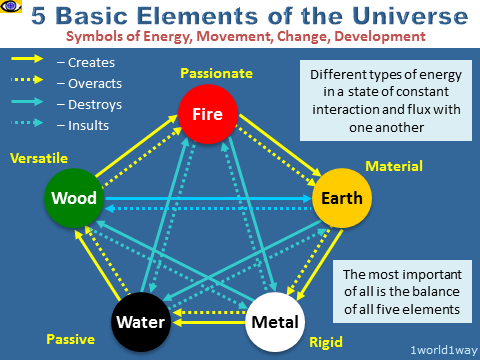
Feng Shui and Five
Basic Elements |
-
Metal. Metal can be found in
many forms. Silver, Gold, Copper, and Bronze are just a few of the
Metal Element. You can also be creative when using this element; you
could use a brass Kwan yin, three-legged toad or a nice Dragon. When
choosing an element try to look at the shape, don't use sharp points
or unattractive objects just because they have the element you need,
Feng Shui is about creating a harmony and
balance and it should look attractive in the environment...
More
Balanced
Organization: 5 Basic Elements
|
|
What is
Fengshui?
Fengshui (also Feng Shui) teaches us how to
create harmony and
balance around us.
The Power of Balance
Fengsgui is
a 5,000 year old tradition which comes to us from
China. It teaches us that
we can decorate our homes and offices in ways that enhance our own personal
energies of Fire, Earth, Metal, Water, or Wood. The purpose of Feng Shui is
to balance the flow of energy in your immediate environment to promote
harmony,
happiness,
and
success in your
life
and
business.
Feng Shui is a method of relating or connecting
your physical surroundings with specific aspects of life.
It works
through your unconscious response to what you see and experience in any
given environment. Feng Shui, which translates into wind and water, provides
easy, creative and fun ways to design your environment to benefit your
love,
life, health,
knowledge, family relationships, career, and
finances.
In ancient China, the Feng Shui master was a
spiritual master as well. He studied the forces of nature, the direction and
force of the wind and water, the surrounding elements, the qualities of
yin and yang, the seasons, the earth energies,
the quality of the land, the building materials, and the direction of the
building in order to maximize the vital energy or Ch'i of the dwelling. Each
factor was crucial in building an auspicious place to live, worship or work.
There are over 72 factors which are considered
in doing a Feng Shui analysis. The major categories are: Site – Building
Exterior – Building Interior – Person – Cosmic.
The guide/road map used is called the ba-gua,
pa-kua, or nine palaces. Color, shape, light, placement, and elements
(water, wood, fire, earth, metal) are some of the tools used in balancing
your environment. These tools are used to create the best environment for
the individual(s) in that particular structure. (residental/commercial)3
The Feng Shui and Tao
By Dina,
Feng Shui Tao
Tao is the
connectedness of all things. It is the thread that brings togetherness to
all things.
The Tao of Leadership
Tao is essential to Feng Shui in that it helps bind together the elements,
colors, senses, and chi (energy). Balance
is the legacy that Tao leaves behind.
For example, if you have ever been in someone’s
home and something feels misplaced (such as the position of a plant, the
color of the carpeting, or the art on the wall) this is the feeling of being
“out” of Tao. If on the other hand you walk into a place and you feel at
home and sense that the space feels peaceful, this is being “in” Tao.
Imagine Tao as a circle and all the pieces that
fit into it are of equal importance because they create a complete circle.
There are many ways to recognize that a person is out of touch with the Tao
in their living or working space – Clutter, un-cleanliness, lack of
photographs of family & friends, no living things that need care to survive,
no books, and few or no accessories – are just a few of the clues. As you
will see, too much or too little of something creates imbalance.
If there is an abundance or lack of things,
this may signify a possible
problem
area in one’s living or working space and in one’s lives. An example of this
would be a bundle of clothes next to the bed, is often a sign of desiring to
escape or change. If there are few or no items in a room, chances are that
person has trouble connecting to certain parts of their life.
It is amazing how one’s home or workspace is
like a treasure map offering clues to what may be going on internally. The
atmosphere that surrounds them daily truly gives messages, as to where there
may be particular imbalances in one’s life. Good, strong, positive Tao is
essential for positive Feng Shui and once balance is attained it will be
very recognizable for all who visit, live, or work in that space.
Take the time to think and search your own
living and/or working spaces and to feel where you might observe a lack of
balance. Try to see what changes may need to be made in order to restore a
harmonious balance between all aspects of your
space and your life and you will see the difference it can make!
Fengshui for Business
While all areas of your home and office are
equally important to bring harmony and life enhancement, your
desk and its placement is
significant for
creativity in business affairs.
Whether your desk helps you run a publicly-traded corporation, a home based
business, or if it is just the place where you manage your personal
finances,
your desk is the most important symbol for
financial success.2

Case in Point
World of Fortune, Singapore
Even multinational corporations (MNCs) are now
turning to fengshui as a solution for
better
business. You would assume that today's science and technology age would
have rendered traditional beliefs obsolete long ago. But this ancient art is
still surviving, and even thriving, in the modern world. According to Mr
Sean Lui1, a fengshui consultant from World of Fortune, geomancy
is catching on in popularity among the younger generation. Believers in the
art are no longer small-time businessmen, and include the heads of MNCs and
international businesses.
In
Singapore, where Mr Lui is based, MNCs make
up about 35% of Mr Lui's clientele, which includes businesses from the
region, such as
Indonesia. All businesses have mostly the same requests when
they approach Mr Lui. Often, they want to see an increase in sales revenue
and their staff to work harmoniously together. Said Mr Lui: “Fengshui
solutions include re-situating the sales department to the office area with
the greatest wealth potential, and shifting the accounts section to the
northernmost, or most protected, office space.” According to Mr Lui, it
takes about six months for the effects of a fengshui consultation to show.
He said: "Some skeptics may not believe that it really works. But fengshui
is an ancient art, so there has got to be some truth in it. Keep an open
mind.”
Ten3 Global Business
Self-Learning Report
What Leaders Strive To Learn
=
Where the World is going
►►
Cultural Intelligence
►►
Full Report
|