Ten3 Business e-Coach – Your 360 Achievement Catalyst!

Unique source of unlimited inspiration, innovation and growth!

We invented inspirational Business e-Coaching in 2001

Today, we have customers in 100+ countries!

Our selected customers: 

3M, ABB, Adidas, Alcatel, American Express, Bayer, Boeing, British American Tobacco, BP, Canon, Cisco, Citigroup, Colgate, Corning, Deloitte, Ernst & Young, Fujitsu-Siemens, GE, Goldman Sachs, HP, Hitachi, Huyndai, IBM, Intel, Johnson & Johnson, JP Morgan Chase, KPMG, Lufthansa, Microsoft, Motorola, Nokia, Oracle, Samsung, Shell, Sony, United Bank of Switzerland


Ten3 Mini-Course


       New Business Models


Win in the New Era of

Rampant Change, Knowledge Enterprise, Pervasive Globalization, and Increasing Complexity!


Vadim Kotelnikov - Author and Founder of Ten3 Business e-Coach

By: Vadim Kotelnikov, Author & Founder, Ten3 BUSINESS e-COACH

 Learn & Teach – fast!

40 PowerPoint slides + 40 half-page Executive Summaries

Discover synergies and create a unique winning business model!


 Yes!  You are in the right place!

This site is Ranked #1 by Google for

"New Business Models"

out of about 600-million-wide (!!!) competition!

Selected buyers

of this Ten3 Mini-course:

 Citigroup, Glaxo, Goldman Sachs, Ernst & Young, Fuji Xerox, IBM, IMD, LG, Motorola, NASA, Tata, Thomson, Unisys, Wrigley


Global bestseller! We are proud to have customers in 50+ countries: Argentina, Australia, Bahrain, Belgium, Brazil, Canada, Chile, China, Columbia, Denmark, Finland, France, Germany, Greece, Kuwait, India, Indonesia, Iran, Italy, Lithuania, Malaysia, Mexico, Netherlands, New Zealand, Norway, Pakistan, Panama, Philippines, Poland, Oman, Qatar, Rep. of Korea, Saudi Arabia, South Africa, Spain, Sweden, Switzerland, Taiwan, Thailand, Trinidad and Tobago, Turkey, UAE, Ukraine, United Kingdom, and United States,


 Contents


1. Why New Business Models?

Business Model: Connecting Internal Inputs to Economic Outputs

Six Components of a Business Model (see slide)

Rapidly Changing Global Scenario

Fundamental Management Changes Engendered by Internet

Changes That Call for New Business Models

Intellectual Assets – the Major Value Driver in the New Economy (see slide)

Knowledge-based Enterprise versus Industrial Enterprise

Corporate Management versus Venture Management

Top 10 Forces Behind New Business Models

Business Case: Direct Model of Dell Computer Corporation (see slide)

2. Innovative Value Proposition

The Best Technique to Win the Customer Over

Business Case: Amazon.com

The Tao of Value Innovation

Customer Intimacy: the Three Routes (see slide)

3. Innovative Market Segmentation

The Normal Curve of New Concept Adoption (see slide)

Psychographic Classification of Customers

Differentiating with Different Types of People

Business Case: Segmentation by Customer by Dell Computers

4. Innovative Value Creation Structures

State-of-the-Art Value Chain (see slide)

Extended Enterprise

Core Competencies

Virtual Integration

Shift from Functional to Cross-functional Paradigm (see slide)

Employee Empowerment  (see slide)

Strategic Alliances  (see slide)

Customer Partnership  (see slide)

5. Innovative Revenue Models

Business Case: Xerox Corporation

Utilizing Intellectual Property by Small Technology Businesses

Customer Training: Traditional and New Business Models

Business Models on the Web: Nine Basic Categories

6. Innovative Competitive Strategies

Four Types of Marketing War Fare

Sustainable Competitive Advantage  (see slide)

Entrepreneurial Organization

Differentiation Strategies

7. Innovative Growth Strategies

Managing Your Venture at Different Growth Stages

Strategy Pyramid (old) versus Strategy Stretch (new)

Achieving Top-line Growth and Bottom-line Results

Business Case: Thermo Electron Corporation  (see slide)

Business Case: Bunsha - a Japanese Company Division Concept

Fast Company

 Sample Ten3 SMART Lesson (Slide + Executive Summary)


NEW BUSINESS MODELS (Ten3 Mini-course and business training)

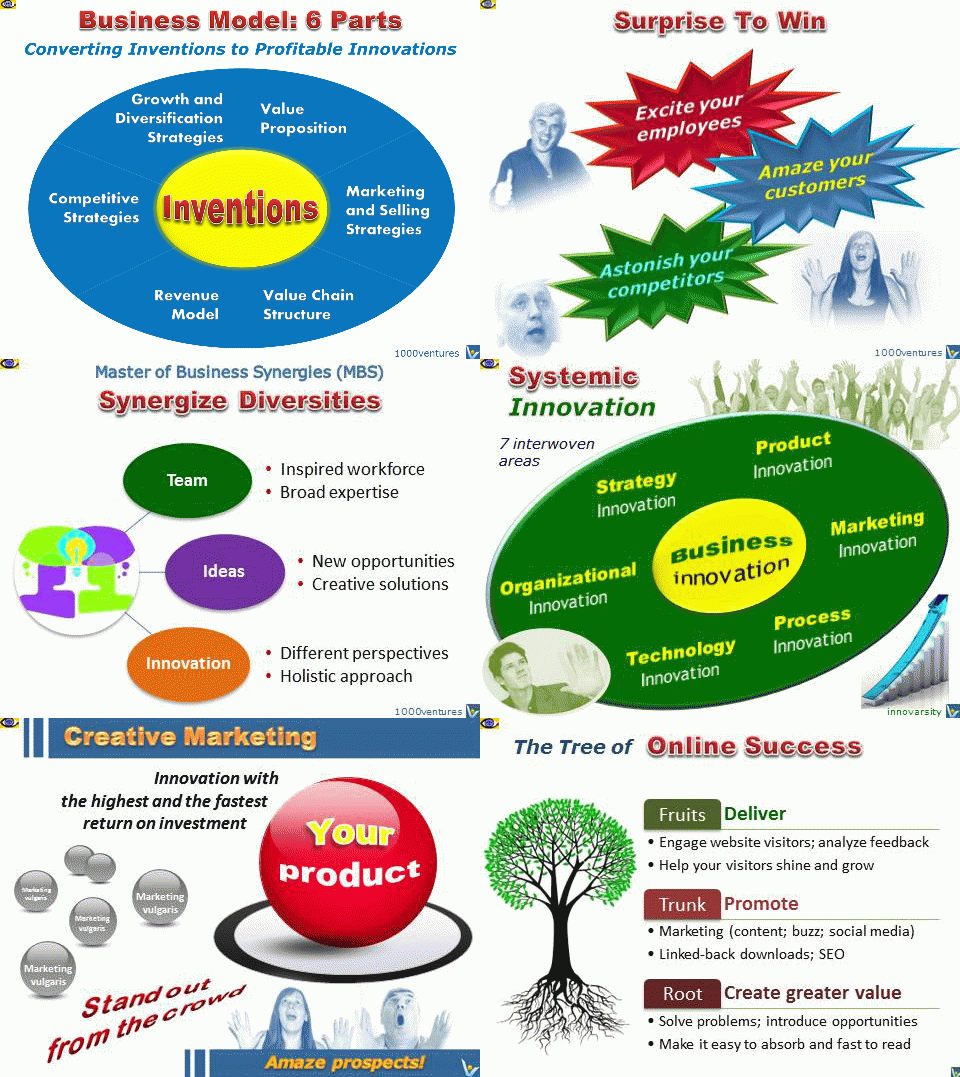
Six Components of the Business Model

According to Henry Chesbrough and Richard S. Rosenbloom

  1. Value Proposition - a description of the customer problem, the solution that addresses the problem, and the value of this solution from the customer's perspective.

  2. Market Segment - the group to target, recognizing that different market segments have different needs. Sometimes the potential of an innovation is unlocked only when a different market segment is targeted.

  3. Value Chain Structure - the firm's position and activities in the value chain and how the firm will capture part of the value that it creates in the chain.

  4. Revenue Generation and Margins - how revenue is generated (sales, leasing, subscription, support, etc.), the cost structure, and target profit margins.

  5. Position in the Value Network - identification of competitors, complementors, and any network effects that can be utilized to deliver more value to the customer.

  6. Competitive Strategy - how the company will attempt to develop a sustainable competitive advantage and use it to improve the enterprise's competitive position in the market.

Business Model vs. Revenue Model

A Business Model is the umbrella term used to describe the method – position in the value chain, customer selection, products, pricing – of doing business.

A Revenue Model lays-out the process by which a company actually makes money by specifying how it is going to charge for the services provided.

New Business Models

Traditional corporations are overstructured, overcontrolled, and overmanaged, but underled. Today, top managers should rather concentrate of that handful of real managerial leadership tasks that will bring success in the future. Thus, a new business model is emerging, a model where most of key missions of the organization are distributed to the myriad individual pieces and unity comes from the vigor of people and the free flow of knowledge.

... and much, much more!

   Ten3 Business e-Coach and Ten3 Mini-Courses with Consultant License Ten3 Training


Usage for teaching purposes:  The presentation can be used on a single computer as often as you wish with any individual or group.

Payment options: Secure Online Credit Card; Wire Transfer; Phone; Fax; Mail/Check/Money Order; PayPal


Map

Ranked #1

Search

Testimonials

Free Downloads

  Products

SMART Learning

Training

 Contact

We invented Business e-Coaching in 2001

Today, we have customers in 100+ countries!

Our customers:

3M, ABB, Adidas, Alcatel, American Express, Bayer, Boeing, British American Tobacco, BP, Canon, Cisco, Citigroup, Colgate, Corning, Deloitte, Ernst & Young, Fujitsu-Siemens, GE, Goldman Sachs, HP, Hitachi, Huyndai, IBM, Intel, Johnson & Johnson, JP Morgan Chase, KPMG, Lufthansa, Microsoft, Motorola, Nokia, Oracle, Samsung, Shell, Siemens, Sony, United Bank of Switzerland

Ten3 Mini-courses: SMART & FAST sets Full version of Ten3 Business e-Coach Ten3 Business e-Coach (home page)

Ten3 Business e-Coach, version 2008

Inventor, Author & Founder – Vadim Kotelnikov

© Vadim Kotelnikov, GIVIS