| |
A
system is a number of
interdependent parts functioning
as a whole for some purpose.
System analysis helps understand
the interdependence of the
parts.
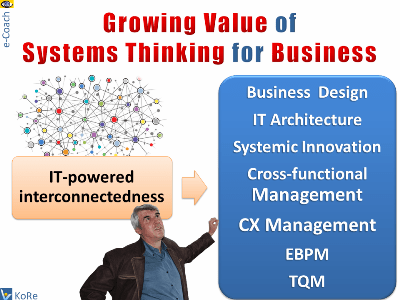
The growing
IT-powered interconnectedness
of all business functions blurs
the boundaries between
departments.
|
|
 |
| |
|
Systems Approach to Management
The systems approach to
management is based on general
system theory – the theory that
says that to understand fully
the operation of an entity, the
entity must be viewed as a
system. This requires
understanding the
interdependence of its parts...
More
|
|
|
| |
|
Cross-functional Management (CFM)
Cross-functional systems
approach to management is about
systems thinking and
management of business processes
across the traditional
boundaries of the functional
areas. CFM relates to
coordinating and
synergizing the activities
of different units for realizing
the superordinate
cross-functional goals and
policy deployment. It is
concerned with building a better
system for achieving such
cross-functional goals as
innovation, quality, cost,
and delivery...
More
|
|
|
|
|

| |
Systems and Wholeness
The concept of "wholeness" is very important in
general system analysis. The system must be
viewed as a whole and modified
only through changes in its parts. Before modifications of the parts can be
made for the overall benefit of the system, a thorough knowledge of how each
part functions and the interrelationships among the parts must be present. |
|
Two Basic
Types
of Systems |
|
Closed system
is one that is not influenced by, and does not interact with, its
environments. Such systems usullay have
predetermined activities that must be performed
regardless of the environment.
Open system is one that is
influenced by, and is continually interacting with, its environment. |
| |
Systems Thinking
Systems thinking is your
ability to things as a whole (or
holistically) including the many different
types of relationships between the many elements in a complex system...
More |
| |
Value Chain
Management and Value System Analysis
Your firm's
value chain
links to the value chains of upstream
suppliers and downstream buyers. The result is a larger stream of
activities known as the value system.
The development of a
competitive advantage depends not only on your firm's specific value
chain, but also on the value system of which your firm is a part.
Making
breakthrough improvements in your value chain requires
out
of the box,
cross-functional, systems thinking. You have to see the
value creation
process across the entire flow of work, not just single points...
More
|
|
|