 |
|
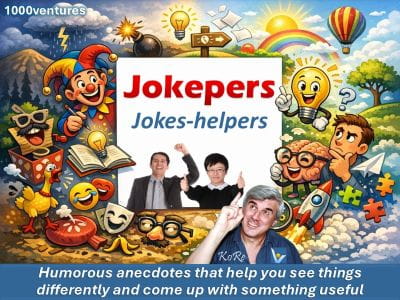
Jokepers are jokes-helpers that humorously
help you see things differently and come up with
creative and useful solutions in real-life
situations.
Jokepers
synergize fun and wisdom –
comparative advantages of anecdotes and teachings.
|
|
| |
|
The Joke
Strategic Business Game
|
|
|
| |
|
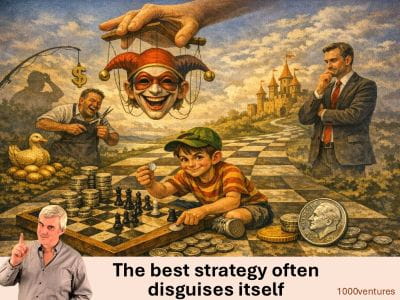
A businessman was talking with
his barber, when they both
noticed a goofy-looking fellow
bouncing down the sidewalk.
The barber whispered, "That's
Tommy, one of the stupidest kids
you'll ever meet. Here, I'll
show you."
|
|
|
| |
"Hey Tommy! Come
here!" yelled the barber. Tommy came bouncing
over "Hi Mr. Williams!" The barber pulled out a
rusty dime and a shiny quarter and told Tommy he
could keep the one of his choice. Tommy looked
long and hard at the dime and quarter and then
quickly snapped the dime from the barber's hand. |
|
 |
| |
|
The barber looked at the
businessman and said, "See, I
told you." After his haircut,
the businessman caught up with
Tommy and asked him why he chose
the dime. Tommy looked at him in
the eye and said, "If I take the
quarter, this strategic game
will end forever."
|
|
|
 |
|
①
Never underestimate your customer. The moment you assume
someone is “stupid,” you stop seeing their strategy.
②
People buy for their reasons, not yours. Tommy chooses
the dime because it maximizes his long‑term gain, not
the barber’s short‑term logic.
③
Perception shapes behavior. The barber’s belief that
Tommy is foolish keeps the “game” alive – and Tommy
profits from that perception.
④
Small wins accumulate. A dime taken repeatedly is worth
more than a quarter taken once. |
|
*****
7 TAKEAWAYS
1. Takeaways for Sellers
Your offer must align with the buyer’s incentives. If
your offer ends the game, the buyer won’t take it.
Observe behavior, not assumptions. Tommy’s pattern
reveals intelligence hidden behind a goofy façade.
The smartest “sell” is often invisible. Tommy sells the
barber the illusion of superiority – and gets paid for
it.
| |
①
Value is contextual. The “less valuable” dime becomes
more valuable when it keeps the income stream flowing.
②
Short-term gain can kill long-term advantage. Taking the
quarter ends the game; taking the dime extends it.
③
Don’t reveal your full intelligence too early. Sometimes
being underestimated is a strategic asset. |
|
|
|
|
|
⑤ Know the rules
of the meta-game better than your opponents.
Tommy understands the meta-game; the barber does not.
⑥
Your choice should serve your strategy, not your ego.
Pride loses money; patience earns it.
⑦
Winning doesn’t and shouldn't always look like winning. Sometimes the
smartest move looks foolish to outsiders. |
|
| |
|
KoRe 7
Rules of the
Meta-Game of
Winning
Interactions
Takeaways from the "Strategic
Business Game" joke
*
* *
① Value is contextual.
② Short-term gain can kill
long-term advantage.
③ Don’t reveal your full
intelligence too early.
⑤ Know the rules of the meta-game better than
your opponents.
⑥ Your choice should serve your
strategy, not your ego.
⑦
Winning doesn’t and shouldn't always look like winning.
|
|
|
3. Takeaways for Leaders
Never judge capability by appearance. Hidden talent
often lives behind unconventional behavior.
Look deeper than surface-level performance. Tommy’s
“mistake” is actually a strategy.
Reward insight, not conformity. Tommy’s thinking is
unconventional but effective.
Leaders must question their assumptions. The barber’s
assumption blinds him to reality.
People behave rationally within their own incentives.
Understand incentives, and you understand people.
Encourage long-term thinking. Tommy’s patience is a
leadership-level skill.
Great leaders see potential where others see
foolishness. The businessman sees what the barber
cannot.
4. Takeaways for Entrepreneurs
Play the long game. Tommy optimizes for recurring
revenue, not one-time profit.
Leverage perception strategically. Being underestimated
can be a competitive advantage.
Turn others’ habits into your opportunity. The barber’s
predictable “game” becomes Tommy’s income stream.
Small, consistent gains beat big, rare wins. This is the
essence of compounding.
Understand the psychology of your market. Tommy knows
exactly how the barber thinks.
Don’t kill your golden goose. Taking the quarter ends
the business model.
Your strategy should outlast the moment. Tommy’s
brilliance is in sustainability, not flashiness.
5. Takeaways for Inventors
Innovation often looks foolish at first. Tommy’s
approach seems silly until you understand the mechanism.
Challenge the default assumptions. Why must the quarter
be the “better” choice?
Design systems that reward repeated use. Tommy’s
“invention” is a self-renewing loop.
Simplicity can hide sophistication. The dime–quarter
choice is a simple interface with a clever outcome.
Observe human behavior to inspire solutions. Tommy’s
strategy emerges from watching how adults behave.
A good invention aligns incentives naturally. The barber
keeps offering; Tommy keeps earning.
The best ideas often exploit overlooked dynamics. Tommy
exploits the barber’s ego and predictability.
| |
① The obvious
answer is not always the correct one. The
quarter is bigger, but the dime is smarter.
②
Wisdom often hides behind paradox. Tommy appears foolish
but behaves intelligently.
③
Meta-thinking beats linear thinking. Tommy thinks about
the game, not the coin. |
|
 |
 |
|
④
Question the frame, not just the options. The real
question isn’t “Which coin is worth more?” but “Which
choice keeps the game alive?”
⑤
Intelligence is contextual. What looks irrational in one
frame is brilliant in another.
⑥
Don’t confuse noise with insight. The barber sees the
coin; Tommy sees the system.
⑦
True understanding requires stepping outside the
situation. The businessman sees what the barber cannot
because he observes from a distance.
|
|
| |
|
7
Takeaways for
Strategists
|
|
|
 |
|
①
Strategy is about systems, not events. Tommy optimizes
the system, not the moment.
②
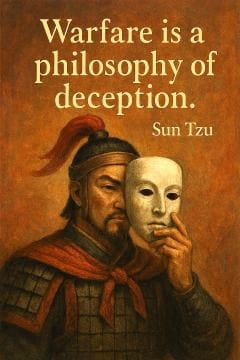
The best strategy often disguises itself. Tommy’s
“foolishness” is camouflage.
③
Control the narrative by controlling expectations. Tommy
lets others believe he is predictable and simple.
④
The ultimate strategic move is to make your opponent
think you’re not playing strategically at all. And Tommy
masters this art.
⑤
A small sacrifice can secure a larger advantage. Giving
up the quarter secures infinite dimes. |
|
| |
⑥
Winning requires understanding incentives – yours and
theirs. Tommy knows the barber’s ego is the engine of
the game.
⑦
A strategy that ends the game is not a strategy – it’s a
stunt. Tommy avoids the stunt. |
|
|
|
|