Buddhism:

The Wheel of Life

The Wheel of Life in the Buddhist Teaching

The Representation of the Suffering and Impermanence of Cyclic Existence

By Hom Bahadur Tamang, thangka painter since 1976


The Wheel of Life in Buddhist Teaching (Thangka)


The two authors:

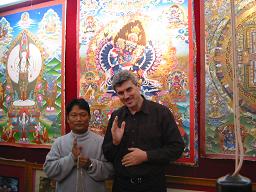
Hom Bahadur Tamang, the Tibetian artist and teacher, the author of the above article and thangka, and

Vadim Kotelnikov, the author of Ten3 Business e-Coach in Nepal, 2004

 Discover much more!

Buddhism

Buddha

Buddha's Path To Liberation

World Cultures

Eastern vs. Western Philosophy: Key Concepts

Balancing Your Life and Business Wheels

The Wheel of Life

Tips for Global Business Travelers

Thailand: 11 Tips for Visitors

  Ten3 Mini-Courses   Presentation:    View    Download

Personal Success 360  (75 slides)   Demo

Cultural Intelligence & Modern Management  (e-book)


 Cultural Intelligence & Modern Management

Discover synergies & Harness the power of diversity!

Eastern vs. Western Philosophy

Achievement Management

Managing Cultural Differences

Organizational Culture

New Management Models from Different Cultures

World Cultures, Philosophies and Religions

New-generation e-book + 50 slides

The Wheel of Life

(as it is presented at the Tibetian Mandala Thangka)


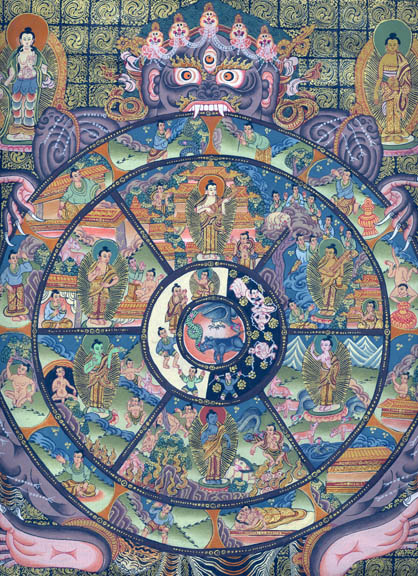
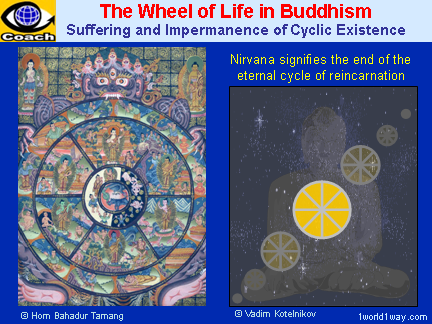
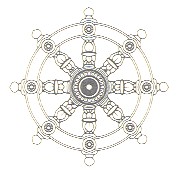
The Wheel of Life is a presentation of the Buddhist teaching on the suffering and impermanence of cyclic existence.

The Lord of Death, Yama, holds the wheel of existence between his teeth, hands and feet.

At the centre of the wheel are three poisonous delusions represented by a red cockerel (passion and lust), a green snake (hatred and aggression), and a black pig (ignorance and confusion). These three creatures chase and bite each others tails, giving rise to the endless cycle or becoming.

In the next circle beings rise to enter the three higher realms, or fall to enter the three lower realms. The six realms are represented within the spokes of the wheel.

The hell realm, in the lower part of the wheel is characterized by the extreme suffering of the various hot and cold hells. The hunger ghost or preta realm in the lower left is characterized by craving and enormous hunger. The denizens of this realm having huge empty stomachs and mouths like pinholes. The animal realm is characterized by extreme stupidity. The jealous gods in the upper left, suffer from competitiveness and ambition as they strive for the realization of their desires. The god realms are sensual heavens, where the inhabitants are totally involved in the pursuit of pleasure. Only in the human realm, with its constant fluctuation of pleasure and pain can the dharma be clearly heard and liberation attained.

In the outer ring are the twelve links of the chain of dependence arising. Clockwise from the top they are:

  1. Ignorance (a blind person)

  2. Action (a potter)

  3. Consciousness (a monkey holding fruits)

  4. Name and form (a person rowing a boat)

  5. Sources (an empty house with five windows and a door)

  6. Contact (sexual contacts)

  7. Feeling (a person with an arrow in his eye)

  8. Craving (a person drinking alcohol)

  9. Grasping (a monkey picking fruit from a tree)

  10. Becoming ( a pregnant woman)

  11. Rebirth (a baby being born)

     
  12. Old age and death (an old person walking with a cane).

At the top right of the painting is the paradise of Amitabha. A pathway leads from the judgment hall of the dead in the hell realm to Amitabha's paradise, along which those being with the most fortunate Karma proceed. At the top left is Shakyamuni Buddha who, having attained liberation from the wheel of existence, points towards his perfect wheel of the Buddhadharma.

Buddha's Path To Liberation

From right understanding proceeds right thought;

from right thought proceeds right speech;

from right speech proceeds right action... More


Demo


Free

Micro-course


Women's T-Shirt

Trucker Hat

Tote Bag

Mug

See more Wisdom designs    See all "Be Honest" products in our online shop


Map

Ranked #1

Search

Glossary

Free Downloads

  Products

Testimonials

Training

 Contact

We invented Business e-Coaching in 2001

Today, we have customers in 100+ countries!

Our customers:

3M, ABB, Adidas, Alcatel, American Express, Bayer, Boeing, British American Tobacco, BP, Canon, Cisco, Citigroup, Colgate, Corning, Deloitte, Ernst & Young, Fujitsu-Siemens, GE, Goldman Sachs, HP, Hitachi, Huyndai, IBM, Intel, Johnson & Johnson, JP Morgan Chase, KPMG, Lufthansa, Microsoft, Motorola, Nokia, Oracle, Renault, Samsung, Shell, Siemens, Sony, United Bank of Switzerland

Ten3 Mini-courses: SMART & FAST sets Full version of Ten3 Business e-Coach Ten3 Business e-Coach (home page)

Ten3 Business e-Coach

Inventor, Author & Founder – Vadim Kotelnikov

© Vadim Kotelnikov, GIVIS