|
Dharma Wheel |
|
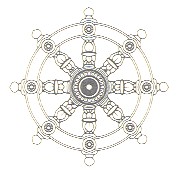 A
Buddhist emblem resembling a wagon wheel, with eight spokes, each
representing one of the eight tenets of buddhist belief. The circle
symbolizes the completeness of the Dharma, the spokes represent
the eightfold path leading to enlightenment. A
Buddhist emblem resembling a wagon wheel, with eight spokes, each
representing one of the eight tenets of buddhist belief. The circle
symbolizes the completeness of the Dharma, the spokes represent
the eightfold path leading to enlightenment.
It is drawn from an Indian
symbol, but instead of representing Samsara, or endless rebirth, it
symbolizes overcoming obstacles.
|
|
According to tradition the Wheel of Dharma
was set in motion three times:
-
in Sãrnãth where
Buddha pronounced his first discourse after attaining complete
enlightenment
-
through origination of the Mahãyãna
-
through the arising of the Vajrayãna
|
|
Buddha's Teachings |
|
Character, Personality
Though he should conquer a thousand men in the battlefield a thousand
times, yet he, indeed, who would conquer himself is the noblest victor.
The thought manifests as the word; The word
manifests as the deed; The deed develops into
habit; And habit hardens into
character. So watch the thought and its ways with care, And let it
spring from love born out of concern for all beings.
He is able who thinks he is able.
Relationships
Do not speak harshly to any one; those who
are spoken to will answer thee in the same way. Angry speech is painful:
blows for blows will touch thee.
Hatreds never cease by hatreds in this
world. By love alone they cease. This is an ancient Law...
More
|
|
The Wheel of Dharma
The
Wheel of Dharma, or the Wheel of the Teaching, is the translation of the
Sanskrit word, "Dharma cakra" (dharma-chakra). Similar to the wheel of a
cart that keeps revolving, it symbolizes the Buddha's teaching as it
continues to be spread widely and endlessly. The eight spokes of the wheel
represent
the Noble Eightfold Path of Buddhism, the most
important Way of Practice. The
Noble Eightfold Path refers to right view, right thought, right speech,
right behavior, right livelihood, right effort, right mindfulness, and right
meditation. In the olden days before statues and other images of the Buddha
we made, this Wheel of Dharma served as a the object of worship. At the
present time, the Wheel is used internationally as the common symbol of
Buddhism.
After he had attained
enlightenment, as a result of requests Buddha rose from meditation and
taught the so-called first "Wheel of Dharma. These teachings, which include
the Sutra of the Four Noble Truths and other discourses, are the principal
source of the Hinayana, or Lesser Vehicle, of Buddhism. Later, Buddha taught
the second and third Wheels of Dharma, which include the Perfection of
Wisdom Sutras and the Sutra Discriminating the Intention, respectively.
These teachings are the source of the Mahayana, or Great Vehicle, of
Buddhism.
In the Hinayana teachings, Buddha explains how to attain
liberation from suffering for oneself alone. In the Mahayana teachings he
explains how to attain full enlightenment, or Buddhahood, for the sake of
others. Both traditions flourished in Asia, at first in India and then
gradually in other surrounding countries, including Tibet. Now they are also
beginning to flourish in the West.
Buddha's teachings, which
are known as "Dharma", are likened to a wheel that moves from country to
country in accordance with changing conditions and people's karmic
inclinations. The external forms of presenting Buddhism may change as it
meets with different cultures and societies, but its essential authenticity
is ensured through the continuation of an unbroken lineage of realized
practitioners. Buddha's teachings are
said to be like a precious wheel because, wherever they spread, the people
in that area have the opportunity to control their minds by putting them
into practice.
Buddha's Path To
Liberation
From right understanding proceeds right
thought;
from right thought proceeds right
speech;
from right speech proceeds right
action...
More
Buddha about Conquering
Conquer the angry man by
love
Buddha Healing Mantra
May the many sentient beings who are sick,
quickly be freed from sickness.
And may all the sicknesses of beings never arise again.
The Value of Leading a Balanced Life
Balance is a key element of a
happy life.
Dalai Lama
teaches, 'A balanced and skillful approach to life, taking care to avoid
extremes, becomes a very important factor in conducting one's everyday
existence... More
Happiness – It's All in Our Own Hands
Here are three little anecdotes that I'd
like to share with you. They concern three sisters: Arom, Aporn, and
Arpa. Taken together, the trio of anecdotes tells us how to
cope with problems, how to turn the negative into the positive. If
we can do that, then we'll have a definite guarantee that, regardless of
what we encounter, we won't suffer as much or as easily as we did
before. That is our true guarantee of
happiness.
Thailand: 11 Tips for Visitors
Thailand is a Buddhist country where Buddha images are held secret.
Sacrilegious acts are punishable by imprisonment even if committed
by foreign visitors.
|