|

|
 |
The
Tao of
Venture Financing |
|

|
Venture
Financing
Complete "A to Z"
Smart & Fast guide
|
|
Make your business attractive to investors!
►
Understand the Venture Financing Chain
►
Understand the requirements of Venture Capital Investors
►
Follow
unique Step-by-step Guide to
Venture Financing
New-generation e-book
+ 40 slides ►
|
|
|
Bootstrapping
Bootstrapping
is a means of financing a small firm through highly creative acquisition and use
of resources without raising equity from traditional sources or borrowing money
from a bank. It is characterized by high reliance on any internally generated
retained earnings, credit cards, second mortgages, and customer advances, to
name but a few sources.
Bootstrapping is the most likely source of initial equity for more than 90% of
technology based firms. It offers many advantages for
entrepreneurs
and is
probably the best method to get an entrepreneurial firm operating and well
positioned to seek equity capital from outside investors at a later time. The
entrepreneurs should learn
bootstrapping options and practice
bootstrapping strategies to be able to bridge successfully the
equity gap...
More

Mergers
and Acquisitions
The role of
mergers and
acquisitions had evolved as a strategy tool for fast-track
technology-led companies. Any pure technology company looking to get
funded that views an acquisition strategy as a likely outcome, ideally needs
to position itself to fill a future technology need that more than one major
company is likely to fight for.
When weighing your options, be sober about your
company's commercial prospects. Early success with a single application or
product lines does not translate into long-term viability in the face of
well-capitalized, entrenched competitors with strong customer relationships.
Therefore, the short-term technologic advantage realized by start-ups may be
best exploited by seeking a merger partner...
More
The Critical Role of Your
Business Model
Many
venture capitalists see themselves as investing in a
business
model. Consequently it often is
the venture capital investor that pushes for a change in the business model
when it becomes apparent that the original model is not working...
More
|
The Iceberg Principle
The
Iceberg of Opportunities' Principle, which our
Business e-Coach
is to help you reverse, illustrates a tremendous potential for bridging the equity
gap - the gap between
venture capital (VC) sough by start-up firms and VC available
with prospective investors, but not used. To illustrate:
-
from the VC receiver side,
only 6 out of 1000 innovative ideas get
funded by venture investors on an average. The main reason for rejection
is that though first-time entrepreneurs may have great technology of
business ideas they lack skills for
converting these ideas into a successful business. To venture capitalists,
"ideas are a dime a dozen: only execution skills count."
-
from the VC supplier side,
in 2000 in the US,
business angels -
early stage private investors - put US$40 billion behind 50,000 deals.
The size of the angel market could potentially
become 10 to 20 times larger, however. It is estimated that only 7% of potential
business angels in US invest in start-up ventures. The remaining 93% are
virgin angels who would like to invest but don't do it for a number of
reasons, which include lack of proposals matching their investment
criteria,
lack of quality business proposals, lack of trust in the entrepreneur or
management team, lack of experience in
valuating and pricing deals, and
lack of experience in
due diligence and monitoring.
Many see a problem in this huge equity gap. We see an
opportunity here. Let's work together to bridge it!
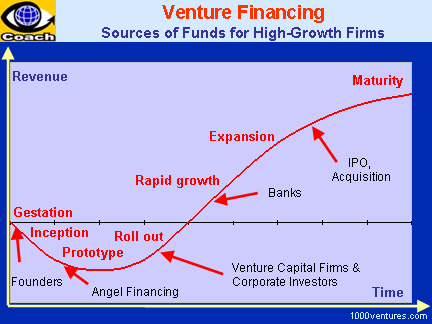
Understanding the Venture Financing Chain
Technology ventures
demand an unbroken financing chain, from pre-seed capital to stock market.
The financing chain is no stronger than its weakest link.
High-tech start-ups
usually go through
multiple funding
rounds. Equity financing conventionally follows the below trajectory:
Business Angels
Business angels
are a
source of pre-revenue seed funding and management guidance for start-ups.
Business angels are wealthy individual investors - usually, people who
have made their own money as entrepreneurs. Better equipped and more
flexible than banks and most capital funds to assess the potential of very
young business, they contribute not only equity but also much needed
business expertise, offering company hands-on support and advice. Angels
bridge the gap between the personal savings of entrepreneurs and the
'early
stage' or 'second round' financing which venture capitalists are able
to offer.
To ensure seamless
integration of financing through the life cycle of a company, good
relations between business angels and VC communities are essential...
More
Venture Capital Firms
Venture
investing is a process by which investors fund early stage, more
risk-oriented ventures. Being a principal funding source, venture capital
can not finance innovation on its own. Too many
VC firms remain unwilling to
invest in high-tech start-ups in the early
stage, often because they lack the investment appraisal capacity to act as
the "first investor". To be fully effective, venture capital
must form part of an unbroken investment chain, from
seed
capital to stock market.
To target and pursue the appropriate
professional venture capital providers, it is a must for the venture
capital seeker to understand their investment strategy and preferences... More
Corporate
Investing
Corporations are a major - and rapidly growing -
source of funds for new ventures. In today's
new entrepreneurial economy, the real shareholder value is created by
companies whose corporate strategies include well-developed
venture strategies.
Partnership between small innovative firms and large corporation is mutually
beneficial. While entrepreneurial companies can identify technology
and market opportunities and move faster to capitalize on them, they can
achieve enormous leverage through technology and distribution agreements
with large global corporations.
According to Venture Economics and the National
Venture Capital Association, in United States in 1994, only 2% of
venture
capital investments was corporate venture capital, but in 2000, corporate
venture capital accounted for 17%, nearly $20 billion. In four years, from
1996 through the end of 1999, the number of companies that were investing in
outside ideas increased elevenfold, from 30 to 330. During the same period,
corporate venture capital spending rose from $100 million to $ 17 billion
annually.
By now,
spinouts, a new form of
creating and financing a high-tech company has become more popular. This
novel approach has a number of advantages over a merger or acquisition and
it plays an increasingly high role for high-tech companies...
More
Banks
Banks are businesses too. They have stockholders to whom they must
report and they are highly regulated by federal and state agencies. You
must prepare a
comprehensive
documentation if you to obtain a commercial loan for your venture...
More
Stock Markets
Stock markets
for high growth companies stimulate venture capital activity by
offering an 'exit route' of flotation. They offer a means for venture
capital funds to realize a return on investment in new companies. Compared
with other exit routes, typically an Initial
Public Offering (IPO) realizes the greatest return on investment. |