|
|
|
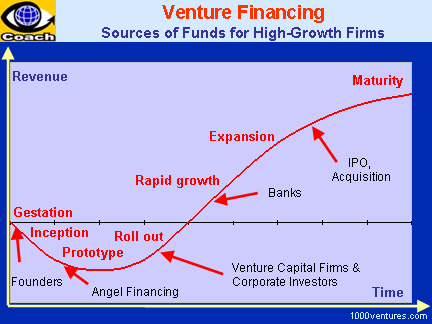
Pre-seed Stage |
A
relatively small amount of capital is provided to an inventor or
entrepreneur to prove a specific concept for a potentially profitable
business opportunity that still has to be developed and proven. The
funded work may involve product development
(as opposed to "pure" research), but it rarely involves initial
marketing. |
|
Seed
Stage |
Financing is provided to newly formed companies for
use in completing product development and in
initial marketing. These companies may be in the process of being
organized or may have been in business a short time. In either case,
products have yet to be sold commercially. Generally, such businesses have
assembled key management, have prepared their initial
business
plan, and have conducted at least initial
market studies. |
|
Early Stage
(First Stage) |
Financing is provided to
companies that have expended their initial capital and now require
funds to initiate commercial-scale manufacturing and sales. |
|
Growth & Expansion Funding |
|
Second Stage |
Working
capital is provided for the expansion of a company which is producing
and shipping products and which needs to
support growing accounts receivable and inventories.
Although the company clearly has made progress, it may not yet be
showing a profit at this stage. |
|
Third Stage |
Funds are
provided for the major expansion of a company which has increasing sales
volume and which is breaking even or which has achieved initial
profitability. Funds are utilized for
further plant expansion, marketing, and working capital
or for development of an improved product, a new technology,
or an expanded product line. |
|
Bridge Financing
(also Later Stage or Expansion
Stage ) |
The firm is mature
and profitable, and often still expanding. Financing is provided for a
company expected to
"go public" within six months to a year.
Often bridge financing is structured so that it can be repaid from the
proceeds of a public offering. Bridge financing also can involve
restructuring of major stockholder positions through secondary
transactions. This is done if there are early investors who want to
reduce or liquidate their positions. This also might be done following a
management change so that the ownership of former management (and
relatives or associates) can be purchased prior to the company's going
public.
|