|
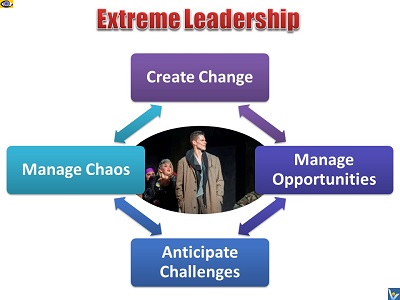
To Lead in Volatile
Times You Must: |
-
learn to stay ahead of the volatility
curve and its inherent dangers
-
learn to manage rapid upturns as well as downturns
-
learn to anticipate and prepare
for volatility
-
distinguish patterns and order amidst chaos
|
|

|
|
Two Techniques for
Turbulent Times |
-
Practice crisis anticipation
-
Determine what can go wrong...
More
|
|
Why Extreme Leadership?
We are living if the
new economy characterized by rapid
unpredictable change and volatility. Volatility and chaos aren't bad or good
– they are just realities.
While associated with strife, hardship, and
discontent, volatility and chaos are also synonyms for fundamental change,
breakthroughs, discoveries, and optimist. "In this new world,
leaders
must anticipate,
rush to think, reach out, build enduring bonds with customers and
stakeholders, and get comfortable with leading at the edge of chaos."1
Foresight and
change anticipation is a hallmark of
great leaders.
To guide your organization through volatile
times, you must learn how to see the patterns in chaos and take charge,
learn how to
act
boldly to safeguard your organization and lead it to a brighter future, and
to alter your strategies to prepare for whatever the world may bring next.
Why Change Fails: 8 Common Errors
Ten Extreme Leadership Best
Practices
The below ten critical elements provide a
process of stabilization that will help you harvest the benefits of the
rapid change brought about by the volatile times, reduce the risk of
volatility and the likelihood of crisis:
-
Make hast slowly
-
Partner with customers
-
Build a culture of
commitment
-
Put the right person, in the right place, right now
-
Maximize
knowledge assets
-
Cut costs, not
value
-
Outposition your competitors
-
Stir, don't shake
-
Cut through the noise
-
Focus, or fail...
More
"While the individual strategies provide proven
solutions to specific challenges, their greatest value lies in the
integrated protocol for leadership created by their fusion – a whole greater
than the sum of its parts."1
Case in Point
BP
Finding an
Equilibrium between Chaos and Order
Source: Managing Complexity, Robin Wood
When John Browne became head of
BP
exploration in 1989 he was determined to
create more value for both
customers
and shareholders. Although BP was successful, Browne knew that the world was
changing and in the face of an uncertain future, the business had to become
more adaptive.
So what did he do? He did not call in the
strategic planners or continue to restructure and rationalize assets.
Instead, he took a more courageous step and decided to raise the creative
tension. Moving with, rather than against, the increasingly heightened
turbulence of the early 1990s, Browne established the preconditions
necessary for creating such tension and deliberately moved the organization
to a situation that was at the edge of chaos. That is, the point at which a
natural equilibrium is found between
chaos and order, comparable to the conditions in the evolving natural
world. Browne and his team were consciously evolving BP into an
adaptive organization, one that
would be better able to survive and prosper in today's uncertain and
turbulent times.
Entrepreneurial
Leader: 4 Specific Attributes
Smart
Executive
Tao of a Winning Organization
|