|
Jack
Welch's Six Rules for
Successful Leadership |
-
Control your destiny, or
someone else will...
More
|
|
Inspirational
Quotes
Jack Welch
Quotes |
-
The idea flow from the human spirit is
absolutely unlimited. All you have to do is tap into that well.
-
Getting great talent, giving them all
the support in the world, and letting them run is the whole
management philosophy of GE.
-
My main job was developing talent. I
was a gardener providing water and other nourishment to our top 750
people. Of course, I had to pull out some weeds, too.
-
An
organization's ability to learn, and translate that learning
into action
rapidly,
is the ultimate
competitive advantage.
-
I've learned that mistakes can often be
as good a teacher as success.
-
Leading a big company
means never allowing a company to take itself too seriously.
-
An overburdened, overstretched
executive is the best executive, because he or she doesn't have the
time to meddle, to deal in trivia, to bother people.
-
Change before you have to.
-
Giving people self-confidence is by far
the most important thing that I can do. Because then they will act.
-
You can't believe how hard it is for
people to be
simple, how much they fear being simple... Clear
tough-minded people are the most simple.
-
Leading a big company...
means never allowing a company to take itself too seriously, and
reminding itself constantly... that yesterday's press clippings
often wrap today's fish.
-
Everything we do is aimed at either
getting a customer or keeping a customer.
-
Globalization has changed us into a
company that searches the world, not just to sell or to source, but
to find intellectual capital – the world's best talents and greatest
ideas.
-
It's [the internet] like the flu – it
just spreads like crazy.
-
I was afraid of the internet... because
I couldn't type.
-
The Internet is the Viagra of big
business.
-
If GE's strategy of investment in China
is wrong, it represents a loss of a billion dollars, perhaps a
couple of billion dollars. If it is right, it is the future of this
company for the next century.
-
If you pick the right people and give
them the opportunity to spread their wings and put compensation as a
carrier behind it you almost don't have to manage them.
-
Strong managers who make tough
decisions to cut jobs provide the only true job security in today's
world. Weak managers are the problem. Weak managers destroy jobs.
-
The 1980s will seem like a walk in the
park when compared to new global challenges, where annual
productivity increases of 6% may not be enough. A combination of
software, brains, and running harder will be needed to bring that
percentage up to 8% or 9%.
-
The world will not belong to 'managers'
or those who can make the numbers dance. The world will belong to
passionate, driven leaders – people who
not only have enormous amounts of energy but who can
energize those whom they
lead.
-
The essence of competitiveness is
liberated when we make people believe that what they think and do is
important – and then get out of their way while they do it.
-
Again, your challenge is not just to
improve. It is to break the service paradigm in your industry or
market so that customers aren’t just
satisfied, they’re so shocked that they tell strangers on the
street how good you are.
-
We bring together the best ideas
–
turning the meetings of our top managers into intellectual orgies.
-
We've only been wealthy in this country
for 70 years. Who said we ought to have all this? Is it ordained?
-
Willingness to
change
is a strength, even if it means plunging part of the company into
total confusion for a while.
|
|
Corporate
Leadership: the Jack Welch Way
Jack Welch has been with the
General Electric Company (GE)
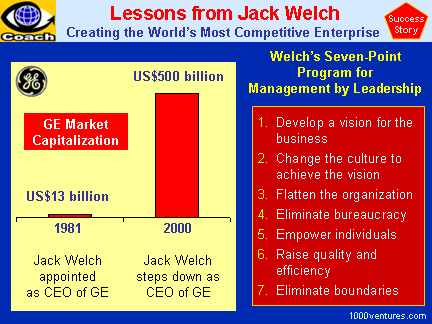
since 1960. Having taken GE with a market capitalization of about $12
billion, Jack Welch turned it into one of the largest and most admired
companies in the world, with a market value of about $500 billion, when he
stepped down as its CEO 20 years later, in 2000. Although Jack Welch is "the
celebrated
leader
of a global manufacturer often noted for its technological prowess, he has
utilized a very human process to
drive change
through GE's vast organization. Having respect for the individual as a
pivotal force in
organizational change,
Welch created a model of exceptional performance every
corporate leader
can learn from.
The Role of the Leader in the
New Economy
As Jack Welch wrote in a letter to
shareholders: "In the old culture, managers got their power from secret
knowledge: profit margins, market share, and all that... In the
new economy,
the role of the leader is to express a
vision,
get buy-in, and implement it. That calls for open, caring relations with
every employee, and face-to-face communication. People who can't
convincingly articulate a vision won't be successful. But those who can will
become even more open – because success breeds self-confidence."
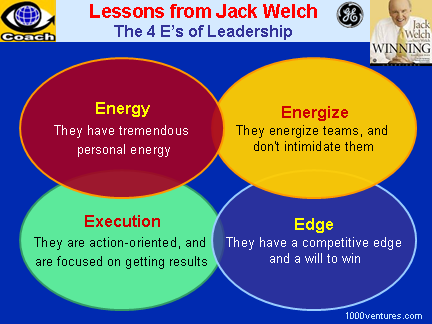
Welch believed that great business leaders have
to:
-
possess large doses of energy, and
-
know how to use that energy to
energize others.
Welch moves from meeting to meeting, conveying
that message – and the host of other ones as well, some of which have become
his trademarks:3
-
Business is simple.
-
Don't make it overly complicated.
-
Face reality.
-
Don't be afraid of change.
-
Fight bureaucracy.
-
Use the brains of your workers.
-
Discover who has the best ideas, and put
those ideas into practice.
Employee
Empowerment
Under Welch's leadership, managers
had wide latitude in building their GE units in
entrepreneurial fashion. Determined to harness the collective power of
GE employees, Jack Welch redefined also relationships between boss and
subordinates. He wrote: "The individual is the fountainhead of
creativity
and
innovation, and we are struggling to get all of our people to accept the
countercultural truth that often the best way to manage people is just to
get out of their way. Only by
releasing the energy and fire of our employees
can we achieve the decisive, continuous productivity advantages that will
give us the freedom to compete and win in any business anywhere on the
globe."
3Ss of Winning
Jack Welch summed up his prescription for winning in three words:
Jack: Straight from the Gut
In his book 'Jack: Straight from the Gut',
Welch is both storyteller and
coach, using
his exceptional career as the backdrop to share his thoughts on what it
takes to be a great leader. Part management text, part page-turner, Jack
shows how the man widely regarded as the finest corporate executive of his
generation built his business and his reputation.
You’ll learn in the executive summary of his
book prepared by
Soundview
that:
-
It’s best to be small, no matter how
big you are. By slashing unneeded bureaucracy and insisting that
GE’s businesses be in the top two positions in their respective fields,
Welch instilled an entrepreneurial spirit and a quick-thinking,
quick-moving approach to competition and constant improvement. It was a
small-company approach to running an enormous, multi-billion-dollar
organization, and it worked marvelously.
-
It’s all about people.
Jack Welch’s passion was making people GE’s core competency, and he saw
to it that the company found and developed great people.
-
Companies must be boundaryless to
unlock their potential. Insular thinking results in stale ideas
and, consequently, stale organizations. By breaking down the walls and
borders that separated various departmental and functional areas at GE,
Welch was able to
unlock the full creativity of his people, propelling the company
forward with fresh, creative approaches to problems.
-
Quality
is nothing without efficiency.
GE’s Six Sigma initiatives
replaced sloganeering quality strategies with ones that brought about
measurable results in increased efficiency, reduced defects and
satisfied customers.
More About
/ From Jack Welch
Characteristics of a Great Corporate Leader
Understanding Strategic Issues
Creating Vision
Simplifying the Strategy
Setting Objectives
Asking Effective Questions
Redesigning
Organization
Creating
Change
Leading by Example
Leading
Transformational Change
Jack Welch Fires an Ineffective Business Architect
Business Innovation
Transforming the Old Management Model
Getting Rid of
Bureaucracy
Turning
Managers into Leaders
People Power
Jack Welch's
Recipe for Winning Employees' Hearts and Minds
Employee
Empowerment
Motivating: Combining "Rewards for the Soul" with "Rewards for the Wallet"
Attitude
Motivation
Build a Star
Team, Not a Team of Stars
Benchmarking
Employee Performance
Harnessing the Power of Diversity
Integrated Diversity
Organizational
Transformation
Building a
Learning Culture
Learning
Organization
Idea
Management
Letting the Best Idea Win
Creativity
Management
Entrepreneurial Organization
Behave Like a Small Company
Customer
Intimacy
Systemic Innovation
Creating a Diversified
Company
The Four E's of Leadership
Venture Strategies
Speed
Simplicity
Winning Worldwide
|