Managing Change:

Organizational Change

Organizational Transformation

Total Systemwide Cultural Transformation of Your Organization

By Vadim Kotelnikov, Founder, Ten3 BUSINESS e-COACH – Innovation Unlimited, 1000ventures.com

 Yes!  You are in the right place!

This site is Ranked Top 5 by Google for

"Organizational Transformation"

out of about 400,000-wide (!!!) competition!

"Change is not a process for the impatient."  

Confucius


Business Environment Ten3 Business e-Coach: why, what, and how 1000ventures.com Business Ecosystem Performance Measurement Knowledge Management Effective Management Shared Values Managerial Leadership Organizational Change Business Design Balancing Your Life and Business Wheels Launching a Crusade

MegaChange: Key Features3

Total Systemwide Cultural Transformation of Your Organization

  • Capability focused: MegaChange is based upon assumptions of human and organizational capabilities rather than limitations.

  • Transformation: MegaChange is not a mere transition, it is cultural transformation of your organization.

  • Systemwide: MegaChange is not piecemeal, it is systemwide

  • Concepts, actions, and tools: MegaChange is produced using and integrated set of concepts, actions, and tools, not just tools without concepts.

  • Empowering: MegaChange affects everyone in the organization. It results in a joint optimization of organizational and individual performance, capability and satisfaction.

  • Cultural: MegaChange results in in new and changed ways of thinking, acting, and cooperating.

  • Theory for practice: MegaChange is not a theory or practice

  • Reformation: MegaChange is not about restructuring or reengineering, it is about reformation. It reforms structural concepts, actions, and tools necessary for creating organizations that achieve extraordinary levels of productivity and satisfaction by engaging human capability rather than denying it.

8-Stage Change Management Process

  1. Establish a sense of urgency

  2. Create the guiding coalition... More

Organizational Fitness Profile (OFP) Road-Mapping

  • OFP road-mapping – to chose and do the right things

  • Corporate management – to do these things well

12 Effective Leadership Roles

Transform Your Business into an Innovative and Creative Culture

  • Empowerment. Ideally, empowerment of employees results in increased initiative, involvement, enthusiasm, innovation and speed, all in support of the company's mission The word empowerment means to authorize, enable, and to permit.  Defining and encouraging empowerment is the job of leadership.  However, traditional leadership in a multi level organisational structure may be fearful of empowering their subordinates in anxiety that ideas and initiatives from 'below' may undermine their authority and ultimately their position in the firm... More

Eliminating the Bureaucracy Problem: 7 Tips

  • Eliminate all staff jobs unless proved to be essential... More

 Discover much more!

Change Management

8-Stage Change Management Process

Corporate Leader

10 Rules for Building a Great Business

Smart Business Architect

Strategies for Leading Breakthroughs

A Leader's Mood: The Dimmer Switch of Performance

Inspirational Leadership: 10 Roles

Sustainable Growth Strategies

Top 7 Principles For Transforming Your Business From Mediocre To Great

Balanced Approach to Business Systems

6Ws of Corporate Growth

3 Strategies of Market Leaders

Winning Organization

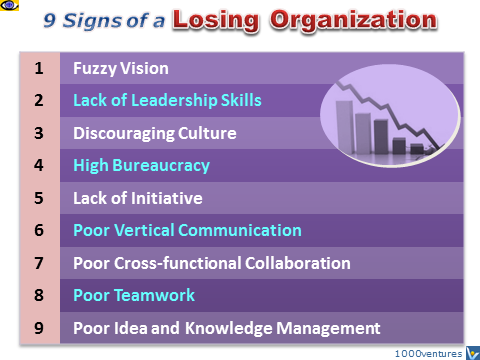
9 Signs of a Losing Organization

Innovation-friendly Organization

How To Transform Your Business Into an Innovative and Creative Culture

Guiding Principles To Liberate Employees from the Fear of Trying New Things

Innovation Management Policies for Large Corporations

7 Tips for Eliminating Bureaucracy

Corporate Culture

Strategies for Building a Growth Culture

5 Strategies for Creating a Culture for Innovation

5 Strategies for Creating a Culture of Questioning

Innovation

Systemic Innovation

Organizing for Innovation: Organizational Models that Support Innovation

  Ten3 Mini-Courses   Presentation:    View    Download

Synergistic Organization  (70 slides)

25 Lessons from Jack Welch  (45 slides)   Demo

Systemic Innovation  (150 slides)

SMART Executive  (225 slides)   ► Demo

3 Strategies of Market Leaders  (125 slides)

Inspiring Culture  (60 slides)

Smart Business Architect  (150 slides)

9 Signs of a Losing Organization

  1. Fuzzy Vision: corporate vision and mission don't inspire people; lack of strategic alignment; people don't know where the organization is going and what it is trying to achieve in the future... More

MegaChange – a New Capability-based Approach


MegaChange3 is a total systemwide cultural transformation of your organization. It means designing and transforming organizations based on assumptions of human capability rather than limitations using the tools of the modern resource-based management model.

Strategies for Leading Breakthroughs

So what separates extraordinary leaders from proponents of the status quo? They break the rules. Except, not in an arbitrary or capricious way. When you look at examples of extraordinary leadership, like the Founding Fathers of the United States or Jack Welch of GE, certain practices or principles become apparent. To start, there is a declaration of what the future will be. There is also a purpose, something to stand for. And finally, there is a clearly articulated commitment... More

8 Common Errors in Organizational Change Efforts

By: John Kotter

  • Neglecting to anchor changes firmly in the corporate culture... More

Entrepreneurial Leadership of Transformational Change

One of the most striking attributes of leaders of successful transformational change efforts is their entrepreneurial spirit and behavior. These individuals think and act like heads of their own businesses and are able to inspire and direct others to act in the same manner.  Entrepreneurial leaders are part visionary, part role model for the new values and behaviors and part crusader. They frequently emerge from lower levels of the organization, from the business, or from other organizations.

 Case in Point  General Electric1

Today, General Electric succeeds in dozens of diverse businesses, and is continuously at the vanguard of change. Some years ago however, in locations throughout GE, local managers were operating in an insulated environment with walls separating them, both horizontally and vertically, from other departments and their workforce. Employee questions, initiatives, and feedback were discouraged.

Determined to harness the collective power of GE employees, create a free flow of ideas, and redefine relationships between boss and subordinates, Jack Welch, CEO, General Electric, created a new corporate culture. It's key elements are:

  • Redesigning the role of the leader in the new economy: creating followers through communicating a vision, and establishing open, caring relations with every employee

  • Creating an open, collaborative workplace where everyone's opinion is welcome

  • Empowering senior executives to run far-flung businesses in entrepreneurial fashion

  • Liberating the workforce; making everybody a participant through improving vertical communication and employee empowerment.

Systems Thinking – Understanding Interactions between Parts


You should master systems thinking if you wish to  succeed in your extremely challenging organizational transformation effort. Systems thinking "focuses on the whole, not the parts, of a complex system. It concentrates on the interfaces and boundaries of components, on their connections and arrangement, on the potential for holistic systems to achieve results that are greater than the sum of the parts. Mastering systems thinking means overcoming the major obstacles to building the process-managed enterprise - for every business process is a whole system."2... More

Ask Searching Questions

Don't ask one or two questions and then rush straight towards a solution. With an incomplete understanding of the problem it is very easy to jump to wrong conclusions.

Ask open-ended questions that elicit a wide rage of answers:

  • 'Why' questions  to discover the roots of the problem

  • 'How' questions to discover different routes to significant improvement

A Leader's Mood: The Dimmer Switch of Performance


Manage the Emotions of Change. Be particularly mindful of how you manage emotions if your organization is undergoing change how you handle emotions during these crucial times can help or hinder the change process. It's a known fact that if the resistance to change is emotional, it is the hardest form of resistance to overcome. As the leader handling a change initiative, don't avoid the emotions that accompany the change process. Set the mood and manage the emotions or they will manage you... More

Cultural Transformation

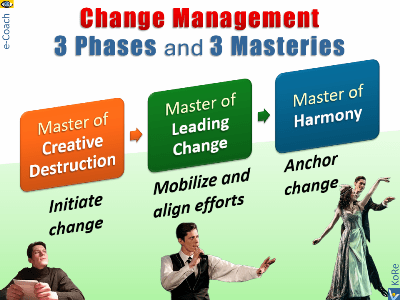
Granted, managing change is important. Competent management is required to keep change efforts on track. But for most organizations, the much bigger challenge is leading change. Only leadership can blast through the many sources of corporate inertia. Only leadership can motivate the actions needed to alter behavior in any significant way. Only leadership can get change to stick, by anchoring it in the very culture of the organization.


Bibliography:

  1. "Extreme Management", Mark Stevens

  2. "Managing Complexity", Robin Wood

  3. "MegaChange", William E. Joyce

Map

Ranked #1

Search

Testimonials

Free Downloads

  Products

SMART Learning

Training

 Contact

We invented Business e-Coaching in 2001

Today, we have customers in 100+ countries!

Our customers:

3M, ABB, Adidas, Alcatel, American Express, Bayer, Boeing, British American Tobacco, BP, Canon, Cisco, Citigroup, Colgate, Corning, Deloitte, Ernst & Young, Fujitsu-Siemens, GE, Goldman Sachs, HP, Hitachi, Huyndai, IBM, Intel, Johnson & Johnson, JP Morgan Chase, KPMG, Lufthansa, Microsoft, Motorola, Nokia, Oracle, Samsung, Shell, Siemens, Sony, United Bank of Switzerland

Ten3 Mini-courses: SMART & FAST sets Full version of Ten3 Business e-Coach Ten3 Business e-Coach (home page)

Ten3 Business e-Coach, version 2008

Inventor, Author & Founder – Vadim Kotelnikov

© Vadim Kotelnikov, GIVIS