|
Learning Organization Defined
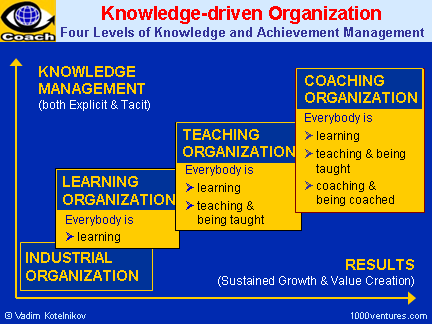
The learning organization is "an organization which
facilitates the
learning of all its members and continuously transforms
itself."8
Leveraging the Power of Knowledge
Learning is the key competency required by any
organization that wants to survive and thrive in the new
knowledge economy. Market champions keep
asking
learning questions, keep learning how to do things
better, and keep spreading that knowledge throughout their organization.
Learning provides the catalyst and the intellectual resource to create a
sustainable competitive advantage.
Knowledge organizations obtain competitive advantage from
continuous learning, both individual and collective. In organizations with a
well established knowledge management
system, learning by the people
within an organization becomes learning by the organization itself. The
changes in people's attitudes are reflected in changes in the formal and
informal rules that govern the organization's behavior.
Knowledge communities organized around the principles of
entrepreneurship
have the best chance at success.
Case in Point
Microsoft
Sharing Knowledge
Bill Gates is clear that high individual
knowledge is not enough in today's dynamic markets.
A company also needs a
high corporate IQ intelligence, knowledge, and expertise of the company -
which hinges on the facility to share information widely and enable staff
members "to build on each other's ideas".
This is partly a matter of storing
the past, partly of exchanging current knowledge. "We read, ask questions,
explore, go to lectures, compare notes and findings... consult experts,
daydream,
brainstorm, formulate and test hypotheses, build models and
simulations, communicate what we're learning, and practice new skills," says
Gates...
More
Case in Point
GE
"Keep learning. Don't be arrogant by assuming
that you know it all, that you have a monopoly on the truth," says
Jack Welch to senior managers. "Always a0ssume that you can learn something from
someone else. Or from another GE business. Or even from a competitor.
Especially from a competitor."
At General Electric (GE) the sum is greater than its parts as
both business and people
diversity is utilized in a most effective way. A
major American enterprise with a diverse group of huge businesses, GE is
steeped in a
learning culture and it is this fact that
makes GE a unique
company.
As
Jack Welch puts it: "What sets GE apart is a
culture that uses
diversity as a limitless source of
learning
opportunities, a storehouse of ideas whose breadth and richness is
unmatched in world business. At the heart of this culture is an
understanding that an organization's ability to learn, and translate that
learning into action rapidly, is the ultimate
competitive business advantage."

Developing Human
Resources Competency in the New Knowledge-driven Economy
Excellent companies recognize that human resources
are their #1 asset.
With the Internet increasingly relied on as a
source of knowledge and with rapid changes in science and technology, the amount
of knowledge is doubling every 7 to
10 years.10 This also hastens
the obsolescence of skills and knowledge. The shelf life of academic degrees has
been estimated to be only one year for computer science, two years for
electrical engineering, and four years for business studies. Training and skills
development must therefore be a continuous process. On average, the training
budget of an organization is about 1% of payroll. Excellent companies, on the
other hand, spend about 4-5% and devote an average of 40-50 training hours per employee per year.
Creating Your Future
Knowledge is most productive when it is shared by all. A learning
organization is "an organization that is continually expanding its capacity
to create its future".1 It is continuously learning new ways of
doing things and also (necessarily) involved in a continuous process of
forgetting old ways of doing things.
Learning Environment
A constructivist learning environment is a
place where people can draw upon resources to make sense out of things and
construct meaningful solutions to problems. It emphasizes the importance of
meaningful, authentic activities that help the learner to construct
understandings and develop skills relevant to
solving problems.
The Toyota Way: 14 Principles
JIT-Style Learning and Training
The best kind of quality oriented
learning (and training) is just-in-time-style learning, that is, learning
that happens on the job, knowledge which is applied immediately as needed,
and learning by doing. The sooner you can apply the material you learned,
the better you will understand it and the longer it will be retained.
Innovative e-learning services
create new opportunities for such on the job
JIT-style learning
and training. In particular, the first-ever
Ten3 Business e-Coach
provides most effective JIT-style e-learning opportunity which is available
free anytime to anybody.

Organization as a Set of Interconnected
Subsystems...
Enhancing Organizational
Learning Capacity through Coaching...
NLP Technology of Achievement: Learning
Principles...
Three Important Features of All
Organizations...
Key Characteristics of High-performance Organizations...
Continuous Corporate Renewal...
Real-Time Business Development...
Learning Bottom-Up...
Systems Thinking...
There is No Failure, only Feedback...
Links Between
Individual
Learning and Collective Learning...
Organizing Knowledge Communities...
Managing Tacit Knowledge...
Managing Knowledge Workers...
Five Learning Disciplines...
Team Members
Learn When They...
Creativity
Management...
Letting the
Best Idea Win...
Case in Point
Dell Inc...
Case in Point
British Petroleum
the Power
of Corporate Learning...
Case in Point
Intel Personal Accountability for Learning...
Case in Point
Toyota...

|