 |
Keep in mind that your opinion
is nothing but your perception;
your expressed opinion is
nothing but a confession of your
character.
~
Vadim
Kotelnikov |
|
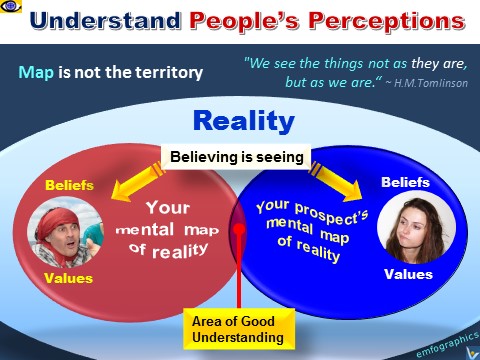
Perceptions are individual maps
of reality – ways in which
individuals perceive the world.
How we generate information about the
world is perceiving.
As H.M. Tomlinson put it, "We
see the things not as they are,
but as we are."
|
|
| |
|
Perceptions Rule
NLP teaches us that
the map is not the
territory;
people respond to
their experience, not to reality itself.
"The bird thinks it is an act of
kindness
to give the fish a lift in the air," said
Tagore.
|
|
|
| |
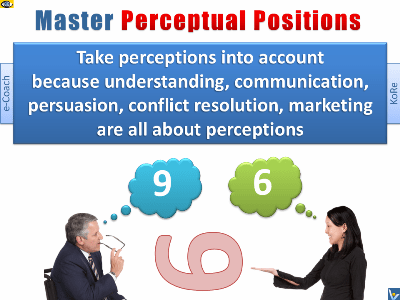
Perceptual differences occur when individuals are exposed to the
same stimuli and perceive them in different ways.
Acknowledge that you are most likely
a prisoner of what you know and what you believe if you want to grow
your
social and
business skills. |
|
 |
| |
|
Be aware of the
lenses of our perceptions that make us see things as we are not as
they are.
|
|
|
 |
|
Business – decision making,
negotiation,
communication, teamwork, motivation, value innovation,
differentiation,
marketing, etc. – is all about perceptions.
The essence of leading, managing and
selling is coming to grips with people's perceptions. |
|
 |
If
you want your message to hit the
target,
make an adjustment to the wind.
~
Vadim
Kotelnikov |
|
In communication, "making an
adjustment to the wind" means
taking into account perceptions
and
expectations of the other
party and adapting a message
accordingly to ensure that it
produces the intended impact.
|
|
|
|
 |
If the servants of the "dark forces"
call you a "villain", then you are on the right path. |
Vladimir
Putin |
| |
Cognitive Dissonance
In the
field of psychology, cognitive dissonance is the perception of contradictory
information. |
|
|
|
|

|
|
|
Selective Perceptions
Most of your judgments result from decisional
shortcuts you use to generate solutions that are good enough most of the
time. Your
→
subconscious
mind
scans your environment and selects what it deems may be important for you to
notice. When you perceive a situation that looks familiar to you, your
past experience causes you to see the event in terms of what you expect...
More
Connecting with Senses
People have three basic methods of perceiving
the world around them:
Individuals have
different preferred ways of thinking and communicating their experiences
– some express themselves in pictures, others talk about how things sound to
them, and others speak about how things feel. If you want to connect with
your target customers, you have to
figure out which sense they
favor...
More
Idea Evaluation: 4x2 Perceptual Positions
→
Smart & Fast
Decision Maker
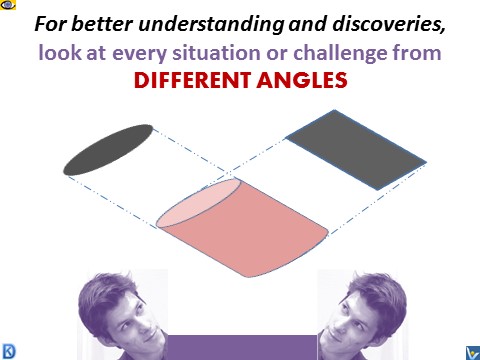
Perceptual positions
can help you gain new understanding through seeing things from different
perspectives...
More
|
|
|
References:
-
"Thinking Outside the Comfort Zone," Jerry Sentell
-
"Selling with NLP," Kerry L. Johnson
-
"Making Better Business Decisions," Steve W. Williams
-
"Driving Customer Equity," Rust, Roland T., Zeithaml,
Valarie A. & Lemon, Katherine E.
-
"A Passion for Excellence: The Leadership Difference," Tom
Peters and Nancy Austin
|
|
|
|