|
Bonus Quick Decision
Making Technique
Toss a Coin |
|
Whenever you're called on to make up your mind,
And you're hampered by not having any,
The simplest way to solve the dilemma you'll find,
Is simply by flipping a penny.
No, not so that chance shall decide the affair,
As you're passively standing there moping.
But as soon as the penny is up in the air,
You'll suddenly know what you are hoping.
Piet Hein
|
|
A
Joke about Fast Evaluation of New Ideas |
|
The Company Director to the Board Chairman: If
any new ideas come up while I am out of the meeting for a brief phone
call, my vote is 'No.'...
More |
|
Selected Techniques for
Fast Decision Making and Idea Evaluation
The ability to
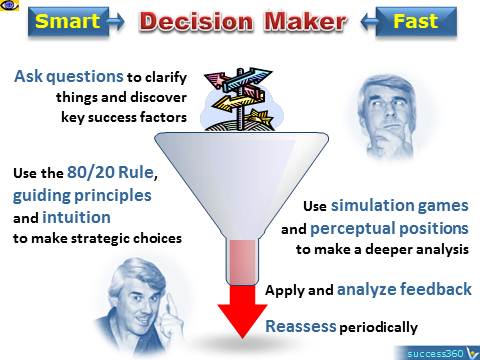
make strategic decisions quickly is vital to your success and survival in
the increasingly competitive marketplace.
At the end of an ideas campaign or the idea
generation phase of the
brainstorming
session, you should also be able choose the ideas you wish to take further
quickly. A good brainstorming session can generate a lot of ideas. If you have
no means of determining which ideas will best meet your needs, it is all too
easy to become overwhelmed by ideas and select none of them, or to choose to
implement one of the most obvious but least effective ideas.
Loose-Tight Leadership
The best approach is to choose the best ideas from
all ideas generated in the brainstorming session and then evaluate them.
Normally, you should determine the evaluation criteria and the evaluators before
you begin your brainstorming session.
Use the three-step approach to choose the most
promising ideas.
Step 1. Quickly reject ideas which you do
not want to follow up. Ideas should be rejected because they do not solve the
problem, are irrelevant, do not
fit your firm's
guiding principles,
are duplicated, or are clearly impossible. Do not reject ideas which are simply
difficult or weird. Such ideas could later prove to be your best ideas.
Step 2. Select the best remaining ideas. The
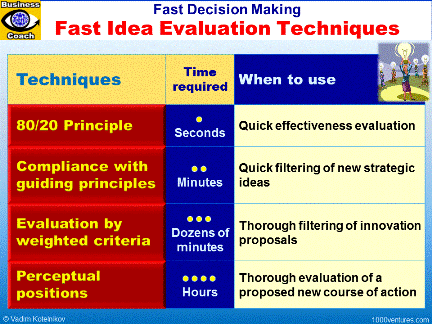
80/20 Principle
can help you to do so: look through your
list of ideas and circle the 20% that will yield 80% of the results you are
looking for.
Do try to include some wild ideas even if you
believe they are near to impossible to implement. Divide ideas into two groups:
(1) the ideas you are likely to implement in the short term and need to evaluate
immediately; (2) the ideas that should be saved for future evaluation and
implementation.
Step 3. Evaluate the most promising ideas.
Have the evaluators rate each idea against each criterion. The following methods
can be used for idea evaluation:
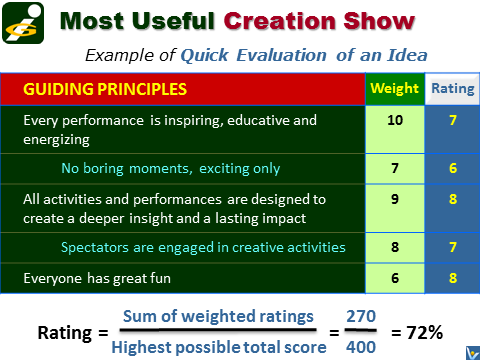
The 5x5 evaluation matrix is the simplest one. You
determine five criteria and compare each idea to each criterion, giving it a
score of 0 to 5 points depending on how well the idea meets the criterion. Add
up the scores and multiply by four and you have a percentile score for each
idea. This facilitates easy comparison of ideas.1
Evaluators should also be able to add remarks to
the evaluation. This will allow them to clarify scores and explain how the idea
could be modified to improve its score.
 |