 |
|
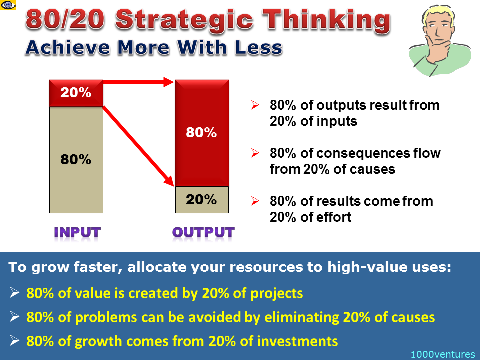
The 80/20
Principle asserts that there is an inbuilt imbalance between
inputs and outputs, causes and consequences, and effort and result.
A minority of causes, inputs or effort usually lead to a majority of
the result, outputs or rewards. A few things are important; most are
not. |
|
| |
Two Ways to Use the 80/20
Principle
80/20 Analysis is
precise, quantitative, requires
investigation, provides facts.
80/20 Thinking is fuzzy,
qualitative, requires thought,
provides
insight.
*
* *
Identify where 20% of efforts
gives 80% of returns if you want
to find ways to grow your
abilities, your
business, and/or your
profits much faster.
"If we did realize the
difference between the vital few
and the trivial many in all
aspects of our lives, and if we
did something about it, we could
multiply anything that we
valued," advises Richard Koch,
the author of The 80/20
Principle book.
|
|
Success Secrets
Resourcefulness
Proactive Futuring
80/20 Principle
80/20 Analysis
80/20 Principle of the Firm
Top 10 Business Uses
80/20 Rule for Customer Success
Higher Profits
Master Key |
|
| |
|
How To Get More from Less: Main
Lessons
80% of your resources are
producing only 20% of value, 20%
of your resources are producing
80% of value – this ratio always
creates arbitrage opportunities
for proactive
entrepreneurs and
innovators. It helps also
evaluate strategic deas quickly.
Focus on exceptional
productivity, rather than raise
average efforts. Make the most
of your
creativity
peaks and your
time.
Only do things you are best at
doing. Delegate or outsource the
rest. Exercise effective control
with the least possible effort
|
|
|
|
|
|
80/20 Thinking
80/20 Thinking, applied to your
daily life, can help you change
behavior and to concentrate on
the most important 20%. Action
resulting from 80/20 Thinking
should lead you to achieve much
more with much less. To engage
in 80/20 Thinking, you must
constantly ask yourself: what is
the 20% that is leading to 80%?
Never assume that you
automatically know what the
answer is, but take some time to
think creatively about it. "For
every ounce of insight generated
quantitatively, there must be
many pounds of insight arrived
at intuitively and
impressionistically," says
Richard Koch.
80/20 Analysis
80/20 Analysis examines the
relationships between two sets
of comparable data and can be
used to change the relationships
it describes...
More
Simple
is Beautiful
To succeed in
managing change
and
transforming your
organization or
business by applying the
80/20 Theory of the Firm, you need to
demonstrate that
simple is beautiful and why. Unless you understand this,
you will never be willing to give up underperforming 80% of your current
business and overheads...
More |
|
| |
|
Achieving Progress by Applying
80/20 Principle
80/20 Principle is inherently
optimistic because it reveals a
state of affairs that is
seriously below what it should
be and shows the direction
towards a better state. To
achieve progress and multiply
your output, you must give power
to the 20% of resources that
really matter in terms of
achievement, and get the
remaining 80% up to a reasonable
level.
According to Richard Koch,
"Progress takes you to a new and
much higher level. But, even at
this level, there will still
typically be an 80/20
distribution of outputs/inputs.
So you can progress again to a
much higher level."
|
|
|
| |
Warning!
Don't apply 80/20 analysis and
strategies in a linear way.
"Like any simple and effective
tool, 80/20 Analysis can be
misunderstood, misapplied and,
instead of being the means to an
unusual insight, serve as the
justification for conventional
thuggery. 80/20 Analysis,
applied inappropriately and in
linear way, can also lead to the
innocent astray – you need
constantly to be vigilant
against false logic," warns
Richard Koch.
|
|
Know Your
Enemies
Personal
Inner Enemies
Enemies of
Thinking
Enemies of
Your Business
Enemies of
Innovation |
|
|
|