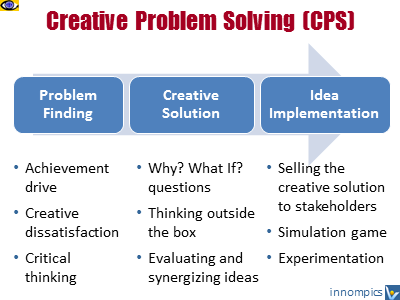
Problem Solving:

Creative Problem Solving

Perfect Brainstorming

A Team-Based Creative Thinking Technique

By Vadim Kotelnikov, Inventor, Author & Founder, Ten3 BUSINESS e-COACH – Innovation Unlimited, 1000ventures.com

 Yes!  You are in the right place!

This site is Ranked #1 by Google for

"Perfect Brainstorming"

out of about 300,000-wide (!!!) competition!

"Creativity is so delicate a flower that praise tends to make it bloom, while discouragement often nips it in the bud. Any of us will put more and better ideas if our efforts are appreciated."

– Alexander Osburn


Brainstorming Creative Problem Solving Idea Management Problem Solving

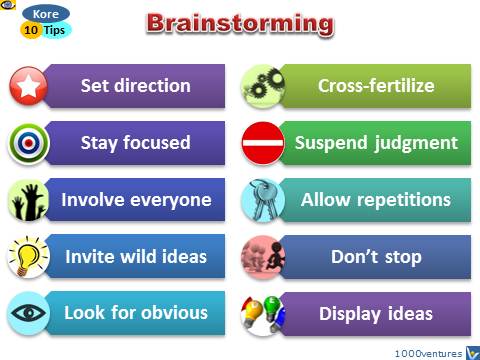
10 Brainstorming Rules

  1. Set directions. Describe the situation and define the problem. Help people to understand the problem to be solved and clarify the objectives.

  2. Involve everyone. Encourage everyone to contribute. Celebrate diversity.

  3. Encourage cross-fertilization. Build on each other. Let others' ideas take you somewhere else. Combine, synergize, and improve upon ideas... More

Trend Spotting Tips

By IDEO – a World Leading Product Design Company

Creating a Sustainable Culture of Innovation

An 8-Step Process

  • Find the Seeds: Invite selected customers/clients to a series of brainstorming sessions... More

BRAINSTORMING: Techniques To Develop Solutions

Keeping Eyes Open for Inspiration

By: IDEO

  • Make brainstorming a religion, practice it every day, weave it into the cultural fabric of your organization... More

The Jazz of Innovation

11 Practice Tips

The Tao of Effective Brainstorming

  1. YANG (active, aggressive side). Divergent thinking phase: attacking the problem with a lot of new, often wild ideas

  2. YIN (passive, accepting side). Convergent thinking phase: analyzing and evaluating the proposed solutions and arriving at the best conclusion.

Three Parts of the Brainstorming Session

  1. Problem identification

  2. Idea generation

  3. Idea selection

Stepping Out Of Your Shoes

By Think Tools

Stepping out of your everyday shoes (and thinking mode) and into the shoes of others may help you surface new insights to a problem. Select a perspective and brainstorm ideas from that perspective for five-minutes before moving on to another perspective.

  • Attitudes: Optimist; Pessimist; Inventor; Researcher; Hip Shooter.

  • Stakeholders: Employer; Shareholder; Employee; Client; Supplier; Competitor.

  • Family: Grandfather; Mother; Small Child... More

How To Run a Brainstorming Session

  • Define the problem. And start brainstorming, "Wouldn't it be great if..."

  • Clarify the objective.

  • Have a brief warm-up session, using a common problem or object

  • Brainstorm as many ideas as possible in a short time-frame. Encourage cross-fertilization. Allow time for silent reflection. When the group seems to have exhausted its ideas, ask them for ten more. Record and display all ideas. Make sure that no critical remarks are made.

  • Ask the group to identify any assumptions they hold.

  • Establish criteria for selecting the feasible ideas.

  • Choose the best idea.

  • Evaluate the idea you chose. Reverse brainstorm to identify the failure risks, or use the Six Thinking Hats tool for a more complete analysis.

 Discover Much More!

Creativity

Unlock Your Creativity

10 Secrets of Creativity

Get Away from Old Ideas

Entrepreneurial Creativity

The Jazz of Innovation

The Jazz of Innovation: 11 Practicing Tips

Keeping Eyes Open for Inspiration

Trend Spotting Tips

10 Brainstorming Rules

Free Ten3 Micro-courses

Smart Innovation

  Ten3 Mini-Courses   Presentation:    View    Download

The Jazz of Innovation  (80 slides)

SMART Innovation  (125 slides)   ► Demo

Why Brainstorming?

The best-known and widely used team-based creative problem solving and creative thinking technique is brainstorming. One major reason why brainstorming is useful is that it helps to free us from 'fixed ideas'.

Brainstorming

How to generate endless ideas in a just few simple steps!  >>> Click here


Understanding Right / Left Brain Functions3

  • The right side of the brain controls your creative, visual, spatial concepts.

  • The left side of the brain controls your logical, mathematical judgmental, analytical activities.

As evaluation and judgment get in the way of creativity, divide your time between these two types of activity. In a brainstorming session, suspend judgment – your left brain activity – while you're coming up with ideas by using your right brain. So, create, create, create. Then switch over and evaluate, evaluate, evaluate, to arrive at the best conclusion.

Innovation Process: Diversion and Conversion of Ideas

The process of innovation is a rhythm of search and selection, analysis and synthesis, cycles of divergent thinking followed by convergence... More

Managing Collective Tacit and Explicit Knowledge

During the new idea generation – divergent or lateral thinking – phase, people create a wealth of possible solutions to a problem. In a well-managed development process, where a group of diverse individuals addresses a common challenge, varying perspectives foster creative abrasion, intellectual conflict between diverse viewpoints producing energy that is channeled into new ideas.1

Brainstorming gathers together a set of experts with diverse skills, preferably including client representatives. Main rules to be followed during the idea generation phase:

  • defer judgments;

  • build on the ideas of others;

  • one conversation at one time;

  • stay focused on the topic;

  • and think outside the box – encourage wild ideas.

All ideas should be recorded and discussed during the selection  –  convergent thinking – phase.

As soon as a sufficient choice of innovative ideas has been generated, a solution – convergence upon acceptable action – needs to be defined and agreed upon. In particular, three types of tacit knowledge – overlapping specific, collective, and guiding – need to be managed.

Managing the Flow of Ideas


The ideas you want to develop during brainstorming session should flow from the strategies you identify to achieve the objectives.3 The clearer your objective is, the better you will be able to devise strategies to achieve it.

The objective is what you want to achieve. Start all objective statements in the infinitive, and make them measurable, e.g. "to generate at least 20 ideas that could help us to solve the problem" (not "to solve the problem").

The strategy is how you propose to achieve the objective. Start all strategy statements with an active verb, e.g. "invite proposals" or "hold a brainstorming session".

An Idea Evaluation and Selection Tool  Six Thinking Hats

The Six Thinking Hats proposal analysis tool invented by Edward de Bono5 is particularly useful for evaluating innovative and provocative ideas. While most of our thinking is adversarial, the six thinking hats technique overcomes these difficulties by forcing everyone to think in parallel. As participants wear each hat – white, red, yellow, black, green, or blue – they all must think a certain way at the same time.

Apply the 80/20 Rule

The 80/20 principle states that 80% of your results come from 20% of your efforts and activities and that the progress means moving resources from low-value to high-value uses. Look through your list of ideas and circle the 20% that will yield 80% of the results you are looking for.

 Case in Point  IDEO

Brainstorming is practically a religion at IDEO, one they practice nearly every day. "Though brainstorms themselves are often playful, brainstorming as a tool – as a skill – is taken quite seriously."4 In a company without many rules, IDEO people have a very firm idea about what constitutes a brainstorm and how it should be organized.

 Case in Point  BIG Project: IT-powered Brainstorming Sessions

Source: European Innovation, September 2006

A Brainstorming Innovation Group (BIG) project supported by the European Regional Development Fund has allowed Technology Enterprise Kent, in England, to develop a new method to support creative thinking in small- and medium-scale enterprises (SMEs) and other groups.

They use computer software during brainstorming sessions to elicit and capture ideas in a more professional and flexible manner than traditional methods.

In each BIG session, participants have laptop computers linked within a wireless network to contribute and develop ideas. Input can be anonymous, if preferred, and as each person types in their suggestions they can see everybody else's contributions popping up on the screen at the same time.

"What tends to happen is that some people send in the first few tentative suggestions, then suddenly you are hit by a flood of ideas that start surging in and feeding off one another," says Peter Parsons, chief executive of Technology Enterprise Kent.

The sessions are led by a professional facilitator, and as each session develops the facilitator can begin sorting the ideas into various themes and making it easier for them to be refined.


The participants can eventually vote on various options, again anonymously, if preferred, allowing the support for different ideas to be assessed.

At the end of a session all of the input and results will have been captured electronically, and can be given or e-mailed to the participants, ready for them to analyze and consider further when they get back to the workplace.

"This is a huge improvement over more traditional systems, where ideas get noted down on flip charts or paper pads, then typed up, often with errors and misunderstandings, and then delivered to participants much later when the burst of creative enthusiasm may have waned," comments Parsons.


Bibliography:

  1. "Knowledge, Groupware, and Internet", Butterworth Heinemann

  2. "The Role of Tacit Knowledge in Group Innovation", Dorothy Leonard and Silvia Sensiper

  3. "101 Ways To Generate Great Ideas", Timothy R.V. Foster

  4. "The Art of Innovation", Tom Kelley with Jonathan Littman

  5. "Six Thinking Hats", Edward de Bono

  6. ConceptDraw MINDMAP: mind map software


Map

Ranked #1

Search

Testimonials

Free Downloads

  Products

SMART Learning

Training

 Contact

We invented Business e-Coaching in 2001

Today, we have customers in 100+ countries!

Our customers:

3M, ABB, Adidas, Alcatel, American Express, Bayer, Boeing, British American Tobacco, BP, Canon, Cisco, Citigroup, Colgate, Corning, Deloitte, Ernst & Young, Fujitsu-Siemens, GE, Goldman Sachs, HP, Hitachi, Huyndai, IBM, Intel, Johnson & Johnson, JP Morgan Chase, KPMG, Lufthansa, Microsoft, Motorola, Nokia, Oracle, Samsung, Shell, Siemens, Sony, United Bank of Switzerland

Ten3 Mini-courses: SMART & FAST sets Full version of Ten3 Business e-Coach Ten3 Business e-Coach (home page)

Ten3 Business e-Coach, version 2008

Inventor, Author & Founder – Vadim Kotelnikov

© Vadim Kotelnikov, GIVIS