|
→
Entrepreneurial Leader:
4 Attributes
→
Business Synergies
Approach to Project Management
|
Specific Leadership
Attributes
Venturepreneurial Attitude and Skills
Ventupreneurial Thinking (strategic creativity, turning challenges to
opportunities, strategic creative problem solving)
Acquisition of competencies and resources for implementation of a radical
project
Assembling and Leading a Venturepreneurial Team
Venture Marketing
Leading Up
Managing Expectations of Stakeholders
Radical Project Management:
Specific Competencies
Strengthening the Business Case
Reducing Uncertainties and Risks (entrepreneurial simulation games)
Strategic Experimentation (emerging opportunities, beta-testing)
Strategic Flexibility (dealing with project discontinuities and emerging
opportunities)
Strategic Alliances with providers of complementary parts and processes
Marketing and Selling Radical Innovations
Specific
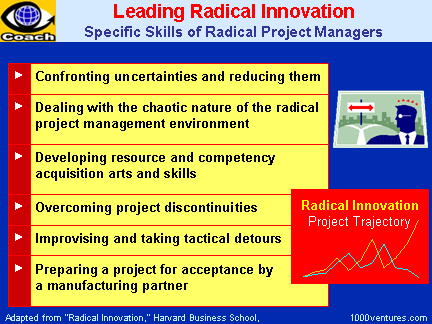
Skills of Radical Project Managers
"The ultimate risk
is not taking a risk." –
James Goldsmith
-
Dealing with the chaotic nature
of the
radical project management environment:
"Without order nothing can exist – without chaos nothing can
evolve."
Radical projects are experimental
as
experimentation
is the key to
discovery
and venture development. The radical project manager
must
balance
formal processes at one extreme with the fluid
creative chaos of
challenges, ideas, opportunities, relationships, interests, and transactions at the other.
→
Freedom To Fail
→
Noble
Failure
-
Overcoming project
discontinuities: The occurrence of unanticipated crises may
force the project to regress to a less mature level. The radical
project manager should work toward establishing both formal and
informal project legitimacy in the eyes of the organization to
counter organizational resistance to
radical innovation.
-
Improvising and
taking tactical detours: The
levels of uncertainties may rise and fall throughout the
project. The project manager must be able to
→
solve problems creatively,
to
take risk, and to
→
lead the team
in adapting and redirecting its focus as necessary to keep the
project moving.
>>>
→
Loose-Tight Leadership
-
Preparing a project for
acceptance by a manufacturing partner – an existing business
unit, a new business unit, or a
spin-off company.
It is difficult and unusual for
radical
innovation projects to reach the level of maturity expected
by most business units before handoff.1 The receiving
unit wants to be confident that:
-
the technology tested on a
pilot scale will work after being scaled up for mass
production
-
the production process have
been designed and tested so that the product can be produced
reliably
-
the product has features and
attributes
that are either
desired in the marketplace
consciously or subconsciously or can be made desirable
through implementation of a specially designed
innovative marketing strategy
-
applications and
customers − enthusiasts, early adopters and pragmatists − are well enough understood so that
marketing, sales and distribution functions can be implemented
successfully
-
projected market share,
capitalization and
revenues can be
achieved.
A "transition team" may be used to
accelerate the project through the final stages of the
maturation process.1
 KoRe 10 Innovative
Thinking Tools
KoRe 10 Innovative
Thinking Tools

KoRe 10 Tools help
innovators approach
creation of
entrepreneurial
strategies and
anticipation of opponents' moves more
systematically.
The KoRe 10 Tools help also
innovation leaders and
radical project managers strengthen and
synergize the
most important
areas of innovation...
More
 GE
Digital X-Ray Project GE
Digital X-Ray Project
The GE Digital X-Ray projetct case study Case is
presented in the form of a
football game
– a revolutionary form of
Ten3 Innovation
Training...
>>> |