|
The Fuzzy Front End
Early Phase of the
Radical Innovation Process
|
|
Rather
than looking for answers,
try to define the critical questions. |
|
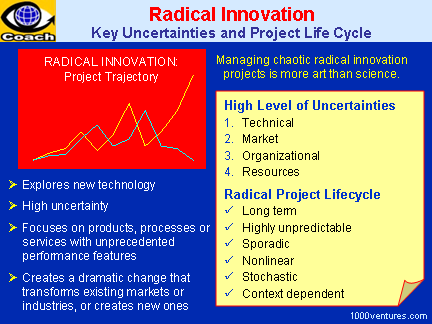
High and
Multidimensional
Uncertainties
that Must Be Resolved |
-
Technical uncertainties
– issues related to completeness and correctness of the
underlying scientific knowledge and the technical specifications
-
Market uncertainties – issues
related to
customer needs and
wants
and
readiness
>>>
-
Organizational uncertainties –
organization
→
resistance that stems from a fundamental conflict between
the mainstream organization and the radical
innovation team
-
Process uncertainties
–
the process is
→
experimental
and
→
non-linear; there are many detours, recycling back through
activities in response to discontinuities and setbacks
>>>
-
Resource uncertainties – project
discontinuities influence the project's funding, staffing, and
management requirements.
>>>
For
radical
projects to mature,
uncertainty must be
→
reduced on all five
dimensions.
>>>
→
Loose-Tight Leadership
→
Freedom to
Fail
→
Noble Failure |
References:
1. "Relentless Growth", Christopher Meyer
2.
"Radical Innovation", Harvard Business School
3.
"Developing Products in Half the Time", D. Reinertson &
P. Smith
4.
"The Art of Innovation",
Tom Kelley
|
The Fuzzy Front End Defined
The early stage of the
radical innovation process is ripe with opportunity, but it is also
devoid of many definitive facts. Due to its
high degree of ambiguity, this
development phase has become known as "the fuzzy front end."3
>>>
 Jokes
about
Unexpected Problems
Jokes
about
Unexpected Problems
Fuzzy Logic
Fuzzy logic is a system of logic that allows
for degrees of uncertainty, rather than depending on absolute truth-values,
and that is used to make human thought processes or imprecise information
accessible to computers.
While the situations that fuzzy logic addresses
are ambiguous, fuzzy logic itself is a very defined methodology. Modern
→
business and technology leaders use the managerial equivalent of fuzzy logic
to address the ambiguity of the fuzzy front end.
The core elements of this approach include...
More
Brainstorming
→
Brainstorming is not just a valuable creative tool at the fuzzy front
end of projects. It's also "a pervasive cultural influence for making sure
that individuals don't waste too much energy spinning their wheels on a
tough
→
problem when the collective wisdom of the team can get them
→ "unstuck"
in less than an hour."4...
More
The Power of Prototyping
"Quick
prototyping is about acting before you've got the answers, about taking
chances, stumbling a little, but then making it right. When you're
creating something
new to the world, you can't look over your shoulder
to see what
→your
competitor are doing; you have to find another source of
inspiration," writes
Tom Kelly4 from
IDEO. "Once you start drawing or
making things, you open up new possibilities of
discovery. Doodling,
drawing, modeling. Sketch ideas and make things, and you're likely to
encourage accidental discoveries. At most fundamental level, what we're
talking about is play, about exploring borders."4...
More
→
Learning SWOT
Questions
 Simulation Games
"InnoBall" and "InnoChess"
Simulation Games
"InnoBall" and "InnoChess"
Innovation Football (Innoball)
and
Innovation Chess (Innochess) are breakthrough
business games that help
disruptive innopreneurs achieve great success in the real world.
These simulation games develop as a sequence of
assumed moves by innovators and their opponents. They help you to:
|


