Business Evolution:

Business Design

Business Model

The Way of Winning the Competition Battle and Creating Economic Value for Your Stakeholders

By Vadim Kotelnikov, Founder, Ten3 BUSINESS e-COACH – Innovation Unlimited, 1000ventures.com

 Yes!  You are in the right place!

This site is Ranked Top 5 by Google for

"Business Model"

out of about 2-million-wide (!!!) competition!

"Great businesses turn on a little pin." 

Business model, Business Models, Business model, Business Models, Business model, Business Models, Business model, Business Models, Business model, Business Models, Business model

Business Model Economic Value Added (EVA) Business Model Economic Value Added Corporate Capabilities Resource-based Model Innovation BUSINESS MODEL: Connecting Resources, Capabilities, and Innovation to Economic Outputs

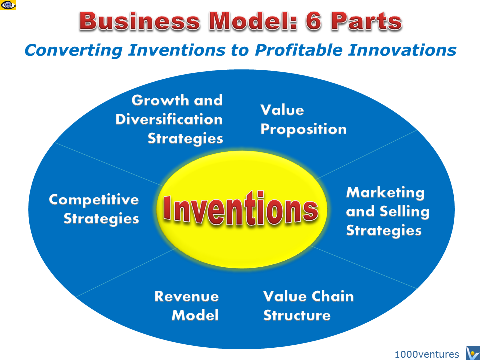
Six Components of the Business Model

According to Henry Chesbrough and Richard S. Rosenbloom3

  1. Value Proposition a description of the customer problem, the solution that addresses the problem, and the value of this solution from the customer's perspective.

  2. Market Segment the group to target, recognizing that different market segments have different needs. Sometimes the potential of an innovation is unlocked only when a different market segment is targeted.

  3. Value Chain Structure the firm's position and activities in the value chain and how the firm will capture part of the value that it creates in the chain.

  4. Revenue Generation and Margins how revenue is generated (sales, leasing, subscription, support, etc.), the cost structure, and target profit margins.

  5. Position in the Value Network identification of competitors, complementors, and any network effects that can be utilized to deliver more value to the customer.

  6. Competitive Strategy how the company will attempt to develop a sustainable competitive advantage and use it to improve the enterprise's competitive position in the market.

Business ModelInnovationCustomer Value PropositionCompetitive StrategiesValue Chain ManagementMarket SegmentationGrowth StrategiesRevenue ModelEconomic Value AddedInnovation BUSINESS MODELS: 6 Components of a Business Model

Business Model vs. Revenue Model

  1. A Business Model is the umbrella term used to describe the method – position in the value chain, customer selection, products, pricing – of doing business.

  2. A Revenue Model lays-out the process by which a company actually makes money by specifying how it is going to charge for the services provided.

 Discover much more!

Entrepreneur

Entrepreneurial Creativity

Corporate Leader

Smart Business Architect

Top 7 Principles for Transforming Your Business from Mediocre to Great

Look at Your Company from Outside In As Well As Inside Out

Business Model

New Business Models

10 Forces Behind New Business Models

Sustainable Growth Strategies

Balanced Approach to Business Systems

6Ws of Corporate Growth

Sustainable Competitive Advantage

Winning and Retaining Customers

3 Strategies of Market Leaders

Innovation

Systemic Innovation

Ten3 Global Business Learning Report

Entrepreneurship     Business Development

Free Ten3 Micro-courses

Business Success 360

6Ws of Corporate Growth

Smart Innovation

  Ten3 Mini-Courses   Presentation:    View    Download

New Business Models  (40 slides)

Venturepreneur  (100 slides)

3 Strategies of Market Leaders  (125 slides)

Smart Business Architect  (150 slides)

What is Business Model?


Business model converts innovation to economic value for the business. The business model spells-out how a company makes money by specifying where it is positioned in the value chain. It draws on a multitude on business subjects including entrepreneurship, strategy, economics, finance, operations, and marketing.

Simply put, a business model describes how a business positions itself within the value chain of its industry and how it intends to sustain itself, that is to generate revenue.

In the most basic sense, a business model is the method of doing business by which a company can sustain itself – that is, generate revenue.

Customer Focus

Exceptional customer service results in greater customer retention, which in turn results in higher profitability. Sadly, mature companies often forget or forsake the thing that made them successful in the first place: a customer-centric business model. They lose focus on the customer and start focusing on the bottom line and quarterly results. They look for ways to cut costs or increase revenues, often at the expense of the customer. They forget that satisfying customer needs and continuous value innovation is the only path to sustainable growth. This creates opportunities for new, smaller companies to emulate and improve upon what made their bigger competitors successful in the first place and steal their customers.

Competitive Strategies


New Business Model

"The classic business model that has dictated the structure of every company from General Motors to Microsoft is so at odds with contemporary economic currents that is must and will disappear."2 Traditional corporations are overstructured, overcontrolled, and overmanaged, but underled. Top managers should rather concentrate on that handful of real managerial leadership tasks that will bring success in the future. Thus, a new business model is emerging, a model where "most of key missions of the organization are distributed to the myriad individual pieces and unity comes from the vigor of people and the free flow of knowledge, not a burdensome central headquarters."2... More

Strategic Innovation

Strategic Innovation is the creation of growth strategies, new product categories, services or business models that change the game and generate significant new value for customers and the corporation... More

The Growing Role of the Business Architect

In today's knowledge- and innovation-driven complex economy, business architects are in growing demand.  They are cross-functionally excellent people who can tie several silos of business development expertise together, create synergies, design winning business model and a balanced business system and then lead people who will put their plans into action... More

Extended Enterprise

The term "extended enterprise" represents a new concept that a company is made up not just of its employees, its board members, and executives, but also its business partners, its suppliers, and its customers. The notion of extended enterprise includes many different arrangements such as virtual integration, outsourcing, distribution agreements, collaborative marketing, R&D program partnerships, alliances, joint ventures, preferred suppliers, and customer partnership... More

Business Model for Radical Innovation Projects

Business model is a broad-stroke picture of how an innovative concept will create economic value for the ultimate user, for the firm and its shareholders and partners. It considers the infrastructure required to move the product/service to the market in a manner that is both easy and convenient for customers and profitable for the firm.


 Discover much more in the FULL VERSION of e-Coach

Business Model Questions...

Business Model vs. Enterprise Strategy: Three Differences...

Dynamic Business Models...

Innovative Revenue Models...

Protecting Your Business Model...

Rethinking the Concept of the Corporation...

Experimental Business Model: Learning to Predict...

Business Model for Radical Innovation Projects...

Spin-Out Model...

Building Cross-functional Synergies...

 Case in Point  Xerox Corporation...

 Case in Point  Dell Computer Corporation...

 Case in Point  Thermo Electron...

 Case in Point  Bunsha...

 Case in Point  Amazon.com...

 Case in Point  Half.com...


References:

  1. "Radical Innovation", Harvard Business School

  2. "The Centerless Corporation", by Bruce A.Pasternack and Albert. J. Viscio

  3. "Business Models on the Web," Prof. Michael Rappa

  4. "New Business Models,: Vadim Kotelnikov

  5. "Venturepreneur," Vadim Kotelnikov

  6. "SMART Executive," Vadim Kotelnikov

  7. "25 Lessons from Jack Welch," Vadim Kotelnikov

  8. "SMART Business Architect," Vadim Kotelnikov

  9. "Sustainable Competitive Advantage," Vadim Kotelnikov

  10. "Strategies of Market Leaders," Vadim Kotelnikov

  11. "6Ws of Corporate Growth," Vadim Kotelnikov

  12. "Systemic Innovation," Vadim Kotelnikov


Map

Ranked #1

Search

Testimonials

Free Downloads

  Products

SMART Learning

Training

 Contact

We invented Business e-Coaching in 2001

Today, we have customers in 100+ countries!

Our customers:

3M, ABB, Adidas, Alcatel, American Express, Bayer, Boeing, British American Tobacco, BP, Canon, Cisco, Citigroup, Colgate, Corning, Deloitte, Ernst & Young, Fujitsu-Siemens, GE, Goldman Sachs, HP, Hitachi, Huyndai, IBM, Intel, Johnson & Johnson, JP Morgan Chase, KPMG, Lufthansa, Microsoft, Motorola, Nokia, Oracle, Samsung, Shell, Siemens, Sony, United Bank of Switzerland

Ten3 Mini-courses: SMART & FAST sets Full version of Ten3 Business e-Coach Ten3 Business e-Coach (home page)

Ten3 Business e-Coach, version 2008

Inventor, Author & Founder – Vadim Kotelnikov

© Vadim Kotelnikov, GIVIS