Planning for an
Extended Enterprise?
IFEAD in their article "Enterprise
Architecture Methods, Tools, Framework, Approach" advises, that in a world populated by value creating and
value exchanging entities, often the decision will come down to owning one
of three fundamental
→
Value Propositions. You will either be able to own the
customer, own the content that the customer seeks to acquire, or own the
infrastructure that allows the content to be produced or the value to be
exchanged. Each has a different
→
Business Model. Each
exploits a unique core
competence. Each employs a different means of generating economic
returns.
However, in the connected economy, attempting to own all of them
simultaneously will increasingly become a game of diminishing returns. When
the network allows competitors to fill the gaps in their offerings at no
additional cost, owning all of these
→
Competencies only increases risk
without necessarily increasing returns.
|
Guiding Principles
for
Designing an Extended Enterprise
Source: IDC |
|
❶ Carefully consider these
Guiding Principles and
augment as necessary with organization unique requirements...
More |
|
|
What Is Extended Enterprise?
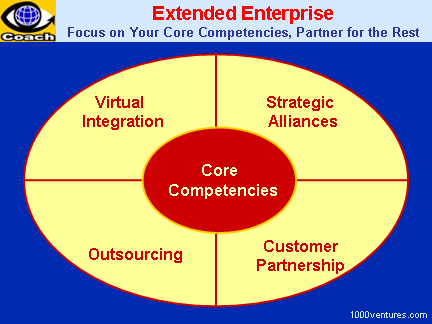
The term "extended enterprise" represents a new
concept that a company is made up not just of its employees, its board
members, and executives, but also its
business partners, its
suppliers, and
its
customers.
The notion of
extended enterprise includes many different arrangements such as
virtual integration,
outsourcing, distribution agreements, collaborative
marketing, R&D program partnerships,
alliances, joint ventures, preferred
suppliers, and
customer
partnership.
Why Extended Enterprise?
Previously
organizations have been thought of as linear entities, each with a linear
value chain that consisted of all the
activities required to design,
market,
sell,
produce, deliver and support products and services. Suppliers and
customers
were thought to be "outside" the organization's domain. And the organization
was depicted as a hierarchy of reporting relationships, primarily
functionally aligned. Such depiction implied a command and control approach
to actions, decision-making and information.
The new economy,
with high-tech companies rapidly evolving and "old economy" enterprises
embracing new
ideas, brought tangible reality and urgency to new
organizational forms.
→
Radical Improvement:
Kore 10 Tips
With
globalization of markets,
productivity pressures, scarce resources,
intensifying competition, blurred industry boundaries and rapid technology
change, new relationships and structures have emerged in all sectors of the
economy.
→
Surprise To Win:
3 Strategies

Modern
organizations create new ways of delivering
value to customers,
new approaches to
collaborating with suppliers along with critical thinking about
organizational structure and purpose.
|
Co-evolving With Customers
and Suppliers
In the new world of
business ecosystems, you must learn
how to get other players, especially your customers and suppliers, to
co-evolve with your
vision
of the future. To be able to do so, you must let go of centralized control,
establish an
adaptive flat organization, and
empower your employees and
business units.
The Role of
Information Technology
→
IT Leader:
New Roles of a CIO
According to Jan Duffy and Mary Tod, IDC, the
authors of the article "The Extended Enterprise: Eliminating the Barriers",
the extended enterprise can only be successful
if all of the component groups and individuals have the information they
need in order to do business effectively.
Extended enterprise applications,
or applications that span company boundaries, include a web of relationships
between a company and its employees, managers, partners, customers,
suppliers, and markets.
Technology
plays a strategic role in the extended enterprise – in some cases driving
the opportunity for
→
Change and in others facilitating collaborative
relationships and inter-organizational operation.
IT enables the openness, immediacy, information sharing, flexibility and
adaptability that the extended enterprise demands. Information technology
also enables customer responsiveness,
speedy decision making, superb inventory control and greater visibility
across the extended organization for demand planning.
The IT vendor community
is ideally positioned to assist with
technology strategy and deployment for
the extended enterprise.
The extended enterprise is an intricate,
interconnected network of information, and you need true enterprise-strength
solutions to tie all these together.
→
The Tree of
Business Success
|

