|
|
10 Key
Features of Partnerships |
-
The voluntary
nature
-
Common interest
-
Synergy-
The mutual dependency
-
Explicit commitment
or agreement
-
Working together
-
Complementary support
-
Shared competencies and
resources
-
Effective communication.
-
Respect and
trust...
More
|
|
IDEO's Innovation
Practice Tips |
|
|
|
12 Tips for Global
Business Travelers |
|
|
|
Negotiating
Negotiation is the game of life and
business, the lifeblood of
relationships, and a
positive way of structuring the communication process. Whenever you
attempt to reconcile differences, resolve disputes,
manage conflict,
influence others,
establish or improve relationships you are negotiating...
More
Joint Ventures
Joint ventures involve sharing the
risks and rewards in an enterprise or project co-owned and operated for
mutual benefit by two or more business partners. There are good business and
accounting reasons to create joint venture with a company that has
complementary resources, skills or assets, such as distribution channels,
technology, or finance...
More
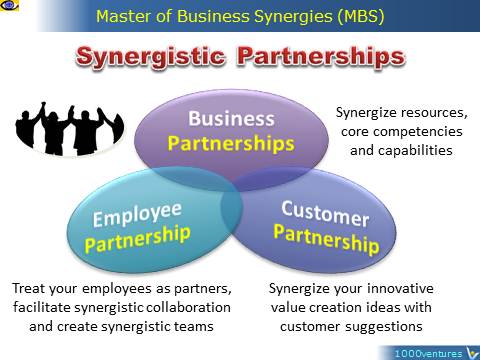
New Employer-Employee Partnership
Today,
people are your firm's most precious and underutilized resource. They
are your firm's repository of
knowledge and they are central to
your company's competitive advantage.
Well
coached,
and highly
motivated
people are critical to the development and execution of strategies,
especially in today's
faster-paced, more perplexing world, where top management alone can no
longer assure your firm's competitiveness. A successful people partnership
is a coherent set of people systems and processes that reflect the
business environment, the
enterprise strategy, and
organizational values. Each one will be unique to an organization and
its employees, but there are some key principles
that are common to all the companies that are exploring the New People
Partnerships...
More
Customer Partnership
"Customer partnership is a shared journey to
create a future for both parties that is better than either could have
developed alone."3
The customer is the foundation of your organization's success. In
today's turbulent times of rapid and chaotic change, "no force is more
grounding and stabilizing than a partnership with customers."3
Creating a partnership with customers will help your organizations maintain
the focus you need to make good decisions and harness the power and
commitment you need to weather volatile times. Customer partnership is more
than "putting customers first", or finding mutually satisfactory
solutions to shared problems, or a dedication to excellence in every
sale or service encounter. It also requires commitment to forging long-term
relationships that create synergies of knowledge, security, and adaptability
for both parties...
More
Extended Enterprise: Virtual Integration
Through virtual integration, the walls
between enterprises crumble. Companies stop being self-contained
business units that produce products or services, and become
integral elements in a larger system. In the new world of virtual
integration, no matter who signs the check, all the people are
working together for a common cause. Vertical integration performs,
virtual integration innovates...
More
Business Process
Outsourcing (BPO)
Although the quest for cost
savings inspired initial forays into offshore outsourcing, companies are now
using offshore delivery to achieve significant improvements in business
performance - transforming outsourcing from a tactical and technical point
solution to a long-term business strategy for creating and defending
competitive advantage. The
decision makers are looking to leverage global sourcing to gain long-term
process optimization, business-oriented measurements, and enhanced control
over IT assets and activities.8...
More
Success
Strategies for Business Partnerships...
Two Primary Approaches to Cooperative
Strategies...
Extended Enterprise: Virtual Integration...
Defining Your Core Competencies...
Joint Venture with
Competitors...
Eight Conditions for Trust
Between Organizations...
Lessons
from Successful Partnerships...
Mutual Creativity...
Mergers and Acquisitions...
Leveraging Diversity...
Strategies for Building Trust Between Partners...
Case in Point
Joint Development by British Petroleum and Schlumberger
Case in Point
Partnering for Auxiliary Capabilities
in Silicon Valley
Case in Point
Cross-Sector Partnership Postgraduate
Certificate...
Case in Point
Progroup's Various Sources of Knowledge...
Case in Point
Joint Engineering Design by Ford and ABB...
|