|
|
| |
What Is
Strategic Alliance
A strategic alliance is
when two or more organisations
join together and
form a loose partnership to help each other to perform
better and achieve shared objectives.
|
Business Alliances
In business, firms form
strategic alliances to help each other make extra
profits.
The businesses, usually,
are not in direct competition, but have similar products or services that
are directed toward the same target audience.
|
 |
According to Jordan D. Lewis, the author of Trusted
Partners, alliance means "cooperation between groups
that produces better results that can be gained from a
transaction.
Because competitive markets keep improving what you can
get from transactions, an alliance must stay ahead of
the market by making continuous advances." |
| |
Benefits
of
Strategic Alliance
In the
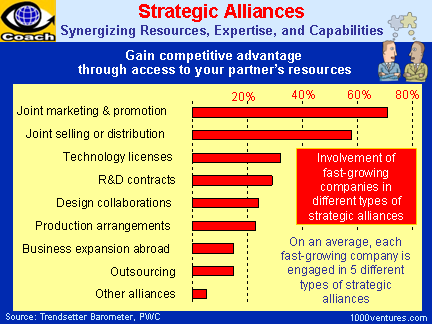
new economy, strategic alliances enable
business to gain
competitive advantage through access to a partner's resources, including markets, technologies,
capital and people.
Teaming up with others
adds complementary
resources and capabilities, enabling participants to grow and expand
more quickly and efficiently. Especially fast-growing companies rely heavily
on alliances to extend their technical and operational resources. In the
process, they save time and boost productivity by not having to develop
their own, from scratch. They are thus freed to concentrate on
innovation and their core business.
Many
fast-growth technology companies use strategic alliances to benefit from
more-established channels of distribution, marketing, or
brand reputation
of bigger, better-known players. However, more-traditional businesses tend
to enter alliances for reasons such as geographic expansion, cost reduction,
manufacturing, and other
supply-chain
synergies.
As global markets open up and competition grows, midsize companies need to
be increasingly
creative about how and with whom they align themselves to go to the
market. |
| |
Consider
Both Pros and Cons
Strategic alliances can
allow your business to meet its objectives, while maintaining the
flexibility to adapt quickly by switching partners, as appropriate.
However, such a
partnership may be too informal if your
corporate strategy requires the long-term certainty of a
joint venture,
merger or
acquisition. In this case, if
your success depends upon a strategic
partner's continued cooperation with your business − and not
your
competitor's business − a strategic alliance might be a trial phase before
committing to such an arrangement. |
| |
Forms of
Strategic Alliances
Strategic alliances can be structured
in various ways,
depending on their purpose. Nonequity strategic alliances, equity strategic
alliances, and joint
ventures
are the three basic types of strategic alliances.
Direct cooperation,
the most common form.
Joint ventures,
where partners create a separate unit they own and control
together.
Minority investments, in
particular
corporate venture investing in young rapidly growing firms. |
| |
Functioning as an Alliance
"A good neighbour is a fellow
who smiles at you over the back fence but doesn't climb over it."
~ Arthur Bear
Alliance is defined by its
synergistic outcome – results must exceed the sum or the parts. This
definition implies needed behavior. "For superior results you can't simply
call each other partners. You must
function as
partners.
Alliances go beyond doing things between firms that become transactions
afterwards – like licensing, co-locating resources, starting to
outsource, or trading a
lower price for a longer term. Such tactics may be involved in alliances;
alone they produce one-time gain. In an alliance, continued
joint creativity leads to regular improvement, outperforming what any
single change can do," says Jordan D. Lewis, the author of Trusted Partners. |
|
|
|
 Toshiba Toshiba
Toshiba’s approach is to develop strategic alliances with different partners
for different
technologies because a single company cannot dominate any technology or
business by itself...
More
Planning for a Successful Alliance
Before entering into a
strategic alliance, enough thought is to be placed behind the structure of
the relationship and the details of how it will be managed. Consider the
following in your planning process:
-
define expected outcomes
from the relationship for all the parties in the strategic alliance
-
define and document the
elements provided by each party, and the benefits a successful alliance
brings to each
-
identify the results that
will cause the alliance to be most beneficial for your business and define
the structure and operating issues that need to be addressed to achieve
these results
-
protect your company's
intellectual
property rights through
legal agreements and restrictions when transferring proprietary
information.
-
define the basics of how
you will operate
-
be certain that the
company cultures
are compatible, and the parties can operate with an acceptable level of
trust.
The
Seven Dimensions of Strategic Innovation
The
Strategic Innovation framework weaves together seven dimensions to
produce a range of outcomes that drive growth.
Core Technologies and
Competencies is the set of
internal capabilities, organizational competencies and assets that could
potentially be leveraged to deliver
value to customers, including technologies,
intellectual
property,
brand
equity and strategic relationships...
More
BP Partners
with Schlumberger To Develop a New Tool
British Petroleum wished to measure the effectiveness of their
horizontal well drilling processes, but there was no available device to do
so. BP pooled their intellectual and financial resources with Schlumberger,
the oil field services company, to build such a tool. The result was that BP
got a tool that has taught them a lot about making horizontal wells even
more effective, and Schlumberger got a new business...
More
Partnership Between TraveLinx and ICit
ICit America and TraveLinx, Canada have
entered into a cross-marketing and supplier agreement to deliver Travelinx
travel and tourism content as well as a reservations and ticketing engine to
TeleCenter installations in hospitality and retail locations. In addition,
TraveLinx deploys TeleCenter solutions in retail locations where destination
marketing and transactions are complimentary to the retailer's products and
customers...
More |
References:
-
Trusted Partners, Jordan D. Lewis
-
Strategic Management: Competitiveness and Globalization, Edition 4,
Thomson Learning
-
Strategis, Canada's Business and Consumer Site
-
Mastering Alliance Strategy: A Comprehensive Guide to Design, Management,
and Organization, James D. Bamford, Benjamin Gomes-Casseres, Michael
S. Robinson
|