|
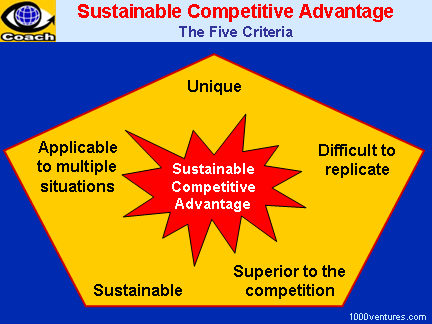
Five Criteria of Sustainable Competitive Advantage |
-
Unique
-
Difficult to replicate
-
Superior to competition
-
Sustainable
-
Applicable to multiple situations...
More
 |
|
Three Parts of
Competitive Advantage1 |
-
Basic
Competitive Advantage (BCA)
- your entry ticket to the global hypercompetition game; implies a
product/service with internationally competitive cost, quality, and
after-sale service
-
Revealed Competitive Advantage (RCA) - reflected by your
market share
-
Sustainable Competitive Advantage (SCA) - allows the
maintenance and improvement of the enterprise's competitive position
in the market
|
|
Creating Competitive
Disruption
7 Strategies |
|
|
|
The Art of War:
Planning an Attack
Excerpts from
the
The Art of War,
Sun Tzu
|
-
You must move as quickly as the wind.
-
The value of time, that is of being a
little ahead of your opponent, often provides greater advantage than
superior numbers or greater resources...
More
|
|
The
GE Leadership Effectiveness Survey (LES) |
-
Understands and uses
speed as a
competitive advantage...
More
 |
|
Transforming Your
Business From Mediocre To Great
Top 7 Principles |
-
Always Seek the
Edge.
In 1954, Roger
Bannister did the seemingly "impossible" and ran the first 4
minute mile. When asked how he did it, he said "It's the ability
to take more out of yourself than you've got.'" How can you
"take more out of yourself than you've got" to achieve the
seemingly impossible in your business?...
More
Smart Business Architect
|
|
|
What is
Sustainable Competitive Advantage?
Sustainable competitive
advantage is the focal point of your
corporate strategy.
It allows the maintenance and improvement of your enterprise's
competitive position in the market.
It is an advantage that
enables business to survive against its competition over a long
period of time.
Todays' Era of
Hypercompetition
Hypercompetition is a key feature of the
new economy. New customers want
it quicker, cheaper, and they want it their way.
The fundamental quantitative and qualitative
shift in competition requires
organizational change on an
unprecedented scale. Today, your sustainable competitive advantage should be
built upon your
corporate capabilities
and must constantly be reinvented.
Distinctive Capabilities
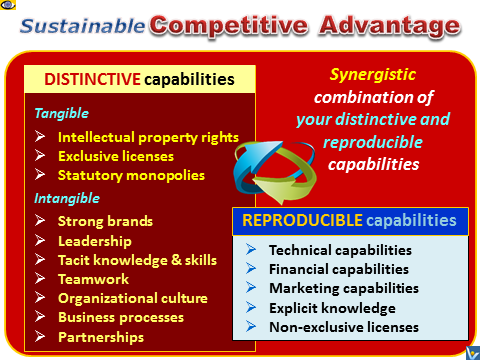
Distinctive capabilities are the basis of
your competitive advantage. According to the new
resource-based view
of the company, sustainable competitive advantage is achieved by
continuously developing existing and creating new resources and
capabilities in response to rapidly changing market conditions.
Among these resources and capabilities,
in the new economy,
knowledge
represents the most important value-creating asset.
The opportunity for your company to
sustain your competitive advantage is determined by your
capabilities of two kinds – distinctive capabilities and
reproducible capabilities - and their unique combination you create
to achieve
synergy.
Your distinctive capabilities - the characteristics of your company
which cannot be replicated by competitors, or can only be replicated
with great difficulty - are the basis of your sustainable
competitive advantage. Distinctive capabilities can be of many
kinds:
patents, exclusive
licenses, strong brands,
effective leadership,
teamwork,
or tacit knowledge. Reproducible
capabilities are those that can be bought or created by your
competitors and thus by themselves cannot be a source of competitive
advantage...
More
Leadership
Leadership
is the necessary condition for long-term competitiveness. In particular in the
knowledge economy, what is proving
to be most effective is "the emerging style of
values-based leadership, both as
motivation for constant innovation up and down all organization levels and as a
source of unity and coherence across fragmented firm boundaries."4
Harnessing your abilities to
lead
through the power of intellect, will, persistence, and
vision
creates
synergies
that propel successful companies in the quest for, and achievement of,
competitive advantage...
More
Systemic Innovation
Innovation
used to be a linear trajectory from new knowledge to new product. Now
innovation is neither singular nor linear, but
systemic.
It arises from complex interactions between many individuals,
organizations and environmental factors. Firms which are successful in
realizing the full returns from their technologies and innovations are
able to match their technological developments with complementary
expertise in other areas of their business, such as manufacturing,
distribution, human resources, marketing, and customer relationships...
More
Radical
Innovation
Long-term corporate success linked
to the ability to innovate. Although corporate investment in
improvements to existing products and processes does bring growth, it is
new game changing breakthroughs that will launch company into new markets,
enable rapid growth, and create high return on investment....
More
Customers for Life
By:
Brian Tracy
The two most
important words to keep in mind in developing a successful customer base are
Positioning
and
Differentiation.
Differentiation refers to your ability to separate yourself and
your product or service from that of your competitors. And it is
the key to building and maintaining a competitive advantage.
This is the advantage that you and your company have over your
competitors in the same marketplace
– the unique and special benefits that no one else can
give your customer...
More
Corporate Culture as a
Fundamental Competitive Advantage
The strength of your
organizational culture
is one of the most fundamental competitive advantages. If you can build and
preserve an
innovation-adept culture, a
culture of commitment, one where employees passionately pursue your
organization's
cause
and mission, you will be better
positioned for success...
More
Leveraging
Opposite Forces
You can find a strategic competitive advantage
in an organizational and cultural context by seeking to leverage, rather
than diminish, opposite forces. "An important but widely overlooked
principle of
the business success
is that integrating opposites, as
opposed to identifying them as inconsistencies and driving them out,
unleashes power. This is true on both a personal level and on
organizational level as well."2 To be successful in
today's complex, rapidly changing and highly competitive world, you must
embrace and manage critical opposites...
More
Cross-Functional Excellence
Although
innovation is driven by technology, required competence extends beyond
technical know-how. In the
new knowledge economy and
knowledge-based enterprises,
systemic innovative solutions arise from complex interactions between
many individuals, organizations and environmental factors. The boundaries
between products and services fade rapidly too. If you wish to be a
market leader today, you must be able to integrate in a balanced way
different types of know-how that would transform stand-alone technologies,
products and services into a seamless, value-rich solution...
More
Case
in Point
7-Part
Competitive Strategy of Microsoft
Although Bill Gates, Founder of
Microsoft, built his empire on technological products, his business
mastery is even more important than his technical skills, and his competitive
urge is a huge driving force.
The early success of Microsoft was founded on the
company's 7-part competitive strategy...
More
Five Sources of Competitive
Advantage...
Competing: The
Art, Science, and Practice...
Defining Your Core Competences: 3 Main
Characteristics...
People as the Main Source
of Competitive Advantage...
Trust as a Source of Competitive Advantage...
Owning Your Competitive Advantage...
Two Basic Ways to Compete
and Prosper in Any Market...
Three Common Traits of
Marketplace Champions...
Three Primary Sources
of Distinctive Capabilities...
Leveraging the
Power of Knowledge...
The Power of
Connectivity...
Value Innovation...
Inclusive Approach...
Sustainable Business Models...
Sustainable Growth
Strategies...
Barriers to Entry as a Source of Competitive Advantage...
Building
on Your Core Competencies and Accessing Missing Ones...
Dynamic Strategy as a Source of Sustainable Competitive Advantage...
The Role of
Intellectual Property Rights (IPR) and Strategy...
Continuous
Improvement Firm (CIF)...
Enterprise-wide Business Process
Management (EBPM)...
Virtual Integration as a Source of Competitive Advantage...
Creating a
Workforce that Would Provide a Competitive Advantage...
Trust as a Source of Competitive Advantage...
Tacit
Knowledge as a Source of Sustainable Competitive Advantage...
Creative Leadership...
7-S Model
–
Organize Your Company for Competitive Advantage...
Behaving Like a Small
Company...
Moving with Speed - Staying Ahead of Your Competition...
Case
in Point General
Electric (GE)...
Case
in Point
Dell
Computer Corporation...
Case
in Point
Warren
Buffet's Investment Criteria...
Case
in Point
Microsoft's
Concept of Network Externality...
Case
in Point
Amazon.com...
Case
in Point
Toyota...
Case
in Point
Fun4Biz...

|