|
Why Organizational
Innovation and Change?
Success in business doesn't come from feeling
comfortable. In
today's technology-driven world, business
life cycles have accelerated exponentially. The challenge is to keep a step ahead of changing market conditions, new
technologies and human resources issues.
Why Change Fails: 8 Common Errors
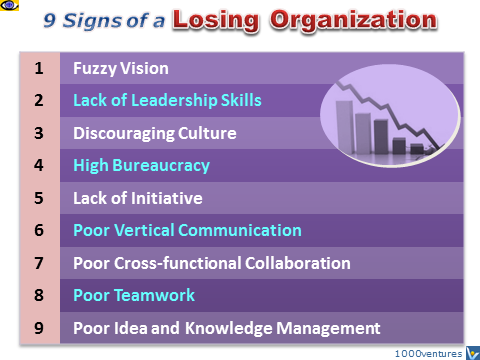
9 Signs of a Losing Organization
-
Discouraging Culture:
no shared
values; lack of trust;
blame culture; focus on problems, not opportunities; diversity is not
celebrated; failures are not tolerated; people lose confidence in their
leaders and systems...
More
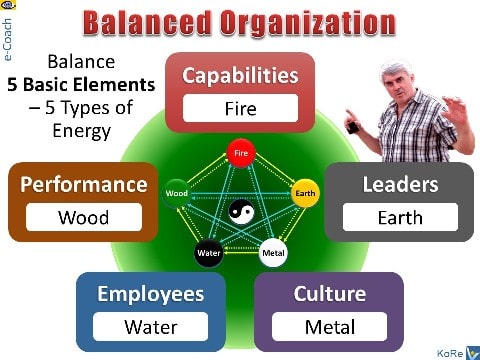
Balanced Organization:
5 Basic Elements
Leadership
(Fire):
What
is
Organizational Innovation?
Organizational innovation reflects the recognition that new
ways of organizing work
in areas such as work-force management (such as
employee empowerment,
new people partnership, or
positive action to involve all employees in order to make work organization
a collective resource for innovation), knowledge
management, value chain management,
customer partnership,
distribution, finance, manufacturing, etc. can improve your competitiveness.
Transform Your Business into an Innovative Culture
Ideally,
empowerment of employees results in increased initiative, involvement,
enthusiasm,
innovation and
speed, all in support of the
company's mission...
More
Inspiring Culture
Do you want to encourage extraordinary
performance from your people? Do you want them to do great things? If yes, then you must create an
inspiring
corporate culture
to
inspire
and
energize them...
More

A Leader's Mood: The Dimmer Switch of
Performance
Manage the Emotions of Change. Be particularly mindful of how you
manage emotions if your organization is
undergoing change
– how you handle emotions during
these crucial times can help or hinder the change process.
It's a known fact
that if the resistance to change is emotional, it is the hardest form of
resistance to overcome. As the leader handling a change initiative, don't
avoid the emotions that accompany the change process. Set the mood and
manage the emotions
– or they will manage you...
More
Strategies for Leading Breakthroughs
So what separates
extraordinary leaders from proponents of the status quo?
They break the rules. Except, not in an arbitrary or
capricious way. When you look at examples of extraordinary
leadership, like the Founding Fathers of the United States or
Jack Welch of
GE, certain practices or principles become apparent. To
start, there is a
declaration of what the future will be. There is also a
purpose, something to stand for. And finally, there is a clearly
articulated commitment...
More

Using the
7-S Model
The Seven-Ss is a framework for analyzing
organizations and their effectiveness. It looks at the seven key elements that make the
organizations successful,
or not: strategy; structure; systems;
style; skills; staff; and shared values.
Consultants at McKinsey & Company developed the 7S model in
the late 1970s to help managers address the difficulties of change. The
model shows that organizational immune systems and the many interconnected
variables involved make change complex, and that an effective change effort
must address many of these issues simultaneously...More
Process-managed Enterprise
New enterprise-wide approach to business process
management (BPM) removes many of the obstacles blocking execution of
management intent. BPM makes it for companies to manage their business
processes with great agility and stay laser focused on the organizational
dimension of business innovation.5...
More
Case in Point Organizational Structures
in Silicon Valley
In contrast to traditional firms where
organizational structure defines the framework within which work occurs,
Silicon Valley firms use the work to define organization's structure. These
structures are best described as flat, flexible, permeable, and fluid.
"Reorganization is a way of life
in the Silicon Valley. Organizations mimic nature's most adaptive organisms
as they constantly reformulate themselves to meet the latest challenge,"
writes
Christopher Meyer.
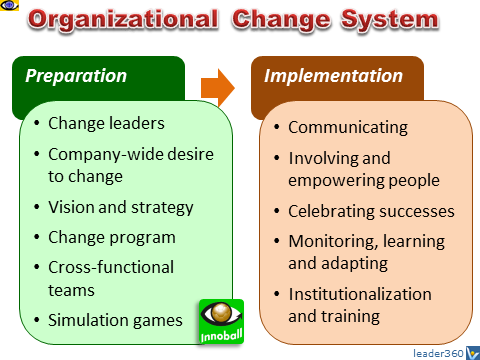
Organizational Change
System...
Adaptive Organization...
The Wheel of
Business
Evolution...
Centreless
Corporation...
Viewing Your Business
with an Outsider's Eyes...
Organizational Fitness Profile (OFP)
Road-Mapping...
MegaChange – an
Organizational Transformation...
Innovation
System...
Ask
Searching Questions...
Behavioral Change...
A Clue to Successful
Change Management...
Internal and External Sources of Changes...
Five Drivers
of Change...
Change
Before You Have To...
Strategic Change Management...
80/20 Thinking...
Create Change for
Improvement and Competitive Advantage...
Creating Change: Steps to Establishing a New Balance...
Methods for Dealing with
Resistance to Change...
Leading
Behavioral Change...
Case Study
General Electric
(GE)...
|