|
|
 |
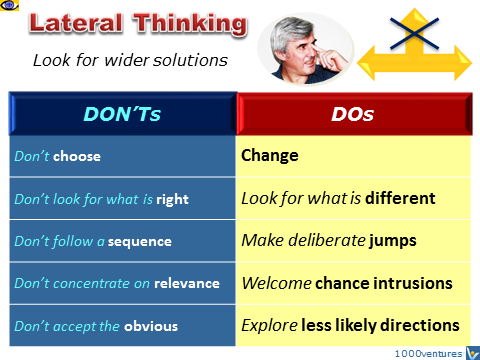
You cannot look in a new direction by
looking harder in the same direction. |
Edward de
Bono |
 |
The mind sharp, but not broad, sticks at every
point but does not move. |
Tagore |
|

| |
Lateral Thinking vs.
Vertical Thinking
Lateral thinking is not a substitute for
vertical thinking. Both are required – they are complementary: lateral
thinking is generative, vertical thinking is selective...
More
|
|
Lateral Thinking Tricks
for
Generating New Ideas |
-
Pick a random unrelated word
(example: window + flying)
-
Suggest the outrageous
(example: no one drives cars anymore)
-
Imagine or ask people to do the opposite
(example:
students teach, teachers take notes; or customers sell, sellers
evaluate the product they are offered)
|
| |
The Power of
Cross-Functional Excellence
If you build broad
cross-functional expertise, no idea will be wasted!
→
Systemic Innovation:
7 Areas
→
IDEO's
6 Innovation Practice Tips
Your
mind can accept only those ideas that have a frame of reference with
your existing knowledge. It rejects everything else. If your knowledge is
functionally focused, you'll be
open to new ideas related to your functional
expertise only and will miss all other learning and innovation
opportunities.
If you develop a broad
cross-functional expertise, no new
idea will be wasted. It will immediately connect with the existing knowledge
and will inspire you, energize you, and encourage your
→
entrepreneurial creativity.
The broader your net, the more fish you catch...
More
|
| |
Ask Searching Questions
Don't ask one or two questions and then rush straight towards a solution.
With an incomplete understanding of the
problem it is very easy to jump to
wrong conclusions.
Ask open-ended questions that elicit a wide rage of answers:
'Why' questions to discover the roots of the problem
'How' questions to discover different routes to significant
improvement
>>>
|
| |
Exercise:
Practicing
Lateral Thinking
Source:
Effective Innovation: How to Stay Ahead of
the Competition, John Adair
The Bicycles and
the Fly
Two boys on bicycles, 20 miles
apart, began racing straight towards each other. The instant they started, a
fly on the handlebar of one bicycle started flying straight towards the
other cyclist. As soon as it reached the other bicycle, it turned and
started back. The fly flew back and forth in this way, from handlebar to
handlebar, until the bicycles met.
If each bicycle had a constant
speed of 10 miles and hour, and the fly flew at a constant speed of 15 miles
an hour, how far did the fly flew? >>>
See
the answer
|
 Encouragement of Lateral Thinking at
GE Work-Out
Encouragement of Lateral Thinking at
GE Work-Out
References:
1.
Lateral Thinking,
Edward de Bono 2. 101 Ways To Generate Great Ideas,
T. R.V. Foster 3. The GE Work-Out,
D. Ulrich, S. Kerr, R. Ashkenas 4.
The Leader's Guide To Lateral Thinking Skills,
P. Sloane
|
|