Thinking:
Asking Effective Questions
Socratic Questions
Enhancing Your Critical Thinking Skills
Socrates (469 – 399 B.C.) was one of the greatest educators who taught by asking questions and thus drawing out answers from his pupils. His pupils include Plato and Aristotle.
Socratic Method is a dialectic method of inquiry, that uses cross-examination of someone's claims and premises in order to reveal out a contradiction or internal inconsistency among them.
Socratic questioning is at the heart of critical thinking – they enhance your critical thinking skills. Socratic questions challenge accuracy and completeness of thinking in a way that acts to move people towards their ultimate goal.
The primary learning goal of Socratic method is to explore the contours of often difficult issues and to learn critical thinking skills.
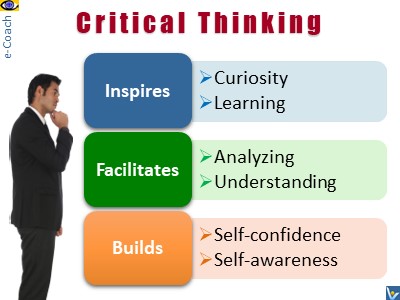
Critical thinking is the process we use to reflect on, access and judge the assumptions underlying our own and others ideas and actions.
In the new era of rapid change, you must constantly expand your horizons beyond simple gathering information and relying on the basic principles.
In business, Socratic method and Socratic questions are often used by lawyers, engineers, innovators, etc.
For instance, when used by lawyers, the Socratic questioning involves asking a series of questions surrounding a central issue, and answering questions of the others involved. The idea is to expose the opponents contradictions in such a way that proves the inquirer's own point.
Socratic Thinking will also help you think critically about everyday issues.
The taxonomy of Socratic questions was created by Richard Paul, author of
Critical Thinking: How to Prepare Students for a Rapidly Changing World
Six Types of Socratic Questions
Types of Questions
Sample Questions
1
Clarification
What do you mean by ____?
Could you put that another way?
Can you give me an example?
2
Probing Assumptions
What are you assuming?
How did you choose those assumptions?
What could we assume instead?
3
Probing Reasons and Evidence
How do you know?
Why do you think that is true?
What would change your mind?
4
Viewpoint and Perspectives
What are you implying by that?
What effect would that have?
What is an alternative?
5
Probing Implications and Consequences
How can we find out?
Why is this issue important?
What generalizations can you make?
6
Questions about Questions
What does that mean?
What was the point of this question?
Why do you think I asked this question?
Discover much more!
Effective Questions
Searching Questions
Create a Culture of Questioning: 5 Strategies
Thinking
Systemic Thinking
Systems Thinking
Effective Thinking Tests
Creativity
Lateral Thinking
Challenging Assumptions
People Skills
Effective Communication
Effective Listening
Active Listening
Persuading People
Become a Master of Persuasion
References: Critical Thinking: How to Prepare Students for a Rapidly Changing World, Richard Paul Thinking Socratically: Critical Thinking About Everyday Issues, Sharon Schwarze and Harvey Lape Aristotle's Dialogue with Socrates, Ronna Burger Philosophy 101 by Socrates: An Introduction to Philosophy Via Plato's Apology, Peter Kreeft Socratic Logic, Peter Kreeft and Trent Dougherty
Critical Thinking: How to Prepare Students for a Rapidly Changing World, Richard Paul
Thinking Socratically: Critical Thinking About Everyday Issues, Sharon Schwarze and Harvey Lape
Aristotle's Dialogue with Socrates, Ronna Burger
Philosophy 101 by Socrates: An Introduction to Philosophy Via Plato's Apology, Peter Kreeft
Socratic Logic, Peter Kreeft and Trent Dougherty
Map
Ranked #1
Search
Glossary
Free Downloads
Products
Testimonials
Training
Contact
We invented Business e-Coaching in 2001
Today, we have customers in 100+ countries!
Our customers:
Ten3 Business e-Coach
Inventor, Author & Founder – Vadim Kotelnikov
© Vadim Kotelnikov, GIVIS