|
Lessons from
Steve Jobs,
Founder of Apple Computer Company
Executive summary
by
Vadim Kotelnikov, Founder,
Ten3 Business e-Coach
–
Inspiration
and
Innovation
Unlimited!
|
"I was worth over
$1,000,000 when I was 23, and over $10,000,000 when I was 24, and over
$100,000,000 when I was 25, and it wasn’t that important because I never did it
for the money."
~
Steve
Jobs
More Steve Jobs Quotes |
|
|
-
Do
what you love to do.
Find your
true passion.
Do what you love to do a make a difference!
The
only way to do great work is to
love
what you do.
-
Be different.
Do you want to spend the rest of your life
selling sugared water or do you want a chance to
change the world?
Think different.
"Better be a
pirate than to join the navy."
-
Do your
best.
Do your best at every job.
No sleep!
You don’t get a chance to do that many things,
and every one should be really excellent. Because this is
your life.
Success
generates more success. So be hungry for it. Hire
good people with passion for excellence.
-
Make
SWOT analysis. As
soon as you join/start
a company, make a list of strengths and weaknesses of
yourself and your company on a piece of paper. Don't
hesitate in throwing bad apples out of the company.
-
Be entrepreneurial. Look
for the next big thing. Find a set of ideas that need to be
quickly and decisively
acted upon
and jump through that window. Sometimes the first step is
the hardest one.
Just take it!
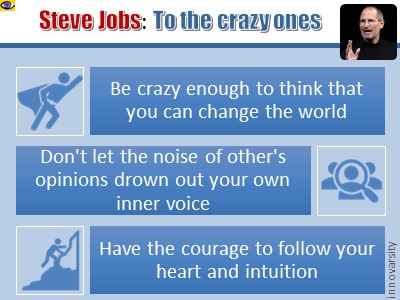
Have
the courage to follow your heart and
intuition.
-
Start
small, think big.
Don't worry about too many things at once. Take a handful of
simple things to begin with, and then progress to more
complex ones. Think about not just tomorrow, but the future.
"I want to put a ding in the universe,” reveal Steve Jobs
his dream.
-
Strive to
become a market leader.
Own and control the primary
technology in everything you do. If there's a better
technology available, use it no matter if anyone else is not
using it.
Be the first, and make it an industry standard.
-
Focus on the outcome.
People judge you by your performance, so
focus on the outcome.
Be a yardstick of quality. Some people aren't used to an
environment where excellence is expected. Advertise. If they
don't know it, they won't buy your product. Pay attention to
design. "We made the buttons on the screen look so
good you'll want to lick them." "Design is not just what it
looks like and feels like. Design is how it works."
-
Ask
for
feedback.
Ask for
feedback
from people with
diverse backgrounds.
Each one will tell you one useful thing. If you're at the
top of the chain, sometimes people won't give you honest
feedback
because they're afraid. In this case, disguise yourself, or
get feedback from other sources. Focus on those who will use
your product –
listen to your customers
first.
-
Innovate.
Innovation
distinguishes a leader from a follower. Delegate, let
other
top executives
do 50% of your routine work
to be able to spend 50% your time on the new stuff.
Say no to 1,000 things
to make sure you don't get on the wrong track or try to do
too much. Concentrate on really important creations and
radical innovation. Hire people who want to make the
best things in the world. You need a very
product-oriented
culture, even in a
technology
company. Lots of companies have tons of great engineers and
smart people. But ultimately, there needs to be some
gravitational force that pulls it all together.
-
Learn from failures.
Sometimes
when you innovate,
you
make mistakes. It is
best to admit them quickly, and get on with improving your
other
innovations.
-
Learn continually.
There's always "one more thing" to learn!
Cross-pollinate ideas
with others both within and outside your company.
Learn from customers, competitors
and
partners. If you partner with someone whom you don't
like, learn to like them – praise them and benefit from
them. Learn to criticize your enemies openly, but honestly.
|
|