Idea Management:

Creativity

Thinking Outside the Box

Moving Out of Your Comfort Zone to Find Innovative Solutions


"Only the hand that erases can write a true thing." – Erasmus

"In all affairs it's a healthy thing to hang a question mark on the things you have long taken for granted."  – Bertrand Russell


Innovation Quotes

  • Once we rid ourselves of traditional thinking we can get on with creating the future. ~ James Bertrand... More

The "Box" – a Collection of Two Sets of Interactive Mental Models1

Paradigms

Knowledge Structures

External to you

Internal to you

Shared

Individual

A universally accepted model providing the context for understanding and decision-making in a particular field

The way you think and what you think about.

Creative Problem Solving Searching Questions Advanced Systematic Inventive Thinking (ASIT) Creativity Creative Problem Solving (CPS): Asking Effective Questions

Thinking Differently

Two Barriers to Overcome

  1. Remove perceptual and cognitive limitations imposed by your own knowledge structures

  2. Be willing to discard the "old" paradigms that have served you long and well, with which you are both familiar and comfortable. This is the "box" in which you must not be trapped if you are to make progress.


Tips for Challenging Assumptions

By: Paul Sloan3

  • Understand the Problem: recognize that you and everyone else have ingrained assumptions about every situation... More


Powerful Concept

The notion 'thinking outside the box' is far more than just another management cliché. It is a very powerful concept worthy of deeper consideration in today's complex and rapidly changing world.

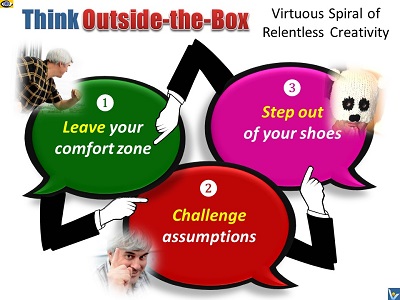
Leave Your Comfort Zone

Thinking outside the box is never easy, nor is it merely a reflection of mental brightness. To leave your psychological comfort zone and explore "solutions in the unknown world on the outside requires large measures of mental agility, boldness, and creativity – and/or an inspirational leader who makes life in the old box so uncomfortable that getting out is the only option. The future rests in those willing and able to do so."1

Step Out of Your Shoes

Change hats and your thinking mode. Stepping out of your everyday shoes and into the shoes of others may help you surface new insights to a problem... More

Challenge Assumptions

Challenging assumptions means questioning the everyday things you take for granted. "The best assumption to have is that any commonly held belief is wrong," says Ken Olson, CEO of DEC... More

Yin-Yang of Entrepreneurial Creativity

Ask Searching Questions

Creativity requires an inquisitive mind. Unless you ask lots of "Why?" and "What If"? questions , you won't generate creative insights. "To avoid this most common of creative errors, be sure to peek under all carpets, including your own. Don't take anything for granted. Especially success. Try looking at the world through more inquisitive eyes; try getting ideas in motion; try asking the all-important: "Why?" See what happens!" says Alexander Hiam.7 ... More

Turning Problems Into Opportunities: 6 Tips

 Case in Point  Caterpillar's Syndrome

A very unusual experiment was conducted by John Fabre, the French naturalist, consisting of processionary caterpillars, a type of caterpillar that blindly follows the one in front of it.5

This explains the name processionary caterpillar. The experiment consisted of several of these caterpillars, a flowerpot filled to the rim with dirt, and pine needles.

The caterpillars formed a complete circle around the rim of the flowerpot, with the first one touching the back of the last one. The pine needles, the food of the processionary caterpillar, were placed in the center of the circle.

The caterpillars began their procession around the flowerpot, one following the other in a circle. This went on hour after hour, day after day, for an entire week. In the end, every one of the caterpillars dropped dead of starvation.

The one thing that could have saved them was only six inches away, but without purposeful thought or action, the caterpillars continued with a habitual routine that eventually proved too much to endure.

This is happening to people, too.

 Case in Point  Half.com

Adapted from Buzzmarketing: Get People to Talk About Your Stuff by Mark Hughes

The entrepreneurs from half.com looked for an interesting way to launch their site – something that would make people and the media talk about their site. They wished to use a buzzmarketing strategy.

At first they hired an ideation company that suggested the usual wild ideas, such as releasing a large balloon from Mount Rushmore... These were not really the kind of things that would make people talk about half.com.

After some time, half.com's team came up with a really interesting out-of-the-box idea. Find a place that has the word "half" in it, and convince them to temporarily change their name to half.com. A brief search in the US list of names of places brought out Halfway, Oregon.

In early December 1999, a representative of the Half.com marketing team paid a visit to Halfway, Oregon to ask Mayor Dick Crow if the town would consider changing its name to Half.com, Oregon.

On Wednesday, January 19th, NBC's Today Show was broadcast live from Half.com, Oregon, and Conshohocken, Pennsylvania, corporate headquarters of Half.com, Inc. as the company launched its web site. Millions of viewers and Internet users throughout the country and the world experienced the proclamation of the World's First Dot Com City and the new person-to-person business model presented by Half.com... More

 Case in Point  The Buddhist Approach to Life vs. Western Science

"In the Western psychology, there is an assumption that everything must be accounted for within this lifetime," says Dalai Lama of Tibet. "So, when you can't explain what is causing certain behaviors or problems, the tendency is to always attribute it to the unconscious. It's a bit like you've lost something and you decide that the object is in this room. And once you have decided this, then you've already fixed your parameters; you've precluded the possibility of its being outside the room or in another room. So you keep on searching and searching, but you are not finding it, yet you continue to assume that it is still hidden somewhere in the room!"... More

Jokes: A Car as Collateral

A Russian businessman walks into a Swiss bank in Geneva and asks for a $100 loan. He offers his luxury Mercedes car as collateral. The collateral is too good, and the bank manager approves the loan. A year later, the Russian comes back. He repays the loan and the 10% interest and is ready to collect his car. Finally, the puzzled bank manager dares to ask him: "Excuse me, sir, could  you tell me: did you really need that $100 so badly? In order to get the money, you left your luxury car with us for a whole year!" The Russian replied, "That's simple – just think outside the box:  where else in Geneva can I find such a great parking place for just $10 a year?"


References:

  1. Thinking Outside the Comfort Zone, Jerry Sentell

  2. Lateral Thinking, Edward de Bono

  3. Improve Your Lateral Thinking: Puzzles To Challenge Your Mind, Paul Sloane

  4. The Art of Happiness, HH the 14th Dalai Lama of Tibet and Howard C. Cutler

  5. Motivation123, Newsletter by Jason Gracia

  6. How To Jazz Up Innovation, Linda Stern