|
Change Defined
"Change is the window through which the future enters your
life." It's all around you, in many types and shapes. You can bring it about
yourself or it can come in ways.
→
Jack Welch's
5 Strategic Questions
Why Change Management?
You can bring the change about yourself or it can come in ways that give you
little choice about its what, when, and how. Fighting against change
slow it down or divert it, but it won't stop it however. If you wish to
succeed in this rapidly changing new world "you must learn to look on change
as a friend – one who presents you with an opportunity for growth and
improvement."9
The rate of change in
today's world is constantly increasing. Everything
that exists is getting old, wearing out and should be replaced.
"Revolutionary technologies, consolidation, well-funded new competition,
unpredictable customers, and a quickening in the pace of change hurled
unfamiliar conditions at management."7
New Survival Strategies
In today's tidal wave of
global economic, technological, and social change, that name of the game
for you and your organization is survival.
If you
are going to withstand relentless and constantly growing global
competition, you need to
be different and
radically change the way of doing business.
|
|
You need to create a new management model,
switch
from
management to leadership, manage
change,
build trust, drive
out fear of failure and create productive
partnerships in which everyone can offer their unique knowledge and
talents. If you know how to help your organization to do this, you can
make a decisive difference...
More
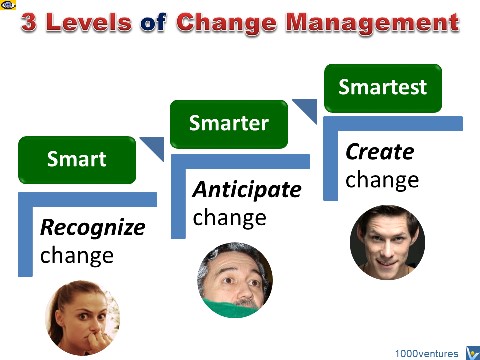
Anticipate Change
Being able
to anticipate that which is likely to occur in the nearest or remote
future gives you an edge over others who simply go along with whatever
happens...
More
|
Harness the
Power of
Change
"The future is coming so fast, we can't possibly predict it;
we can only learn
to respond quickly."
~ Steven Kerr
Discontinuities of the
new
rapidly changing economy offer unlimited
→
opportunities
to
those who can grasp them. For truly
adaptive firms, a rapidly
changing environment becomes a
strategic
advantage.
Understand that change in never over. See your
organization as a
winning team of rafters that strives to win a race in white waters of a
rough river. Embark on your brave 'Change Management' boat and
ride the waves of change that
come relentlessly from different directions in
different forms.
→
Learning SWOT
Questions
Change Before You
Have To
Deal with change in a
proactive
manner. Success in business doesn't come from feeling comfortable. In
today's technology-driven world, business life cycles have accelerated
exponentially. The challenge is to keep a step ahead of changing market
conditions, new technologies and human resources issues...
More
Evolutionary vs.
Revolutionary Change
When choosing between evolutionary change and
revolutionary action, you as a
→
leader must pursue a
→
balanced
and pragmatic approach...
More
|
|
Managing Evolutionary Change
Successful
evolutionary changes are
→
led from behind
and managed by small steps...
More
→
Leadership-Management Synergy

Create Change for
Improvement
and
Competitive
Advantage
Change creates
→
opportunities, but only for those who recognize and seize
them.
Yet, discovering and seizing an opportunity is not enough. You must
experiment with various options, ask
→
learning SWOT
questions,
adapt strategies and
keep innovating this way. Simulation games, such as
Innovation Football, are to help you prepare to win and
exceed
the initially desired results...
More
Clues to
Successful Change
Management Efforts
→
Why Change Fails:
8 Common Errors
To
create and implement change
successfully, you must make the stakeholders believe
that what is to come is much more
attractive and interesting than what they have.
Dissatisfaction with the status quo helps you
→
make the first step.
A
questioning
culture and
→
creative dissatisfaction
and help you keep going
→
innovatively
and relentlessly...
More
Motivate Employees to
Embrace Change
You have a choice of instruments to
→
motivate
your people to
embrace change. Performance-incentive
levers are especially useful in driving those who lack direction or
initiative. You may also encourage employee
→
feedback
on where and how the company can take corrective action and
reward
employees for their contribution...
More
→
How To
Overcome Resistance to Change:
KoRe 10 Tips
Keep People
in the Know
MAKE decision, NAKE decision.
"Transformational leaders
empower others by keeping them "in the know," by keeping them
fully informed on everything that effects their jobs," says
Brian Tracy. "People want and need to feel that they are
“insiders,” that they are aware of everything that is going on.
There is nothing so demoralizing to a staff member than to be
kept in the dark about their work and what is going on in the
company."
Evolutionary Change
vs. Revolutionary Action...
Start
Change With Yourself...
Understanding What's Going On in the Real World...
Systems
Thinking...
Non-financial Barriers to Change...
Change and
Leadership...
Internal and External Sources of Changes...
Anticipate Change...
Five Drivers
of Change...
Manage
Resistance to Change...
Viewing Your Business
with an Outsider's Eyes...
80/20 Thinking...
Creating Change: Twin Strategies...
Creating Change: Steps to Establishing a New Balance...
How To Ask Searching Questions...
Lead
Change...
Make
Quick Decisions...
Create
Corporate Guiding Principles...
Lead
Behavioral Change...
Tips for Setting and
Communicating the Vision...
Beer's Formula for
Leading Change...
Sustainable Ability to
Change...
Real Time Business Development...
Manage Change through Projects...
Case Study
BP...
|