Sustainable Growth:

Performance Management

Employee Empowerment

Harvesting the Creative and Emotional Power of All Your People

By Vadim Kotelnikov, Founder, Ten3 BUSINESS e-COACH – Innovation Unlimited, 1000ventures.com

  Yes! You are in the right place!  

This site is Ranked #1 by Google for

"Employee Empowerment"

out of about 2-million-wide (!!!) competition!

"One machine can do the work of fifty ordinary men. No machine can do the work of one extraordinary man."

– Elber Hubbard

employee empowerment, employee empowerment, employee empowerment, employee empowerment, employee empowerment, employee empowerment, employee empowerment

Employee Empowerment

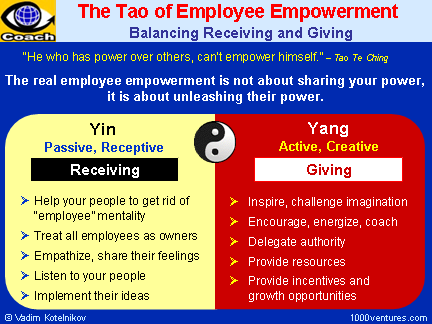
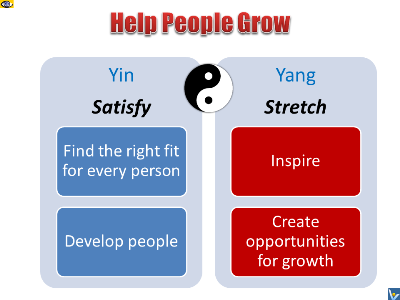
The Tao of Employee Empowerment

  • Yin: Listen to your people

  • Yang: Inspire, challenge imagination... More

10 Rules for Building a Great Business

  1. Create a winning organization.  Cultivate leaders. Create hot teams, inspire, energize, and empower employees. Create an adaptive organization. Build a growth culture. Search for synergies. Leverage diversity... More

6Ws of Corporate Growth

  1. Know WHO: develop leaders, empower employees, build teams, establish strategic alliances, partner with customers... More

Building a Team Culture

10 Action Areas

  1. Empower teams... More

Employee Empowerment: 3 levels

Transform Your Business into an Innovative and Creative Culture

5 Strategies for Creating a Culture for Innovation

Main Subjects for Suggestions in Japanese Companies

  • Improvement in one's own work... More

12 Effective Leadership Roles

  1. Empower people; delegate authority; be open to ideas; have faith in the creativity of others... More

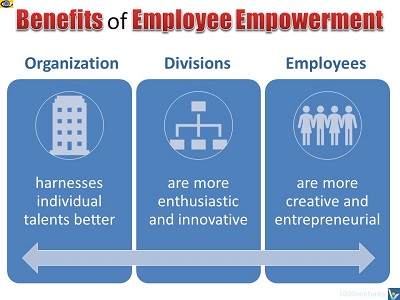
Benefits of Employee Empowerment4

  1. The organization: harnesses individual talents to the full. Changes the managers' mind-set and leaves them with more time to engage in broad-based thinking, visioning, and nurturing.

  2. The department / team: becomes more enthusiastic, active, and successful. Facilitates teamwork and harnessing of collective power of employees.

  3. Employees: entrusted new responsibilities and are stretched beyond what they previously thought they could achieve. Releases the individual wisdom, creativity and energy of employees.

Empowerment versus Delegation4

  • Delegation is an old idea used in the traditional management model. The idea was to make sure that responsibility and authority were equal for every job. When delegation was implemented correctly, people had the authority that they needed to execute their responsibilities. Limitations of this approach: assigning authority does not mean that someone has the ability, motivation, and understanding necessary to perform.

  • Empowerment is a core concept of the new management model. In the new-generation adaptive organization, delegation is replaced by empowerment, and responsibility by ownership. Authority and responsibilities are formal aspects or organizing. They are based upon organizational properties and not individual capabilities. Empowerment and ownership are social aspects of organizing, They are based on efficacy and initiative, and not just on roles and requirements. They belong to people.

Developing The Fast-Paced Flexible Culture

By: Michael Dell

  • Facilitate Personal Growth. Cultivate commitment to personal growth. Success isn't static – and your culture shouldn't be either. Pay attention to what your best people are achieving, and build an infrastructure that rewards mastery. The best way to keep the most talented people is to allow their jobs to change with them. Sometimes, reducing their responsibilities will give them the space to tackle new opportunities and to expand – and your business will expand too... More

The 8 Stage Change Process

By John P. Kotter

Introduce new practices:

  1. Empower a broad base of people to take action... More

IDEO's Innovation Practice Tips

  • Stay human, scale your organizational environment so that there's room for hot teams to emerge and thrive... More

How To Lead Creative People

By: Max DePree

  • Innovation is the lifeblood of an organization. Knowing how to lead and work with creative people requires knowledge and action that often goes against the typical organizational structure. Protect unusual people from bureaucracy and legalism typical of organizations... More

Business BLISS

Balance – Leadership – Innovation – Synergy – Speed

 Discover much more!

Winning Organization

The Tao of Employee Empowerment

Balanced Organization: 5 Basic Elements

9 Signs of a Losing Organization

Guiding Principles To Liberate Employees from the Fear of Trying New Things

7 Tips for Eliminating Bureaucracy

Corporate Leader

Inspirational Leadership: 10 Roles

The Leader Is the Best, When...

Smart Business Architect

10 Rules for Building a Great Business

3 Strategies of Market Leaders

12 Effective Leadership Roles

The Key To Motivation

How To Lead Creative People

Modern Manager

Leadership-Management Synergy

Delegation DOs and DON'Ts

Three Easy Ways To Maximum Motivation

Corporate Culture

Strategies for Building a Growth Culture

Developing the Fast-paced Flexible Culture

Creating a Culture for Innovation

5 Strategies for Creating a Culture for Innovation

5 Strategies for Creating a Culture of Questioning

How To Transform Your Business Into an Innovative and Creative Culture

Quality Management

Deming's 14 Point Plan for Total Quality Management (TQM)

Free Ten3 Micro-courses

6Ws of Corporate Growth

Kaizen and Lean Manufacturing

  Ten3 Mini-Courses   Presentation:    View    Download

Synergistic Organization  (70 slides)

Inspiring Culture  (60 slides)

New Management Model  (45 slides)

25 Lessons from Jack Welch  (45 slides)   Demo

SMART Executive  (225 slides)   ► Demo

3 Strategies of Market Leaders  (125 slides)


People Power

People as your most important asset. Your technologies, products and structures can be copied by competitors. No one, however, can match your highly charged, motivated people who care. People are your firm's repository of knowledge and they are central to your company's competitive advantage. Well educated, coached, and highly motivated people are critical to the development and execution of strategies, especially in today's faster-paced, more perplexing world, where top management alone can no longer assure your firm's competitiveness.

Balanced Organization: 5 Basic Elements

Empowered Employees (Metal):

Why Employee Empowerment?

People are your firm's most underutilized resource. In the new knowledge economy, independent entrepreneurship and initiative is needed throughout the ranks of your organization. Involvement in an organization is no longer a one-way street. In today's corporate environment a manager must work towards engaging organization forcefully enough to achieve its objectives. New knowledge-based enterprises are characterized by flat hierarchical structures and multi-skilled workforce. Managers assume more leadership and coaching tasks and work hard to provide employees with resources and working conditions they need to accomplish the goals they've agreed to. In brief, managers work for their staff, and not the reverse.

Empowerment is the oil that lubricates the exercise of learning. Talented and empowered human capital is becoming the prime ingredient of organizational success. A critical feature of successful teams, especially in knowledge-based enterprises, is that they are invested with a significant degree of empowerment, or decision-making authority.

Equally important, employee empowerment changes the managers' mind-set and leaves them with more time to engage in broad-based thinking, visioning, and nurturing. This intelligent and productive division of duties between visionary leaders, focusing on emerging opportunities, and empowered employees, running the business unit day to day (with oversight on the leader's part) provides for a well-managed enterprise with strong growth potential.

18 Leadership Lessons from Colin Powell

  • Never neglect details. When everyone's mind is dulled or distracted the leader must be doubly vigilant. Good leaders delegate and empower others liberally, but they pay attention to details, every day. The job of the leader is not to be the chief organizer, but the chief disorganizer.".... More

Inspirational Leadership: 10 Roles

Inspirational leaders create an inspiring culture within their organization. They supply a shared vision and inspire people to achieve more than they may ever have dreamed possible. They are able to articulate a shared vision in a way that inspires others to act.

People do what they have to do for a manager,


they do their best for an inspirational leader... More

The Leader Is the Best, When...

By: Lao Tzu

The leader is best,...

When his work is done, his aim fulfilled,

The people say, 'We did it ourselves.'... More

Quick and Easy Kaizen

Quick and Easy Kaizen empowers employees, enriches the work experience and brings out the best in every person. It Improves quality, safety, cost structures, delivery, environments, throughput and customer service... More

7 Principles of Toyota Production System (TPS)

  1. Employee involvement and empowerment... More

 Case in Point  Canon Production System (CPS)

The Canon Production System (CPS) includes:

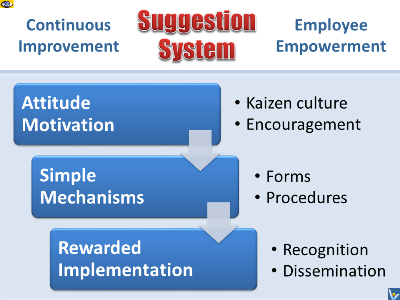
Three Stages of the Suggestion System

1. Encouragement. In the first stage, management should make every effort to help the workers provide suggestions, no matter how primitive, for the betterment of the worker's job and the workshop. This will help the workers look at the way they are doing their jobs... More

 Case in Point  14 TQM Slogans at Pentel

Pentel is a Japanese firm manufacturing stationary products. The following is a list of 14 Pentel's slogans for explaining Total Quality Management (TQM) and Quick and Easy Kaizen philosophy to its employees.

  • You are surrounded by mountains of treasures... More

Leadership-Management Synergy

Leaders: Provide vision. Managers: Provide resources.

Synergy: Employee empowerment... More

Empowerment through Coaching

The new breed of leaders recognizes that in today's complex business environment autocracy no longer works, yet the empowerment alone is not enough. Coaching aims to enhance the learning ability and performance of others. "It involves providing feedback, but also uses other techniques such as motivation, effective questioning and consciously matching your management style to the player's readiness to undertake a particular task. It is based on helping the player to help her/himself through interacting dynamically with her/him - it does not rely on a one-way flow of telling and instructing."5...More

Keep People In The Know

"Transformational leaders empower others by keeping them "in the know," by keeping them fully informed on everything that effects their jobs," says Brian Tracy.


"People want and need to feel that they are “insiders,” that they are aware of everything that is going on. There is nothing so demoralizing to a staff member than to be kept in the dark about their work and what is going on in the company."... More

Strategies for Leading Breakthroughs

  • A clearly defined commitment helps people understand whom they have to become to build a legacy. In essence, people become the accomplishment. When people become their accomplishment, it empowers them to take the appropriate actions... More

Empowering the People Around You: 3 General Rules

The three general rules for empowering the people around you, which apply to everyone you meet, are appreciation, approval, and attention. Voice your thanks and gratitude to others on every occasion. Praise them for every accomplishment. And pay close attention to them when they talk and want to interact with you. These three behaviors alone will make you a master of human interaction and will greatly empower the people around you... More

 Case in Point  Jack Welch and GE

Some years ago, in locations throughout GE, local managers were operating in an insulated environment with Chinese walls separating them, both horizontally and vertically, from other departments and their workforce. Employee questions, initiatives, and feedback were discouraged.

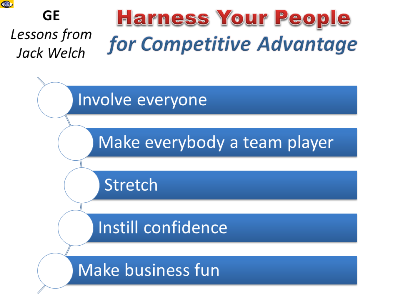
In the new knowledge-driven economy, Jack Welch, CEO, GE, "viewed this as anathema. He believed in creating an open collaborative workplace where everyone's opinion was welcome."3 He wrote in a letter to shareholders: "If you want to get the benefit of everything employees have, you've got to free them - make everybody a participant. Everybody has to know everything, so they can make the right decisions by themselves."


 Discover much more in the FULL VERSION of e-Coach

Contemporary Management Functions...

Two Common Traits of Great Leaders and Managers...

Balance between Authority and Employee Empowerment...

Developing  Entrepreneurial Staff...

10 Steps to Empowerment...

Participatory Management...

Employee Ownership of Quality...

Inspiring People...

Caring Is the Key...

Getting Employees Involved...

Energizing Employees...

25 Lessons from jack Welch: Involve Everyone..

Letting the Best Idea Win...

Emotional Task of the Leader...

Creative Leadership...

Employee Self-Leadership – the Key to Success in the New Economy...

Supeleadership...

Building and Nurturing Customer Relationships...

 Case in Point  "Great Game of Business"...

 Case in Point  Hewlett-Packard Way...

 Case in Point  Dell Inc...

 Case in Point  Silicon Valley Firms...


References:

  1. Competitive Manufacturing Management, John M. Nicholas

  2. Motivation and Goal-Setting, Jim Cairo

  3. Extreme Management, Mark Stevens

  4. Empowering People, Jane Smith

  5. The Tao of Coaching, Max Landsberg

  6. MegaChange, William E. Joyce

  7. SMART Executive, Vadim Kotelnikov

  8. Entrepreneurial Leadership, Vadim Kotelnikov

  9. 25 Lessons from Jack Welch, Vadim Kotelnikov

  10. SMART Business Architect, Vadim Kotelnikov

  11. SMART Innovation, Vadim Kotelnikov

  12. Strategies of Market Leaders, Vadim Kotelnikov

  13. Motivate to Win, Richard Denn

  14. Jack Welch and the GE Way, Robert Slater


Mouse Pad

Framed Tile

T-Shirt

Mug

See more Leadership & Management designs    See all Leadership products in our online shop


Map

Ranked #1

Search

Testimonials

Free Downloads

  Products

SMART Learning

Training

 Contact

We invented Business e-Coaching in 2001

Today, we have customers in 100+ countries!

Our customers:

3M, ABB, Adidas, Alcatel, American Express, Bayer, Boeing, British American Tobacco, BP, Canon, Cisco, Citigroup, Colgate, Corning, Deloitte, Ernst & Young, Fujitsu-Siemens, GE, Goldman Sachs, HP, Hitachi, Huyndai, IBM, Intel, Johnson & Johnson, JP Morgan Chase, KPMG, Lufthansa, Microsoft, Motorola, Nokia, Oracle, Samsung, Shell, Siemens, Sony, United Bank of Switzerland

Ten3 Mini-courses: SMART & FAST sets Full version of Ten3 Business e-Coach Ten3 Business e-Coach (home page)

Ten3 Business e-Coach, version 2008

Inventor, Author & Founder – Vadim Kotelnikov

© Vadim Kotelnikov, GIVIS