|
Leadership
Defined
"Leadership is
influencing people to get things done to a standard and quality above
their norm. And doing it willingly."15
As an element in social interaction, leadership
is a complex activity involving:
-
a process of
influence
-
actors who are both leaders and followers
-
a range of possible outcomes – the achievement of goals, but also the
commitment of individuals to such goals, the enhancement of group cohesion
and the reinforcement of change of
organizational culture.16
Building Better Leaders
through Attributes
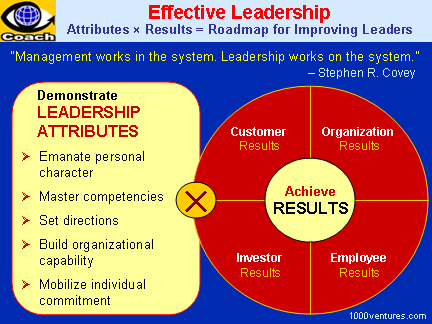
Leadership attributes are the inner
or personal qualities that constitute effective leadership. These attributes
include a large array of characteristics such as values, character, motives,
habits, traits, motives, style, behaviors, and skills.
The Leader Is Best, When...
By:
Lao Tzu
The leader is best,...
When his work is done, his aim fulfilled,
The people say, 'We did it ourselves.'...
More
Inspirational
Leadership:
10 Roles
Inspirational leaders
create an
inspiring culture
within their organization. They supply a shared
vision
and
inspire people
to achieve more than they may ever have dreamed possible.
They are able to articulate a shared vision in
a way that inspires others to act.
Great leaders
lead by example.
People do what they have to do for
a manager. Inspired and
energized
people do their best for an inspirational leader...
More
Entrepreneurial
Leadership
In the
new era.
of rapid changes and
knowledge-based enterprises, managerial work becomes
increasingly a leadership task.
In the increasingly turbulent
and competitive environment firms face today, a new type of
"entrepreneurial" leader distinct from other behavioral forms of
managerial leadership is required.
Entrepreneurial leadership
is the primary force behind
successful change.
Entrepreneurial leaders discover emerging business opportunities and
empower employees
to act on the
vision.
They execute through inspiration and develop implementation capacity
networks through a complex web of aligned relationships...
More
9 Signs of a Losing Organization
-
Lack of Leadership Skills:
fear of
change;
leaders
lack
entrepreneurial spirit; leadership style on the
part of management is either too directive or too hands-off;
managers do not
lead
and don't
manage
change,
they just administrate and micromanage; weak
leadership
development
program....
More
Balanced
Organization:
5 Basic Elements
Corporate Leadership
(Fire):
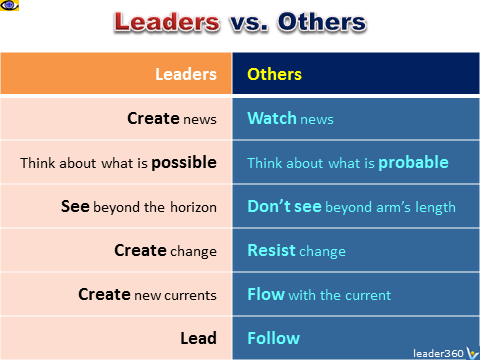
create positive change
and
see change as an opportunity...
More
Develop a Clear Vision
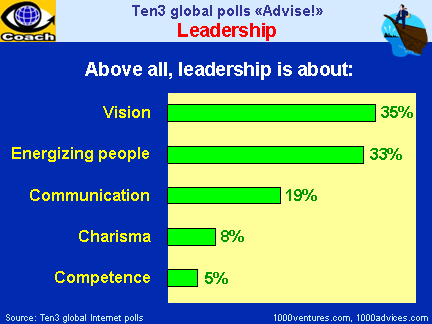
The one quality that all
leaders
have in common is that they have a
clear and exciting
vision
for the future. This is something that only the leader can do.
Only the leader can think about the future and plan for the
future each day.
Effective
Leadership as a Source of
Competitive
Business Advantage
Leadership is imperative for
molding a group of people into a
team, shaping
them into a force that serves as a
competitive business advantage.
Leaders know how to make people
function in a collaborative fashion, and how to
motivate them to excel their performance. Leaders also know how to
balance
the individual team member's quest with the goal of producing
synergy
– an outcome that exceeds the sum of individual inputs. Leaders require that
their team members forego the quest for personal best in concert with the
team effort.9
An important measure of a leader's
own success is he success of his or her followers. The strength of a leader
is measured by the ability to facilitate the self-leadership of others. The
first critical step towards this goal is to master self-leadership. If
leaders want to lead somebody, they must first lead themselves.
Super-leaders
Super-leaders
help each of their follower to develop into an effective self-leader by
providing them with the behavioral and cognitive skills necessary to
exercise self-leadership. "Super-leaders establish
values,
model, encourage,
reward, and in many other ways foster self-leadership in
individuals, teams, and wider
organizational cultures."5
What is Leadership? Three Simple One-line Answers...
Role, Task,
Responsibility, and Source of Power of a Leader...
Learning to
Lead...
Leader 360...
Learning
to Lead...
Four Competencies that Leaders Need To Develop...
Integrity...
Leadership Styles...
Positioning of a Leader...
Emotional Task of the Leader...
Creative Leadership...
Inspiring People...
Energizing Employees...
Coaching – a Vital Skill for Leaders...
Leader as Servant...
Leading by Example...
NLP Solutions:
Pacing and Leading...
Integrity - the New Leadership Story...
Three Levels of
Leadership in Organizations...
Inclusive Leadership...
Results-based
Leadership...
Employee
Self-Leadership...
Volatility Leadership...
Leading Change...
Managing Resistance To Change...
Leading Organizational Change...
Transformational Leadership...
How To Make Big Changes...
Pros and Cons of Situational Leadership...
Strategic Leadership Lessons...
Strategic Thinking...
Strategic Achievement...
Creating and
Leading an Adaptive Organization...
2 Sets of Skills of a Good Leader in a Hierarchical Organization...
Thought Provokers...
Case in Point
GE
Leadership Effectiveness Survey (LES)...
Case in Point
Lee Iacocca...
|