| |
Everything starts with a
vision. You cannot
create a
synergistic team without one because people will not
find the desire to achieve the common goal.
The team
members will work together and sacrifice only if they can see
what they're working toward.
Create an inspiring
shared vision.
Only you can do it.
|
|
 |
| |
Capturing and communicating
vision is your role as a team
leader.
Provide the big picture
and keep
the vision of the big picture before yourself and your people.
Give every team member an
inspiring role to play.
Every role must have its part in
contributing to the bigger
picture, and every team member
must be informed about the
significance of s/his role.
|
|
 |
| |
|
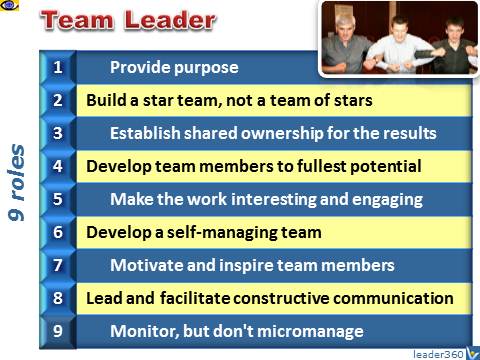
②
Build
a star team, not a team of stars
|
|
|
| |
Everything starts with a
vision. You cannot
create a
synergistic team without one because people will not
find the desire to achieve the common goal.
The team
members will work together and sacrifice only if they can see
what they're working toward.
Create an inspiring
shared vision.
Only you can do it.
|
|
 |
| |
Capturing and communicating
vision is your role as a team
leader.
Provide the big picture
and keep
the vision of the big picture before yourself and your people.
Give every team member an
inspiring role to play.
Every role must have its part in
contributing to the bigger
picture, and every team member
must be informed about the
significance of s/his role.
|
|
|
| |
②
Build
a star team, not a team of stars |
| |
→
Winning Team:
7 Elements

Your team
will not reach its potential if players are unwilling to
subordinate their personal goals to the good of the team.
As
Ervin "Magic" Johnson put it, "Everybody on a championship team
doesn't get publicity, but everyone can say he's a champion." Be
personally a team player. Teach people to cooperate to make a
team a winning team, and thus all of them winners. Involve
everyone.
Establish
shared values
and
an environment
oriented to
trust,
joint creativity,
open communication, and cohesive team effort. Help resolve dysfunctional behavior. Facilitate join
problem solving and
collaboration. Fully utilize
diversity of team members. |
| |
③
Establish
shared ownership for the results |
| |
Start with yourself – share
your own individual results with the group. Shared
responsibility is better achieved if the pay and reward system
has a significant element that is dependent on the overall
outcome.
Keep the team informed how individual members are
performing – it is important
if Individuals' rewards depended on the performance of the group
as a whole. |
| |
④
Develop team
members to fullest potential |
| |
|
| |
⑤
Make the
work interesting and engaging |
| |
Create enjoyable work
environment.
Encourage
entrepreneurial creativity,
risk-taking, and constant improvement.
This
includes also
freedom to fail
and
fun in the workplace.
Maintain healthy group
dynamics. Facilitate problem solving and collaboration.
>>>
→
Loose-Tight
Leadership
|
| |
⑥
Develop a self-managing team |
| |
Be a
superleader. Develop team
members so that they can
lead themselves. Don't give direct
commands or instructions, use
questions (such as
"What do you think should be done?") and
coaching instead.
Empower
people,
delegate authority, and be open to ideas. Trust
your team,
rely on their judgment. Give your people authority to
decide as much as possible.
Encourage your team to engage in
self-leadership behaviors such as self-observation, role-playing
exercises, and self-problem
solving.
Encourage your team or groups within your team to evaluate
themselves and to give both positive and negative
feedback. Share with the team
members certain areas of your responsibility. Ask for their
input when you need to make a decision regarding recruitment,
firing, discipline, training, and promotion. |
| |
⑧
Lead and facilitate
constructive communication |
| |
Lead the
rich array of
types of communication exchanged between team members that
include goal setting, task assignments, work scheduling,
announcements, problem solving, performance evaluation,
corrective feedback,
praise, discussions, etc. Communicate in a way that is truthful
and believable to team members. Provide constructive feedback to
the team on where and how it might improve.
Encourage open
communication among team members and communicate team views to
and from other teams. Encourage self-criticism and rehearsal.
Strive for team consensus and
win-win agreements.
Provide guidance to the team based on upper
management direction.
Escalate issues which cannot
be resolved by the team and communicate
team views to upper management.
Serve as a focal point to communicate and resolve interface and
integration issues with other teams.
|
| |
⑨
Monitor, but
don't micromanage |
| |
Avoid
close supervision; do not overboss; do not dictate. Help
keep the team focused and on track. Communicate team status,
task accomplishment, and direction.
Intervene when necessary to
aid the group in resolving issues.
>>> |
|
|
|