Managerial Leadership:

Teamwork

10 Ways to Distinguish between a Team and a Group

Moulding Your People into a Pro-active and Productive Team

By Australian Business Limited and Australian Commonwealth ITR Department

Adapted by Dean Prebble and Prof. Howard Frederick, Ten3 NZ Ltd.

"Teamwork is a make or break situation. Either you help make it or the lack of it will break you."  – Kris A. Hiatt

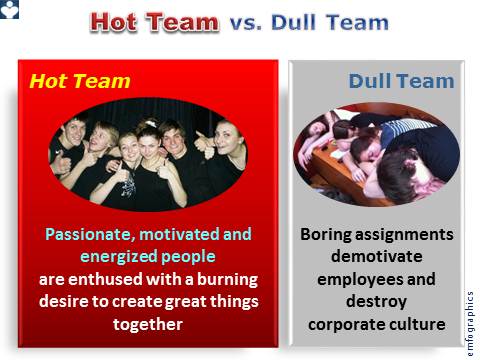
The purpose of assembling a team is to accomplish bigger goals than any that would be possible for the individual working alone. The aim and purpose of a team is to perform, get results and achieve victory in the workplace and marketplace.  The very best managers are those who can gather together a group of individuals and mould them into a team. Here are ten key differentials to help you mould your people into a pro-active and productive team.

  1. Understandings.  In a group, members think they are grouped together for administrative purposes only.  Individuals sometimes cross purpose with others.  In a team, members recognise their independence and understand both personal and team goals are best accomplished with mutual support.  Time is not wasted struggling over "Turf" or attempting personal gain at the expense of others.

  2. Ownership.  In a group, members tend to focus on themselves because they are not sufficiently involved in planning the unit's objectives. They approach their job simply as a hired hand. "Castle Building" is common.  In a team, members feel a sense of ownership for their jobs and unit, because they are committed to values-based common goals that they helped establish.

     
  3. Creativity and Contribution.   In a group, members are told what to do rather than being asked what the best approach would be.  Suggestion and creativity are not encouraged.  In a team, members contribute to the organisation's success by applying their unique talents, knowledge and creativity to team objectives.

  4. Trust.   In a group, members distrust the motives of colleagues because they do not understand the role of other members. Expressions of opinion or disagreement are considered divisive or non-supportive.  In a team, members work in a climate of trust and are encouraged to openly express ideas, opinions, disagreements and feelings. Questions are welcomed.

  5. Common Understandings.   In a group, members are so cautious about what they say, that real understanding is not possible. Game playing may occur and communication traps be set to catch the unwary.  In a team, members practice open and honest communication.  They make an effort to understand each other's point of view.

  6. Personal Development.   In a group, members receive good training but are limited in applying it to the job by the manager or other group members.  In a team, members are encouraged to continually develop skills and apply what they learn on the job.  They perceive they have the support of the team.

  7. Conflict Resolution.   In a group, members find themselves in conflict situations they do not know how to resolve.  Their supervisor/leader may put off intervention until serious damage is done, i.e. a crisis situation.  In a team, members realise conflict is a normal aspect of human interaction but they view such situations as an opportunity for new ideas and creativity. They work to resolve conflict quickly and constructively.

     
  8. Participative Decision Making.   In a group, members may or may not participate in decisions affecting the team.  Conformity often appears more important than positive results.  Win/lose situations are common.   In a team, members participate in decisions affecting the team but understand their leader must make a final ruling whenever the team cannot decide, or an emergency exists.  Positive win/win results are the goal at all times.

  9. Clear Leadership.   In a group, members tend to work in an unstructured environment with undetermined standards of performance.  Leaders do not walk the talk and tend to lead from behind a desk.  In a team, members work in a structured environment, they know what boundaries exist and who has final authority.  The leader sets agreed high standards of performance and he/she is respected via active, willing participation.

  1. Commitment.   In a group, members are uncommitted towards excellence and personal pride.  Performance levels tend to be mediocre.  Staff turnover is high because talented individuals quickly recognise thatINSPIRING CORPORATE CULTURE (Ten3 Mini-course)

(a) personal expectations are not being fulfilled

(b) they are not learning and growing from others and

(c) they are not working with the best people.

In a team, only those committed to excellence are hired.  Prospective team members are queuing at the door to be recruited on the basis of their high levels of hard and soft skill sets.  Everyone works together in a harmonious environment.

Teamwork: 5 Characteristics of a Winning Team

17 Indisputable Laws of Teamwork

Model of a Team Leader

Team Assessment and Improvement

Corporate Culture

Team Culture

Building a Team Culture: 10 Action Areas

Inspiring Culture

Strategies for Building a Growth Culture

Developing the Fast-paced Flexible Culture

Corporate Leader

12 Effective Leadership Roles

Inspirational Leadership: 10 Roles

Develop a Clear Vision

Winning Organization

9 Signs of a Losing Organization

The Tao of Employee Empowerment

  Ten3 Mini-Courses

Inspiring Culture  (60 slides)

Synergistic Organization  (70 slides)


References:

  1. "Teambuilding That Gets Results," Linda Diamond and Harriet Diamond

Map

Ranked #1

Search

Glossary

Free Downloads

  Products

Testimonials

Training

 Contact

We invented Business e-Coaching in 2001

Today, we have customers in 100+ countries!

Our customers:

3M, ABB, Adidas, Alcatel, American Express, Bayer, Boeing, British American Tobacco, BP, Canon, Cisco, Citigroup, Colgate, Corning, Deloitte, Ernst & Young, Fujitsu-Siemens, GE, Goldman Sachs, HP, Hitachi, Huyndai, IBM, Intel, Johnson & Johnson, JP Morgan Chase, KPMG, Lufthansa, Microsoft, Motorola, Nokia, Oracle, Renault, Samsung, Shell, Siemens, Sony, United Bank of Switzerland

Ten3 Mini-courses: SMART & FAST sets Full version of Ten3 Business e-Coach Ten3 Business e-Coach (home page)

Ten3 Business e-Coach

Inventor, Author & Founder – Vadim Kotelnikov

© Vadim Kotelnikov, GIVIS