|
Contents
1.
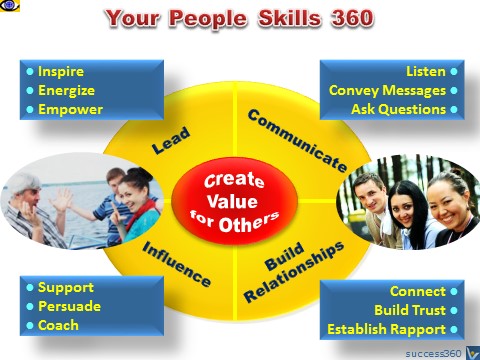
Creating Value, Building Relationships, Influencing
Your People Skills 360
The Role of Your People Skills
Humorous Quotes: Communicating,
Building Relationships
Strive To Make People Happier
Become a Generous Star
Create Greater Value for People Around
You
Win-Win Mindset
A Short Course in Human Relations
The Tao of Building Relationships
The Tao of
Influencing People
Rapport
– the Key to Influencing People
Solving People Problems
Effective
Conflict Resolution: No-Lose Method
Internal and External Conflict
Resolution: 10-Step Yoga Method
Effective Negotiations: Reaching a Wise
Agreement
Wise Negotiation DOs and DON'Ts
Principled Negotiation
Separate the People from the Problem
Principled Negotiation: 9 Principles
Benjamin Franklin's 5 Bargaining Tips
2.
Knowing
People and
Cultural
Intelligence
Understanding People's Perceptions: Map
is Not the Territory
Perceptual
Positions
Empathic Listening
Mental Maps
Six Fundamental Patterns of
Cultural
Differences
Yin and Yang of
Cultural
Intelligence
3.
Communication
The Tao of Communication
Communication GEM
The Way Your Message is Conveyed
Most People
Prefer to Talk To Great Listeners
Effective Listening
The Tao of Effective Listening
Empathic Listening
Active Listening
Socratic
Questions
How To Sell Your Ideas To Other
Stakeholders: DOs and DON'sTs
How To Make Effective
Presentations
Understand EGA of Your Audience
10 Essentials of Effective
Communication
4.
Leading
Leader 360
Above All
Leadership Is About...
Lead by Example
9 Roles of a Team Leader
Empathy
Super-Leadership
The Tao of Leadership
Inspirational Leader: 10 Roles
Inspire Your Team
How To Lead Creative People
Leader As Servant
Lateral Leadership
7 DOs and 7 DON'Ts of Lateral
Leadership
Leading Up
5.
Coaching
Effective
Coaching: Definition and the Keys to Success
Coach 360
Selecting an Appropriate Coaching Style
GROW Model
Instant
Payoff Coaching
Feedback
The Tao of Coaching
|
Sample Smart & Fast Lessons
Slide
+ Executive Summary

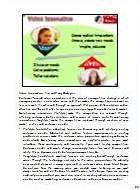
The Meaning of the
Communication is the Response Your Get
One NLP presupposition says: "The
meaning of the communication is the response you get". We often deal
with new ideas, with changing how things are done, with trying to
persuade others about your point of view. There are many built-in
obstacles to people automatically accepting and absorbing
information, however.
Perhaps the greatest single stumbling
block to real communication is the one-sided nature of speaking.
Most of us think of "communicating" as a one-way process. We
concentrate on what to say, how to say, and how to communicate it
better. But, in our zeal to achieve our goal and get our message
across to others, we forget that at the other end of our message is
an 'other' - someone with his own zeal, his own goal, and his own
concerns. These often do not coincide with ours, especially at the
moment when we are about to start communicating our new ideas.
NLP Solutions:
How To Prevent Misunderstanding
Neuro-Linguistic Programming (NLP) is
an accessible model to enhance effective communication, personal
change and personal development. Rapport is the first step in good
communication. We are all excellent communicators – and still we are
misunderstood, for we are not only gifted and creative
communicators, we are also gifted and creative receivers. A sender
cannot decide what the signal will actually mean to the other
person, only what they would like it to mean. When you mean one
thing and the other person shows you by their response that they
have a different meaning, nobody is wrong and nobody is to blame.
How misunderstandings can be prevented? This is usually done by
paying attention to the other person's response. The responses you
get give you valuable pointers about what to do next.
Cross-Cultural
Communication Challenges
Culture is often at the root of
communication challenges. Becoming more aware of cultural
differences, as well as exploring cultural similarities, can help
you communicate with others more effectively. Next time you find
yourself in a confusing situation, ask yourself how culture may be
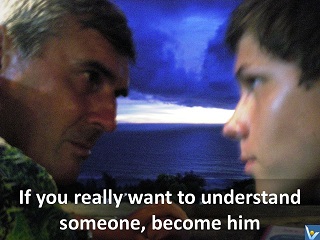
shaping your own reactions, and try to see the world from the
other's point of view.
|