Communication Skills:

Business Communication

Effective Presentation

How To Make Effective Presentations and What Makes an Audience Listen

By Vadim Kotelnikov, Author & Founder, Ten3 BUSINESS e-COACH – Innovation Unlimited, 1000ventures.com

 Yes! You are in the right place!

This site is Ranked #1 by Google for

"How To Make Effective Presentations"

out of about 50-million-wide (!!!) competition!

Peter's Placebo:

An ounce of image is worth of a pound of performance.


Select Your Content

Focus on your audience, not yourself – tell them what they need to know, not all you know!

How to Keep Your Audience Interested1

Your information has to be terrific and up-to-date. You have to prepare thoroughly. AND...if you don't pay attention to these items, you can lose the interest of your audience.

  • Make eye contact.

  • Use body language.

  • Show you're happy to be there.

  • Move around. Avoid using podiums.

  • Show your audience what you tell them.

  • If you're using flip charts, use two.

  • Present your information instead of reading your notes.

  • Use visual-aids.

  • Vary your activities and presentation modes.

  • Get the audience involved.

  • Be a good listener.

  • Be yourself.

Creating a Sustainable Culture of Innovation

An 8-Step Process

  • Fence the Garden: Train your workforce in the art and science of making skillful presentations... More

The Most Effective Format of Presentation

  • Introduction: set the tone and the theme

  • Motivation opening: tell them why to listen; lift your visor

  • Outline of agenda: help them to understand and picture the structure of your material

  • Present your basic idea: explain the whole idea first so whatever further explanation comes next can be hung from the framework you create right at the beginning

  • Content – section by section: begin to break into segments; present each segment with its details

  • Recap each section: build in a recap at the end of each section before you finish and go on, for reinforcement and additional clarification

  • Make transitions to next section: let everyone know you're about to go to a new topic; this makes your outline structure continuously clear

  • Wrap-up: at the end of all the components, wrap up by restating the whole idea, hitting the major points

  • Conclusion: finish memorably with a grand finale – bringing together all the elements of your presentation by reviewing the highlights and restating your major argument.


Our Brain Cannot Accept a Message When It:

  • Lacks enough or the right kind of information

  • Has no frame of reference

  • Is unable to find a familiar hook to connect the new information to the current state of mind

  • Can't connect the parts of what it's hearing as it has not been provided with an overall presentation structure

 Discover much more!

Creating, Winning, and Retaining Customers

How To Present With Passion

Effective Selling

Selling by Listening

Relationship Marketing and Selling

Closing the Sale

The ABC of Selling: Always Be Closing

Marketing and Selling Quotes

Venture Presentation

How To Make an Effective Venture Presentation

Effective Venture Fair Presentation: 8 Issues in 8 Minutes

People Skills

Effective Listening

Ten3 Global Business Learning Report

Self-Improvement     Leadership     Entrepreneurship     Top Management

Free Ten3 Micro-courses (10 powerful hyper-slides each)

Personal Success 360

  Ten3 Mini-Courses   Presentation:    View    Download

Your People Skills  (40 slides)

Winning Customers  (100 slides)

Analyze Your Audience

Put yourself in the audience's shoes - try to understand your listener's level of understanding, their map of reality, and anticipate what they want to know. Once you know what your audience wants, you can figure out how to "sell" the benefits of your topic to them.

Set Your Goal and Keep It Before You


Decide what it is you would like to happen as a result of your presentation. The four main goals of any communication are to inform, to request for an action, to persuade, and to build relationship. Decide which of these goals you are planning to achieve. Let your listeners know what you want them to do near the beginning of your talk and again at the end. Present your basic idea and give them an outline of your presentation that would lead you and your audience to the desired result.

Do Your Homework

Research your topic speak about something you have earned the right to talk about through experience or study. Anticipate questions, and make sure you have the facts to answer them.

"Develop reserve power", advised Dale Carnegie, "assemble a hundred thoughts around your theme, then discard ninety... Always prepare so that you are ready for any emergency such as a change of emphasis because of the previous speaker's remarks or a well-aimed question from the audience in the discussion period following your talk... This will give you reserve power, the power that makes people sit up and take notice."

Seize every opportunity to practice no professional in any field performs without practicing. Remember, your time in front of a group is your showcase.

Confidence is the Key

Predetermine your mind to success. That's the main secret of being a good presenter: you have to be confident to show confidence. You must be inspired by the deep belief in your cause. To have faith in yourself and your message, explore all phases of your subject and ask yourself how your talk will help the audience to get what they want. Careful preparation provides the solid ground you need to support your self-confidence. Tell yourself you can do it, that you are more qualified than any member of the audience to give this particular talk.

Plan the Parts of Your Presentation

List all points you plan to cover. Group them in sections and put your list of sections in the order that best achieves your objectives. Begin with the most important topics. When you put your talk together, keep in mind why your audience would want to hear what you have to say.

Plan Your Format and Delivery

How you give your talk can be more important than what you say. Whenever possible speak from an outline. If you have a formal written speech to deliver, use a marking system in the text to guide your delivery.

Making a Powerful First Impression

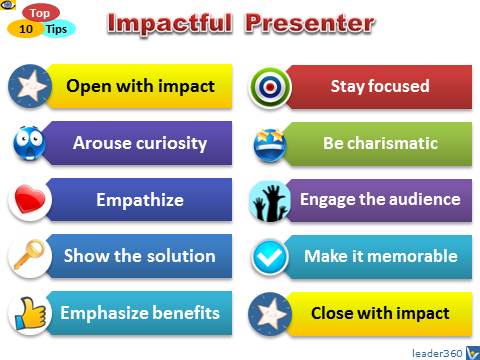
The audience will make decisions about you from your first appearance, your words and the sound of your voice. You can't make a first impression twice. Plan your opening sentences and practice them in front of a mirror. Use short sentences. Keep technical information at a minimum. Grab attention with a joke, an interesting fact, a short anecdote, a quotation, a positive statement, a provocative question... something designed to arouse curiosity and get the audience looking and listening to you.

How To Present with Passion

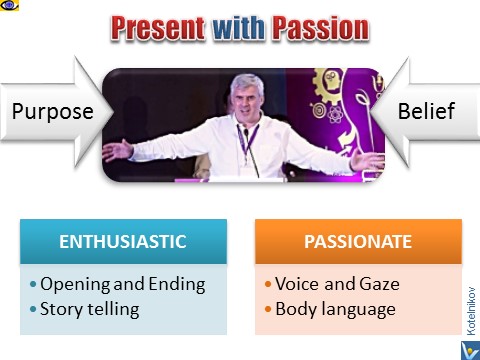
No matter what you are, we are all in sales. Selling is a transfer of emotions. When you speak, do your listeners sense how strongly you believe in what you're saying? If you want people to give you their undivided attention and feel compelled to heed your advice, they must hear and see in you an unwavering commitment to your message... More

Keep Your Audience's Attention

Promise to tell the audience how they can get something they want.

Outline the agenda – knowing your order increases attention.

Never take your audience for granted. People have very short attention span. Not more than 15% of their brain power is required to understand the language and grasp what you mean. Don't let the remaining 85% of their brain to do daydreaming. To keep your audience with you, you must build in new devices – make your message visual, build anticipation, create a conversation cycle, use role-play practices – to keep your listener's mind 100% occupied.

The sound of your voice makes a great difference. Practice projecting enthusiasm. People aren't going to be influenced by a lifeless voice. To hear yourself speak, record your voice during a phone conversation or practice your presentation using a tape recorder. Then make necessary changes.1

Manage Expectations


Communication is a two-way street. Before you begin your workshop or presentation, be sure your participants know what to expect. They will arrive with some preconceived ideas. Your advance communication about your presentation needs to be clear to set the perceptions right so there is no confusion or disappointment.

Do More than Lecture

There's nothing wrong with lecturing, as long as you realize the limitations. Lecturing is a way of presenting information verbally and is teacher/trainer focused. The facilitator speaks and the learners listen. Learners can become easily bored and inattentive.

Short lectures or verbal presentations of information need to be enhanced and supported with visuals and activities directly related to the information being presented. In the classroom, the teacher can complement his information by assigning extra study or independent practice. In a workshop, activities are more immediate--small groups, games, buzz sessions, guided practice, role play, brainstorming. The idea is to engage the learners and stimulate them to participate in their own learning.

Provide for every type of learner – visual, auditory and kinesthetic. Provide for everyone with things to see, hear and do. You'll stimulate your learners, whether in the classroom or meeting room. They'll enjoy it more, learn more and retain it longer.1

Using Videos

Videos can be effective training aids if you edit them carefully and use at the appropriate times. Videos can illustrate an idea and put it into action. The theme of the video must correspond with the main points you are discussing. Show only the parts that are related. Remember, the video is not the entire presentation, it just supports the main points. Give the participants suggestions of what to watch for. A question and answer period, discussion and/or a handout should accompany the video.1

How To Make an Effective Venture Presentation

By Terry Collison

The history of venture financing is littered with the carcasses of truly worthy companies that just never made it through financing.

That’s why I’m so dedicated to giving entrepreneurs the keys to a potential investor’s brain.

You must plan your pitch based on an awareness of how the investor is likely to be thinking.

Then you must communicate to the investor that you intend to present your information in a way that will help the investor assess whether this opportunity represents a "fit" with the investor’s interests and capabilities (notice: I didn’t phrase that in terms of "whether or not this is a ‘good’ investment")... More


Speak to WinReferences:

  1. "The Presentation Tipster", Jan Noyes

  2. "Instant Speaking Success," Paul Evans

  3. "Effective Presentations," Click2Value

  4. "Success Secrets," Vadim Kotelnikov

  5. "People Skills," Vadim Kotelnikov

  6. "Effective Leadership," Vadim Kotelnikov

  7. "Modern Manager," Vadim Kotelnikov

  8. "Smart Corporate Leader," Vadim Kotelnikov

  9. "Smart Business Architect," Vadim Kotelnikov

  10. "Creating, Winning, and Retaining Customers," Vadim Kotelnikov

Effective Presentations

How to create best possible presentations

  • Best practices for presentations

  • Planning your speech

  • Creating effective slides

  • Using graphs and charts

  • Applying Microsoft PowerPoint animation


Map

Ranked #1

Search

Testimonials

Free Downloads

  Products

SMART Learning

Training

 Contact

We invented Business e-Coaching in 2001

Today, we have customers in 100+ countries!

Our customers:

3M, ABB, Adidas, Alcatel, American Express, Bayer, Boeing, British American Tobacco, BP, Canon, Cisco, Citigroup, Colgate, Corning, Deloitte, Ernst & Young, Fujitsu-Siemens, GE, Goldman Sachs, HP, Hitachi, Huyndai, IBM, Intel, Johnson & Johnson, JP Morgan Chase, KPMG, Lufthansa, Microsoft, Motorola, Nokia, Oracle, Samsung, Shell, Siemens, Sony, United Bank of Switzerland

Ten3 Mini-courses: SMART & FAST sets Full version of Ten3 Business e-Coach Ten3 Business e-Coach (home page)

Ten3 Business e-Coach, version 2008

Inventor, Author & Founder – Vadim Kotelnikov

© Vadim Kotelnikov, GIVIS