 |
|
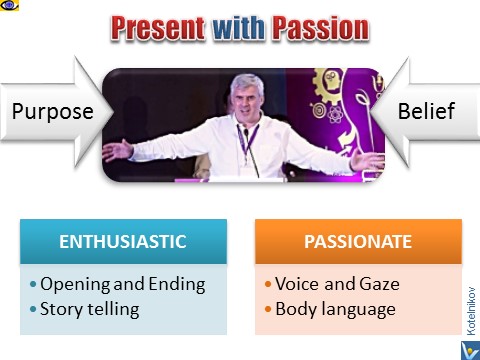
Believe in the importance of your subject
and
let
your passion show!
People feel compelled to listen to passionate presenters and
cannot help but give them their undivided attention. |
|
| |
Present your
Big Idea
Decide what it is
you would like to happen as a result of your presentation and
explain your main idea first. It will serve as a framework for
further explanations. |
|
Don't Be Lesser than Yourself
Product Vision |
|
 |
If you want your message to hit
the target, make an adjustment
to the wind.
~
Vadim
Kotelnikov |
|
Content –
section by section
Begin to break into
segments; present each segment with its details. Make your
presentation
visual. Support your presentation with activities directly related to
the information being presented – create a conversation cycle,
use role-play practices, etc. |
|
| |
Do more that lecture. – engage your listeners. |
|
PLIMAD
|
|
| |
Conclusion
You must
finish memorably. Bring together all the elements of your
presentation by reviewing the highlights. Finish with emotional
statement of the Big Idea you wish to convey. |
|
|
| |
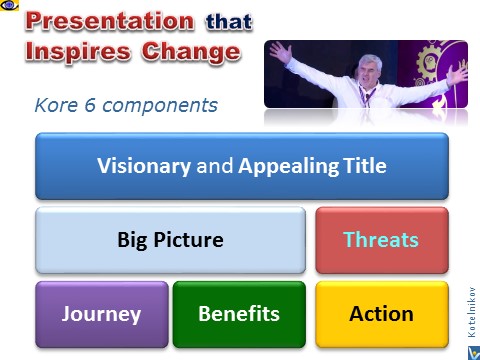
Inspire Change
Use the
6Ws model.
Start your presentation in an unorthodox way, share something
extraordinary, tell an eye-opening story.
Tell a Story
Communicate with
pictures to increase your influence over your audience. |
|
 |
|
|