Systemic Innovation:

Lateral Thinking

Building Your Cross-Functional Excellence

Knowing how to transform stand-alone ideas, technologies, products and services into value-rich solutions

By Vadim Kotelnikov, Founder, The first-ever BUSINESS e-COACH – Innovation Unlimited!, 1000ventures.com

 Yes!  You are in the right place!

This site is Ranked #1 by Google for

"Cross-functional Excellence"

out of about 500,000-wide (!!!) competition!

"He who knows only his own side of the case, knows little of that."

John Stuart Mill


Innovation Jazz

11 Practice Tips

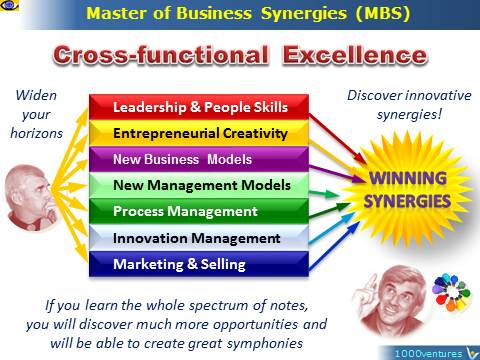
Cross-functional Extertise Corporate Leader Leadership People Skills Synergy Entrepreneur Business Model Management Business System Sustainable Growth Corporate Strategies Enterprise-wide Business Process Management (EBPM) Innovation Management Marketing and Selliing Competitive Strategies Vadim Kotelnikov Cross-functional Excellence / Cross-functional Expertise

Effective Innovation Process

7 Lessons from Silicon Valley Firms

  1. Make cross-functional involvement the path of least resistance...  More

Pearls of Wisdom

 East

The mind, sharp but not broad, sticks at every point but does not move.

Rabindranath Tagore

We join screws in the wheels, but it is the hole in the wheel that drives the vehicle.

Lao Tzu

I see true innovation to be made up of three 'creativities' – creativity in technology, product planning, and marketing.

– Akio Morita

 West

You can't do carpentry, you know, if you only have a saw, or only a hammer, or you never heard of a pair of pliers. It's when you put all those tools into one kit that you invent.

– Peter Drucker

Most great ideas are really combinations of other ideas.

– Paul Sloane

The simple secret of my genius is that I created something new out of the ideas and inventions of others.

– Henry Ford

Build Your Cross-Functional Excellence

to Achieve Your Objectives:

As a Corporate Leader:

As an Innovation Project Leader

As an Entrepreneur (in the broad sense of this word)

Cross-Functional Technology Managers

  • are skilled technologists

  • value the contribution from other functions

  • play an active role integrating these functions during the innovation process

Business BLISS

Balance – Leadership – Innovation – Synergy – Speed

 Discover much more!

Entrepreneur

Entrepreneurial Creativity

Corporate Leader

Smart Business Architect

Business Model

New Business Models

Sustainable Growth Strategies

Balanced Approach to Business Systems

6Ws of Corporate Growth

Business BLISS

Winning Organization

Innovation-friendly Organization

How To Lead Creative People

Business Processes

Enterprise-wide Business Process Management (EBPM)

8 Essential Principles of Enterprise-wide Business Process Management (EBPM)

Innovation

Systemic Innovation: 7 Areas

7 Dimensions of Strategic Innovation

Innovation Jazz

Free Ten3 Micro-courses

Business Success 360

6Ws of Corporate Growth

Smart Innovation

  Ten3 Mini-Courses   Presentation:    View    Download

SMART Executive  (225 slides)   ► Demo

Entrepreneurial Leadership  (40 slides)

Smart Business Architect  (150 slides)

6Ws of Corporate Growth  (150 slides)

New Business Models  (40 slides)

3 Strategies of Market Leaders  (125 slides)

Sustainable Competitive Advantage  (40 slides)

Systemic Innovation  (150 slides)

Why Do You Need Cross-Functional Excellence?

Although innovation is driven by technology, required competence extends beyond technical know-how. In the new knowledge economy and knowledge-based enterprises, systemic innovative solutions arise from complex interactions between many individuals, organizations and environmental factors. The boundaries between products and services fade rapidly too. If you wish to be a market leader today, you must be able to integrate in a balanced way different types of know-how that would transform stand-alone technologies, products and services into a seamless, value-rich solution.

No Idea is Wasted!

Your mind can accept only those ideas that have a frame of reference with your existing knowledge. It rejects everything else. If your knowledge is functionally focused, you'll be open to new ideas related to your functional expertise only and will miss all other learning and innovation opportunities. If you develop a broad cross-functional expertise, no new idea will be wasted. It will immediately connect with the existing knowledge and will inspire  you, energize you, and encourage your entrepreneurial creativity. The broader your net, the more fish you can catch.

Combining the Unusual

The vast majority of new ideas are not original but derived from something else. Most great ideas are really combinations of other ideas.4

When asked about the secrets of his success, Henry Ford answered, "The simple secret of my genius is that I created something new out of the ideas and inventions of others."

The Danger of Categorization

"It's a pity nature isn't divided into the same categories as universities."


We need categories to be able to handle the huge amount of information we use and control.

That's why we have a hierarchy of folders and files in our computer, and that's why universities are categorized into faculties and departments. Categorization helps you, but can also prevent you from using what you know about one field in another.

There is a well known problem in education called the transference problem. If you teach something in one context, students most likely will not be able to use that knowledge in another6 and build synergies.

Learn Playing More than One Note

If you learn not one, but the whole spectrum of notes, you will not have to play mono-tone music all the time. Your will discover much more opportunities and, by engaging your lateral thinking, self-motivation, and systems thinking arts and skills, create great symphonies and improvise whenever necessary.

The Growing Role of the Business Architect

In today's knowledge- and innovation-driven complex economy, business architects are in growing demand.  They are cross-functionally excellent people who can tie several silos of business development expertise together, create synergies, design winning business model and a balanced business system and then lead people who will put their plans into action... More

Leading Organizations

We all start our careers as specialists – men and women with narrow corridors of functional expertise. The goal of specialists is to optimize individual effort. Technologists want to design the best products. Salespeople want to develop the most effective marketing strategies... and on and on. But "to raise to the ranks of senior management, you must forgo this quest for personal perfection, seeking instead to balance the skills and capabilities of the specialists working for you."1 You need to apply the balanced business systems approach and consider your business as a system of interrelated factors of strategy, owners, investors, management, workers, finance, processes, products, suppliers, customers, and competitors.

Cross-functional Management

Cross-functional management (CFM) manages business processes across the traditional boundaries of the functional areas. CFM relates to coordinating and synergizing the activities of different units for realizing the superordinate cross-functional goals and policy deployment. It is concerned with building a better system for achieving such cross-functional goals as innovation, quality, cost, and delivery... More

Driving Radical Innovation

"Here is the paradox: You need a great team of people with diverse skills to perform a symphony well, but no team has ever written a great symphony!".3

While cross-functional teams are key players in defining and implementing incremental innovation projects, cross-functional disruptive individuals tend to be key players in defining radical innovation projects. Individuals who are likely to excel in a radical innovation project, besides having superior technical capabilities, should be goal-oriented, broadly educated, creative, extremely bright, not afraid to be different, integrative, flexible, passionate, entrepreneurial, aggressive, eager to learn business, able to take risks, and inquisitive.3

Managing Technology

In the new era of systemic innovation, cross-functional technology managers are in high demand. In the Silicon Valley, for instance, many companies found that when they moved to a flatter organization, they had plenty of top-flight technologists but too few technology managers. "These managers are skilled technologists who also value the contribution from other functions, and who play an active role integrating these functions during the innovation process".2

How To Lead Creative People

By: Max DePree

  • Creative people need diverse experiences to do their work... More

Managing Knowledge

The explosion of knowledge growth, combined with its rapid distribution, makes it difficult to stay on top of the available knowledge in any industry. Thus, a global knowledge economy rewards not only creators of new knowledge but also those who can identify and integrate knowledge effectively.2

 Case in Point  The Rise of the IT Architect

IT architects are in growing demand.  They are cross-functionally excellent people who can "tie several silos of expertise together," relate to business problems as well as technology, and then sell their ideas upward and downward in the corporate hierarchy. The position of IT architect has become increasingly important to the ever-changing IT industry, and is one that established corporations and start-ups are seeking.

"As IT positions become more specialized and include increasingly detailed responsibilities, there's a need for someone who can tie several silos of expertise together," says Al Volvano, a product manager for Microsoft's Learning Group. "Enterprise architects aren't just technology experts; they are leaders with broad IT knowledge, the savvy to apply it to business problems and the communication skills necessary to coordinate the people who will put their plans into action," says Bill Liguori, senior vice president and co-founder of the placement firm Leadership Capital Group.7

 Case in Point  Ten3 Business e-Coach


Ten3 Business e-Coach, a new-to-the-world product and the world leader in business e-coaching is a great illustration of the power of cross-functional expertise as a source of sustainable competitive advantage.  The e-Coach integrates synergistically and systemically many various expertises to inspire innovation and entrepreneurial creativity. Launched in 2001 initially as  a hobby and later on as a home business, by 2005 it has customers in more than 70 countries. This global success created no direct competition to Ten3 Business e-Coach however. Why? Because potential me-tooers had no cross-functional experts to develop a competitive systemic e-coaching service and keep upgrading it continuously with the same speed.

 Case in Point  Nurturing Cross-Functional Experts at Hewlett-Packard

Most companies tend to recruit, train and promote people within functional corridors. But Hewlett-Packard (HP) breaks the walls, creating a carrier network that begins with the recruitment of diverse people in terms of their skills and personality and then promotes horizontally, as well as vertically throughout the company. "Typically, HP employees move through four to six functional areas in the course of their carriers. This creates broad knowledge of the company and fosters the kind of teamwork other companies covet".1 When it comes time to promote, managers don't look who is next down the carrier line, they look for the best people. Neither employees should follow a pre-defined path to a particular post, nor need they to get a bigger title to be given new responsibility.

 Case in Point  Genetics


Gregor Mendel, an Austrian monk, combined mathematics and biology to create the science of genetics. "Working in a small monastery garden in 1850s, he crossed different varieties of peas to see which characteristics were inherited. He conceived the idea that the inherited traits were based on pairs of units that we know now as genes, and these genes followed simple statistical laws."4

 Case in Point  Printing Press

Around 1450 in Strasbourg, Germany, Johannes Gutenberg invented the printing press by combining two existing ideas. He coupled the flexibility of a coin punch with the power of a wine press to invent a method of printing with movable type.4


Selected Ten3 Trademark Mini-courses related to this subject

Clickable pictures


Bibliography:

  1. "Extreme Management," Mark Stevens, 2001

  2. "Relentless Growth," Christopher Meyer, 1998

  3. "Radical Innovation," Harvard Business School, 2000

  4. "Lateral Thinking Skills," Paul Sloane, 2003

  5. "The Coming of the New Organization," Peter Drucker, 1988

  6. "ASIT Technique – Creativity and Inventive Thinking," Roni Horowitz

  7. "The Rise of the IT Architect," Ryan DeBeasi, Network World, Sept. 2005


Map

Ranked #1

Search

Testimonials

Free Downloads

  Products

SMART Learning

Training

 Contact

We invented Business e-Coaching in 2001

Today, we have customers in 100+ countries!

Our customers:

3M, ABB, Adidas, Alcatel, American Express, Bayer, Boeing, British American Tobacco, BP, Canon, Cisco, Citigroup, Colgate, Corning, Deloitte, Ernst & Young, Fujitsu-Siemens, GE, Goldman Sachs, HP, Hitachi, Huyndai, IBM, Intel, Johnson & Johnson, JP Morgan Chase, KPMG, Lufthansa, Microsoft, Motorola, Nokia, Oracle, Samsung, Shell, Siemens, Sony, United Bank of Switzerland

Ten3 Mini-courses: SMART & FAST sets Full version of Ten3 Business e-Coach Ten3 Business e-Coach (home page)

Ten3 Business e-Coach, version 2008

Inventor, Author & Founder – Vadim Kotelnikov

© Vadim Kotelnikov, GIVIS