Sustainable Growth:

Business Model

Business Architect

Creating a Winning Organization and Business Model

By Vadim Kotelnikov, Inventor & Founder, Ten3 BUSINESS e-COACH Innovation Unlimited!, 1000ventures.com

 Yes!  You are in the right place!

This site is Ranked #1 by Google for

"Business Architect"

out of about 6-million-wide (!!!) competition!

"It takes a business architect to take an innovative business idea into a successful venture and achieve lasting business success."

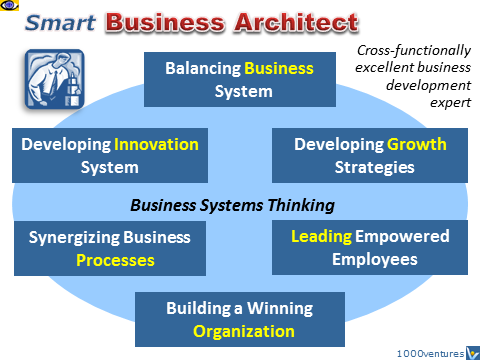
SMART Business Architect (Ten3 Mini-course)


Business Architect Synergy Systems Thinkins Balanced Business System Sustainable Growth Strategies Managerial Leadership Building a Winning Organization Enterprise-wide Business Process Management Innovation System Vadim Kotelnikov Cross-functional Excellence Business Architect

10 Rules for Building a Great Business

6Ws of Corporate Growth

5 Strategic Questions

You Should Ask to Understand Where Your Business Is Going

By: Jack Welch

  • In the last three years, what have your competitors done?... More

Creating Competitive Disruption: 7 Strategies

  • Develop the ability to surprise

  • Develop ability to move quickly... More

The Tasks of a Business Architect

Cross-functional Expertise of a Business Architect

Corporate Culture

Strategies for Building a Growth Culture

  • Diversity-friendly... More

Developing The Fast-Paced Flexible Culture

By: Michael Dell

  • Set a Common Goal. Mobilize your people around a common goal. Help them feel a part of something genuine, special, and important, and you'll inspire real passion and loyalty... More

Systemic Innovation

7 Interwoven Areas

  1. Business Innovation

  2. Organizational Innovation

  3. Strategy Innovation... More

Business BLISS

Balance – Leadership – Innovation – Synergy – Speed

Transforming Your Business from Mediocre to Great

7 Principles

Transform Your Business into an Innovative and Creative Culture

Main Subjects for Suggestions in Japanese Companies

  • Improvement in the working environment... More

 Discover much more!

Corporate Leader

Cross-functional Excellence

Business Architect

Look at Your Company from Outside In As Well As Inside Out

Inspirational Leadership: 10 Roles

Business Model

New Business Models

10 Forces Behind New Business Models

Sustainable Growth Strategies

3 Strategies of Market Leaders

10 Rules for Building a Great Business

High-growth Business Development Roadmap

Balanced Approach to Business Systems

6Ws of Corporate Growth

Real Time Business Development

5 Keys To Building a Great Company

8 Attributes of Corporate Success

Winning and Retaining Customers

Systemic Innovation

Business BLISS: Balance + Leadership + Innovation + Synergy + Speed

Enterprise Strategies

SWOT Analysis: Questions To Answer

5 Strategic Questions

Competitive Strategies

Sustainable Competitive Advantage

Blue Ocean Strategy

6 Principles of Blue Ocean Strategy

Creating Competitive Disruption: 7 Strategies

7-Part Competitive Strategy of Microsoft

Winning Organization

9 Signs of a Losing Organization

Organizational Success 360: Five Basic Elements

Innovation-friendly Organization

Organizing for Innovation: Organizational Models that Support Innovation

Guiding Principles To Liberate Employees from the Fear of Trying New Things

Innovation Management Policies for Large Corporations

7 Tips for Eliminating Bureaucracy

Google: 10 Golden Rules

Corporate Culture

Building Team Culture: 10 Action Areas

Strategies for Building a Growth Culture

Developing the Fast-paced Flexible Culture

Creating a Culture for Innovation

5 Strategies for Creating a Culture for Innovation

Inspiring Culture

Business Processes

Enterprise-wide Business Process Management (EBPM)

Lean Production

Using Best Practice: The Trotter Scorecard

Quality Management

Deming's 14 Point Plan for Total Quality Management (TQM)

14 Slogans for TQM at Pentel, Japan

Innovation

7 Dimensions of Strategic Innovation

3 Criteria To Assess Your Innovation Portfolio

The Jazz of Innovation

IDEO's Innovation Practice Tips

Ten3 Global Business Learning Report

Business Development     Top Management

Compare Your Country or Region with Others

Free Ten3 Micro-courses

Business Success 360

6Ws of Corporate Growth

  Ten3 Mini-Courses   Presentation:    View    Download

Smart Business Architect (150 slides)   ► Demo

Why Business Architect?


In today's knowledge- and innovation-driven complex economy, business architects are in growing demand.  To build a winning synergistically integrated organization, companies need  cross-functionally excellent people who can tie several silos of business development expertise together, create synergies, design a winning business model and a balanced business system and then lead people who will put their plans into action.

Business Architect Defined

Business architect is a person that initiates new business ventures or leads business innovation, designs a winning business model, and builds a sustainable balanced business system for a lasting success.

Business architects can be found in a multitude of business settings: corporate change leaders, initiators of joint ventures, managers of radical innovation projects, in-company ventures, spin-outs, or new start-up ventures.

Although the settings in which business architects act are different, they all design and run a new venture to achieve its sustainable growth.

The Power of Your Cross-Functional Excellence

If you build broad cross-functional expertise, no idea will be wasted! Your mind can accept only those ideas that have a frame of reference with your existing knowledge. It rejects everything else. If your knowledge is functionally focused, you'll be open to new ideas related to your functional expertise only and will miss all other learning and innovation opportunities. If you develop a broad cross-functional expertise, no new idea will be wasted. It will immediately connect with the existing knowledge and will inspire  you, energize you, and encourage your entrepreneurial creativity. The broader your net, the more fish you catch.

Balanced Organization: 5 Basic Elements

Leadership (Fire):

Balance Your Business System

The primary goal of any business is to increase stakeholder value. It is achieved through a dynamic balancing of competing values. In order for a business to maximize economic value, it must balance customer satisfaction and competitive market forces with internal cost and growth consideration... More

The Tao of Business Success

The Tao helps you achieve much more with much less effort. This effortless skill comes from being in accord with reality. You can't tell the singer from the song. You can't tell the dancer from the dance. When you are in harmony with the Tao, when you go with its current  of energy, your innate intelligence takes over, and the right action happens by itself.

The Tao teaches you the art of living and doing business. It gives you advice that imparts perspective and balance. It applies equally well to the managing of a large corporation or the running of a small business, to the governing of a nation or the leading a small team, to your personal development or to the coaching of others... More

Sustainable Business Models

Sustainable business success is based not on great ideas, guts, or instinct alone – but on your ability to create an master your business model. In the new era of unrelenting change and competition, your face a daunting challenge: how to sustain the business model of your firm. "The fact is, no matter how bulletproof your firm's current business model, it will be challenged by new business models."4 The new reality is that business models have shorter shelf life. You must constantly attempt to discover new business models if you hope to survive and grow... More

9 Signs of a Losing Organization

  1. Fuzzy Vision: corporate vision and mission don't inspire people; lack of strategic alignment; people don't know where the organization is going and what it is trying to achieve in the future... More

Building an Innovation-friendly Organization

Leaders of successful, high-growth companies understand that innovation is what drives growth, and innovation is achieved by awesome people with a shared relentless growth attitude and shared passion for creative problem solving and for turning ideas into realities.

Companies that continuously innovate will create and re-invent new markets, products, services, and business models which leads to more growth. Innovation is founded on your enterprise's ability to recognize market opportunities, your internal capabilities to respond innovatively, and your knowledge base... More

SWOT Analysis: Questions To Answer

  • What is your strongest business asset?

  • What do you offer that makes you stand out from the rest?

  • Do you have any specific marketing expertise?... More

Build Your Sustainable Competitive Advantage

Sustainable competitive advantage is the prolonged benefit of implementing some unique value-creating strategy based on unique combination of internal organizational resources and capabilities that cannot be replicated by competitors... More

3 Strategies of Market Leaders

The market leader is dominant in its industry and has substantial market share. If you want to lead the market, you must be the industry leader in developing new business models and new products or services. You must be on the cutting edge of new technologies and innovative business processes. Your customer value proposition must offer a superior solution to a customers' problem, and your product must be well differentiated... More

 Case in Point  Silicon Valley Companies: Deciding If Your Innovation Portfolio Has Enough Stretch

Adapted from “Relentless Growth,” Christopher Meyer

  1. Balance between revolutionary and evolutionary initiatives. First, Silicon Valley companies assess the overall balance between revolutionary and evolutionary projects. The ultimate arbitrator of portfolio stretch if the innovation leaders’ judgment, experience, intuition, and luck... More

Integrated Approach To the Management Process


The integrated business systems approach to business development and the management process is what distinguishes modern cross-functionally excellent business architects from functional managers. As a business architect and an extremely effective leader, you must have a broad view to be able to link together – synergistically! – the key components of corporate success – from functional planning to cross-functional cooperation, from supply chain management to customer value creation, from the art of continuous learning to the practice of effective communication and influencing people – and bundle them in an intellectual, innovative and pragmatic package that can be used to achieve sustainable competitive advantage and business growth, both top-line and bottom-line. To fulfil these responsibilities, a Business Architect typically should have broad cross-functional expertise.

Systems Thinking and Modern Management

The goal of systems thinking is to manage the rapidly growing complexity of the worlds of business and technology. The task of a business architect and a process manager is to create systems, within a sensibly structured business, that empowers employees and enables people to achieve higher productivity and greater competitive advantage.

Systems thinking characterizes many of the world's leading executives. It is a formal discipline of management science that deals with the whole business system and in terms of the interconnections and interactions of its parts.

"Many managers fail to see the forest for the trees. This is not an either/or problem. The trick is to see both the forest and the trees. Systems thinking is a methodology for doing both simultaneously. It's more than a methodology, it's like learning a new language and takes nearly as long as learning a foreign language to achieve maturity."1

The Rise of the IT Architect

IT architects are in growing demand.  They are cross-functionally excellent people who can "tie several silos of expertise together," relate to business problems as well as technology, and then sell their ideas upward and downward in the corporate hierarchy. "Enterprise architects aren't just technology experts; they are leaders with broad IT knowledge, the savvy to apply it to business problems and the communication skills necessary to coordinate the people who will put their plans into action," says Bill Liguori, senior vice president and co-founder of the placement firm Leadership Capital Group. 2

Enterprise-wide Business Process Management (EBPM)

EBPM, representing the third-wave of Business Process Management, is "a deliberate and collaborative approach to systematically – and systemically – managing all of a company's business processes," says Andrew Spanyi.

EBPM addresses the pressing need of the new knowledge-driven economy to integrate business process thinking with strategy, organizational structure and people issues. It requires that your executive team lead and manage differently and think more systemically about your business... More

Corporate Culture

In six words, corporate culture is "How we do things around here."

Corporate culture is the collective behavior of people using common corporate vision, goals, shared values, beliefs, habits, working language, systems, and symbols. It is interwoven with processes, technologies, learning and significant events. In addition, different individuals bring to the workplace their own uniqueness, knowledge, and ethnic culture. So corporate culture encompasses moral, social, and behavioral norms of your organization based on the values, beliefs, attitudes, and priorities of its members... More

Building a Team Culture: 10 Action Areas

It is becoming increasingly important that teams function productively with a minimum of supervision. Team culture ensures that individual members both demonstrate their best talents and function synergistically as a unit to achieve common goals.

When team culture reigns, teams are dependable and consistent. People voice their opinions openly. They demonstrate creativity, innovate and see a job through to conclusion.

To build a team culture:

  1. Provide an inspiring vision

  2. Define shared values

  3. Set stretch goals... More

Creating a Culture for Innovation

By: Soren Kaplan

Shaping culture, especially when it comes to creating a culture of innovation, is a daily task that involves elevating the mundane to the strategic.

By managing the strategic levers of culture, and by practicing the strategies of envisioning, communicating and sponsoring, it becomes possible to create a culture of innovation and drive long-term strategic advantage... More

Kaizen Culture

Kaizen, or continuous improvement, is an integral part of corporate culture. It requires continuous both conscious and sub-conscious thinking about improvements from everyone. Nurturing and effectively integrating Kaizen into corporate culture is not easy. It requires a sustained effort. But, as Toyota has demonstrated, it offers a more sustained competitive advantage... More

29 Obstacles To Innovation

Leading Systemic Innovation

There are many parts of the whole field of innovation: strategy innovation, new product development, creative approaches to problem solving, idea management, suggestion systems, etc. Though all of these components are important, in the new era of systemic innovation, you must design your firm's innovation process holistically. Innovation is not divisible – ‘good in parts’ is no good at all. Innovation systems are only as strong as their weakest links... More

Strategies for Leading Breakthroughs

So what separates extraordinary leaders from proponents of the status quo? They break the rules. Except, not in an arbitrary or capricious way. When you look at examples of extraordinary leadership, like the Founding Fathers of the United States or Jack Welch of GE, certain practices or principles become apparent. To start, there is a declaration of what the future will be. There is also a purpose, something to stand for. And finally, there is a clearly articulated commitment... More

SMART Business Architect (Ten3 Mini-course)


References:

  1. "Smart Business," Jim Botkin

  2. "The Rise of the IT Architect," Ryan DeBeasi, Network World

  3. "Extreme Management", Mark Stevens

  4. "Top 7 Principles For Transforming Your Business From Mediocre To Great," D.Corcoran

  5. "SMART Executive," Vadim Kotelnikov

  6. "Entrepreneurial Leadership," Vadim Kotelnikov

  7. "25 Lessons from Jack Welch," Vadim Kotelnikov

  8. "Cultural Intelligence & Modern Management," Anastasia Bibikova & Vadim Kotelnikov

  9. "SMART Business Architect," Vadim Kotelnikov

  10. "New Business Models,: Vadim Kotelnikov

  11. "SMART Manager," Vadim Kotelnikov

  12. "Strategic Management," Vadim Kotelnikov

  13. "Sustainable Competitive Advantage," Vadim Kotelnikov

  14. "Strategies of Market Leaders," Vadim Kotelnikov

  15. "6Ws of Corporate Growth," Vadim Kotelnikov

  16. "Systemic Innovation," Vadim Kotelnikov

  17. "SMART Innovation," Vadim Kotelnikov

  18. "Business BLISS," Vadim Kotelnikov


Map

Ranked #1

Search

Testimonials

Free Downloads

  Products

SMART Learning

Training

 Contact

We invented Business e-Coaching in 2001

Today, we have customers in 100+ countries!

Our customers:

3M, ABB, Adidas, Alcatel, American Express, Bayer, Boeing, British American Tobacco, BP, Canon, Cisco, Citigroup, Colgate, Corning, Deloitte, Ernst & Young, Fujitsu-Siemens, GE, Goldman Sachs, HP, Hitachi, Huyndai, IBM, Intel, Johnson & Johnson, JP Morgan Chase, KPMG, Lufthansa, Microsoft, Motorola, Nokia, Oracle, Samsung, Shell, Siemens, Sony, United Bank of Switzerland

Ten3 Mini-courses: SMART & FAST sets Full version of Ten3 Business e-Coach Ten3 Business e-Coach (home page)

Ten3 Business e-Coach, version 2008

Inventor, Author & Founder – Vadim Kotelnikov

© Vadim Kotelnikov, GIVIS